
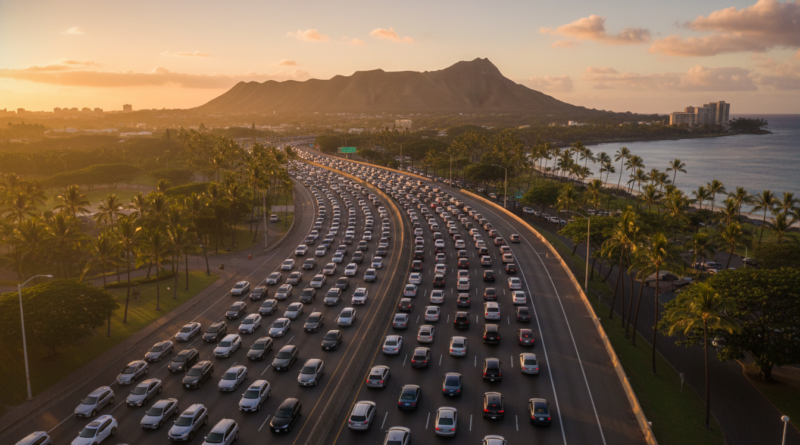
Record-Breaking H-1 Freeway Congestion Sparks New Transit Debate
Traffic on the H-1 Freeway reached unprecedented levels last week, with commuters reporting travel times exceeding three hours for trips that typically take 45 minutes, according to new data from the Hawaii Department of Transportation. The gridlock, which stretched from Pearl City to downtown Honolulu during peak hours, has reignited discussions about the island’s long-stalled rail project and alternative transportation solutions.
The worst congestion occurred Tuesday morning when a multi-vehicle accident near the Aiea off-ramp combined with construction delays to create what transportation officials are calling the most severe traffic backup in recent memory. Commuters abandoned their cars on the freeway, with some choosing to walk several miles to reach their destinations.
“I’ve been driving this route for 20 years, and I’ve never seen anything like it,” said Maria Santos, a Kapolei resident who works in downtown Honolulu. “People were turning off their engines and getting out of their cars. It was like a parking lot that went on forever.”
The Hawaii Department of Transportation recorded average speeds of just 3.2 miles per hour on the H-1 between 7 a.m. and 9 a.m. during the peak congestion period. Normal rush hour speeds typically range between 15-25 mph on the same stretch of highway.
Rail Project Returns to Spotlight
The traffic nightmare has prompted renewed calls for faster completion of the Honolulu Authority for Rapid Transportation’s rail project, which has faced years of delays and cost overruns. The elevated rail system, designed to connect West Oahu communities to downtown Honolulu, was originally scheduled to open in 2020.
City Council member Tommy Waters, who chairs the Transportation Committee, said the recent congestion demonstrates the urgent need for alternative transportation options. “This is exactly why we need rail service operational as soon as possible,” Waters said during Wednesday’s council meeting. “Our residents can’t continue to lose hours of their lives sitting in traffic.”
HART officials announced last month that the first phase of rail service, connecting East Kapolei to Halawa, could begin operations by late 2025. However, the crucial connection to downtown Honolulu and Ala Moana Center remains years away from completion.
Economic Impact on Local Businesses
The severe congestion is already affecting Honolulu’s business community, particularly companies that rely on employee punctuality and delivery schedules. Several Kalihi and Iwilei businesses reported significant disruptions to their operations, with some employees unable to reach work until midday.
Restaurant owner Jennifer Chang, who operates three locations across the island, said delivery times for supplies increased dramatically during the congestion period. “Our suppliers couldn’t get through, and our staff couldn’t get to work,” Chang explained. “It’s a domino effect that hits every part of the business.”
The Hawaii Restaurant Association estimates that severe traffic delays cost member businesses thousands of dollars in lost productivity and delayed deliveries during peak congestion days.
Alternative Solutions Gain Traction
In response to the crisis, city officials are fast-tracking several traffic mitigation measures. These include expanding flexible work arrangements for city employees, increasing bus service frequency during peak hours, and implementing dynamic traffic signal timing adjustments along major arterial roads.
The Department of Transportation Services is also exploring partnerships with major employers to stagger work schedules, potentially reducing the concentration of commuters during traditional rush hours. Several large companies, including Hawaiian Electric and Kaiser Permanente, have already expressed interest in participating in pilot programs.
State transportation officials are reviewing emergency protocols for handling similar incidents in the future, including improved communication systems and faster deployment of tow trucks and emergency crews to clear accidents.
Looking Ahead
Transportation experts warn that Oahu’s traffic problems will likely worsen before they improve, as the island’s population continues to grow while highway capacity remains limited. The recent congestion event serves as a preview of what residents might face if major infrastructure improvements aren’t accelerated.
The next phase of the rail project’s construction could provide some relief, but not for several years. In the meantime, city officials are urging residents to consider alternative transportation options, including carpooling, remote work arrangements, and adjusted commute times.
For Honolulu residents, the message is clear: the days of predictable commute times may be numbered without significant changes to how the island approaches transportation infrastructure and urban planning.