UH Researchers Win National Award for Waikiki Flood Adaptation Designs
A University of Hawaii research team has earned national recognition for innovative architectural designs that reimagine how Waikiki could adapt to rising seas and increasing flood risks. The group received the Outstanding Research Award at the 2026 Architecture Research Centers Consortium and European Association for Architectural Education (ARCC-EAAE) International Conference, held earlier this month in Portland, Oregon.
The award-winning project, titled “Amphibious Waikiki: Resilient Design Strategies for a Floating Future,” presents detailed architectural renderings and engineering solutions for transforming the iconic tourist district’s built environment. With recent storms highlighting Waikiki’s vulnerability to flooding, the research offers a timely glimpse into potential adaptive strategies.
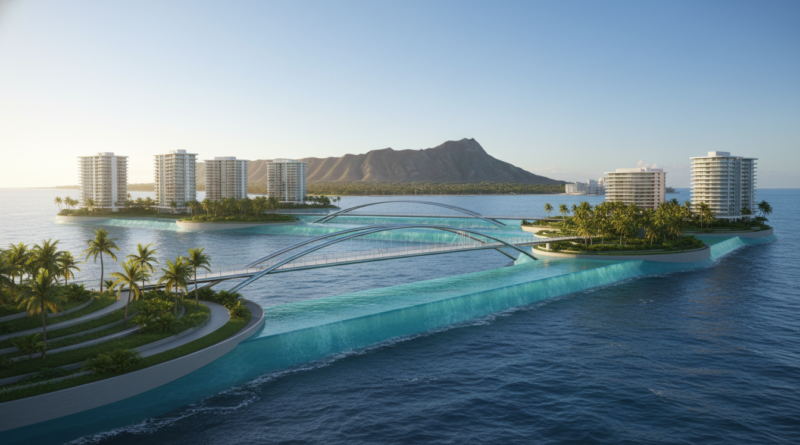
Led by Dr. Sarah Nakamura from UH Manoa’s School of Architecture, the interdisciplinary team spent three years developing designs that allow buildings to literally rise with floodwaters. Their proposals include floating foundations, water-permeable ground floors, and elevated pedestrian walkways connecting hotels and shops above anticipated flood levels.
“We’re not trying to fight the water — we’re learning to live with it,” Nakamura said. “These designs recognize that Waikiki will face regular flooding in the coming decades, so we need architecture that can adapt rather than resist.”
Floating Foundations and Elevated Walkways
The research team’s renderings show familiar Waikiki landmarks transformed with amphibious features. Hotels along Kalakaua Avenue would rest on floating foundation systems that rise and fall with water levels, while maintaining structural integrity. Ground floors would serve as temporary flood zones, with critical functions moved to higher levels.
Perhaps most striking are the proposed elevated walkways — a network of bridges and platforms connecting buildings at the second-story level. The design envisions tourists and residents moving seamlessly between hotels, shops, and restaurants even during flood events, with the street level temporarily surrendered to water.
The team also incorporated traditional Hawaiian design principles, drawing inspiration from ancient fishpond management and taro farming techniques that worked with, rather than against, natural water cycles.
Duke Kahanamoku Beach and the areas near the Royal Hawaiian Center feature prominently in the renderings, showing how public spaces could be redesigned with permeable surfaces and temporary structures that enhance rather than obstruct flood management.
Community Input Shapes Vision
The research incorporated extensive community feedback from Waikiki residents, business owners, and cultural practitioners. Over 200 participants attended community meetings where the team presented preliminary designs and gathered input on practical concerns and cultural considerations.
Local business owner James Tanaka, who operates a surf shop near the Moana Surfrider, participated in the community sessions. “At first I was skeptical about letting water into our neighborhood regularly, but the designs show how it could actually work,” he said. “The floating systems could protect our investments while keeping Waikiki accessible to visitors.”
The team also consulted with Native Hawaiian cultural experts to ensure their designs respected traditional relationships with water and land. Elements like integrated rain catchment systems and spaces for cultural practices were woven into the architectural proposals.
Real-World Applications
While the award-winning designs represent visionary thinking, they’re grounded in practical engineering principles already tested in flood-prone cities worldwide. Similar amphibious architecture projects in the Netherlands and Bangladesh provided technical foundations for the team’s Waikiki-specific solutions.
The research addresses growing concerns about Waikiki’s flood vulnerability, highlighted by recent severe weather events that inundated streets and forced business closures. Climate projections suggest such flooding will become more frequent and severe, making adaptive design strategies increasingly urgent.
City and County of Honolulu officials have expressed interest in the research, though no formal plans exist to implement the designs. The team estimates that pilot projects could begin within five years, starting with smaller-scale demonstrations of floating foundation technology.
The national recognition brings international attention to Hawaii’s climate adaptation efforts and positions UH researchers as leaders in resilient coastal design. For Waikiki residents and businesses, the award-winning project offers a hopeful vision of coexistence with rising waters rather than constant battle against them.
As flooding becomes an increasingly regular part of island life, these innovative designs suggest Waikiki could remain vibrant and accessible even as environmental challenges intensify. The question now is whether the community and city officials will embrace this amphibious future.