Street Artist Transforms Kakaako Warehouse District With Massive New Murals
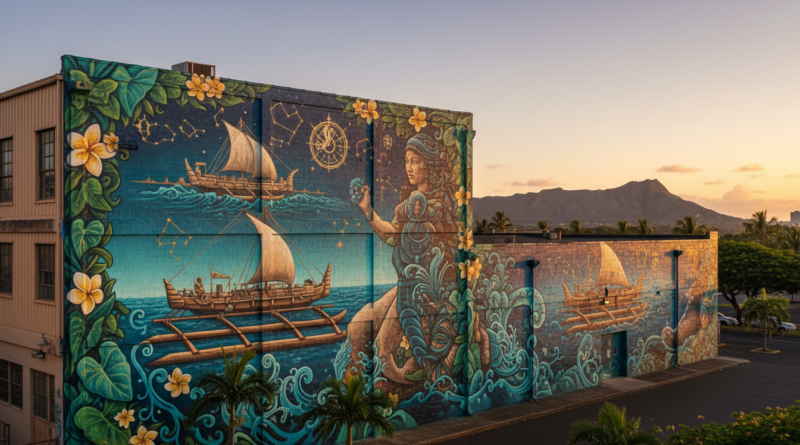
The concrete walls of Kakaako are getting a vibrant makeover as internationally recognized street artist Keoni “Bones” Makana unveils three massive murals across the warehouse district, transforming the industrial landscape into an open-air gallery that celebrates Hawaiian culture and urban life.
The largest piece, spanning 80 feet across the side of a former pineapple processing plant on Auahi Street, depicts traditional Polynesian navigation patterns interwoven with modern cityscapes. Makana, who grew up in nearby Kalihi, spent six weeks completing the work using eco-friendly paints that can withstand Hawaii’s humid climate.
“I wanted to show how our ancestors were the original explorers, and how that spirit lives on in today’s innovators and entrepreneurs calling Kakaako home,” Makana said while putting finishing touches on the mural Tuesday afternoon. “This isn’t just decoration — it’s storytelling on a grand scale.”
The mural project, commissioned by Kakaako Community Development Authority, represents a $150,000 investment in public art designed to enhance the district’s ongoing transformation from industrial zone to mixed-use community. Two additional murals on Cooke and Pohukaina streets feature native Hawaiian plants and marine life rendered in bold, contemporary styles.
Makana’s work has gained international attention over the past decade, with pieces appearing in galleries from Los Angeles to Berlin. However, he says returning to paint in his hometown holds special significance.
Community Response
Local business owners are already noticing increased foot traffic as art enthusiasts and social media users flock to photograph the colorful additions to their neighborhood. Sarah Chen, who owns Kava Collective on Queen Street, reports seeing more visitors asking for directions to “the mural district.”
“It’s brought so much energy to the area,” Chen said. “People are walking around, taking pictures, really engaging with the space in a way I haven’t seen before.”
The timing aligns with broader efforts to establish Kakaako as Honolulu’s creative hub. The nearby Salt at Our Kakaako development has attracted local artisans and boutiques, while the upcoming Honolulu Museum of Art contemporary gallery is set to open just blocks away in 2024.
Ward Village, the master-planned community rising nearby, has also incorporated public art into its development strategy, creating what urban planners call an “arts corridor” stretching from Keeaumoku Street to the waterfront.
Cultural Significance
Beyond their aesthetic appeal, Makana’s murals address ongoing conversations about development and cultural preservation in rapidly changing neighborhoods. The artist incorporated QR codes into each piece that link to audio narratives about Hawaiian history and the area’s evolution from royal fishponds to industrial center to modern community.
“Street art has always been about giving voice to communities,” said Dr. Lisa Tamura, professor of Pacific Island studies at the University of Hawaii at Manoa. “Keoni’s work creates dialogue between past and present in a way that makes Hawaiian culture accessible to residents and visitors alike.”
The murals also reflect growing recognition of street art as legitimate artistic expression worthy of preservation and promotion. Similar public art initiatives in cities like Miami and Philadelphia have generated millions in tourism revenue while revitalizing neighborhoods.
Makana plans to host monthly community painting sessions where residents can contribute smaller elements to designated sections of the murals. The first session is scheduled for this Saturday at 10 a.m. near the Auahi Street installation.
Looking Forward
HCDA officials hint that Makana’s project may be the first phase of a larger public art initiative. Executive Director Craig Hirai said the authority is reviewing proposals for additional murals and sculptural installations throughout the district.
“This is exactly the kind of placemaking that helps communities develop their own identity,” Hirai said. “We’re not just building buildings — we’re creating spaces where culture and creativity can flourish.”
For Kakaako residents and workers, the murals represent more than aesthetic improvement. They signal the neighborhood’s emergence as a destination that honors its Hawaiian roots while embracing contemporary urban culture — exactly the kind of authentic local experience that makes Honolulu unique.
The completed murals will be formally dedicated in a community celebration next month, featuring local musicians and food vendors. For now, they stand as bold statements that art belongs not just in galleries, but on the streets where communities live, work and tell their stories.