Hawaiian Language Immersion Schools Report Record Enrollment for Fall 2026
Hawaiian language immersion schools across Oahu are celebrating a milestone as enrollment reaches an all-time high for the fall 2026 semester, with more than 2,800 students now participating in programs that teach core subjects entirely in ʻŌlelo Hawaiʻi.
The Department of Education reported a 12% increase in enrollment compared to last year, with waiting lists at popular programs like Ke Kula ʻo Nāwahīokalaniʻōpuʻu in Kaneohe and Ke Kula Kaiapuni ʻo Ānuenue in Palolo Valley stretching into the hundreds. The surge reflects growing interest among families seeking to preserve Hawaiian culture while providing their children with a rigorous academic foundation.
“We’re seeing parents who maybe didn’t grow up speaking Hawaiian themselves, but they understand the value of this education for their keiki,” said Kalehua Krug, principal at Ke Kula Kaiapuni ʻo Ānuenue. “They see how our students develop not just language skills, but a deep connection to place and culture that serves them throughout their lives.”
The Hawaiian language immersion program, known as Kaiapuni, began in 1987 with just 15 students at one school. Today, it operates at 22 sites statewide, with 11 programs on Oahu serving students from kindergarten through 12th grade.
Building Cultural Identity Through Education
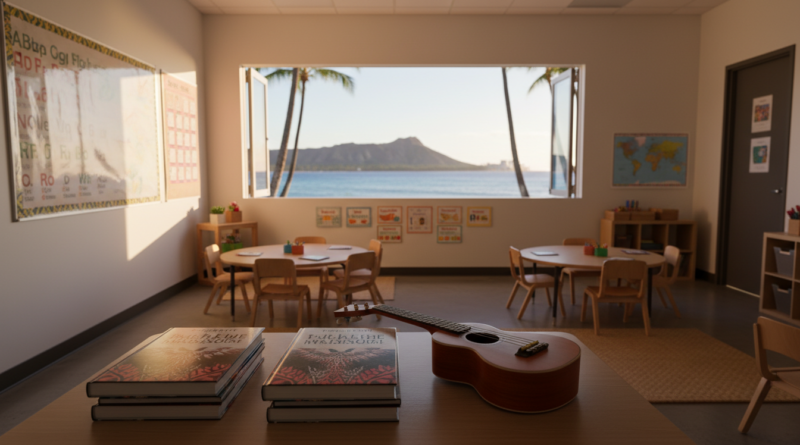
At these schools, students learn mathematics, science, social studies and other core subjects entirely in Hawaiian. English is introduced gradually, typically beginning in fifth grade. The approach has produced impressive results, with Kaiapuni students consistently scoring above state averages on standardized tests and demonstrating higher rates of college enrollment.
The enrollment boom comes as Hawaiian language experiences a broader renaissance across the islands. The University of Hawaii reports increased interest in Hawaiian language courses, while businesses and government agencies increasingly value employees with Hawaiian language skills.
For families like the Nakamuras of Kailua, the decision to enroll their daughter in Kaiapuni represents an investment in Hawaii’s future. “My husband and I aren’t Native Hawaiian, but we want Mei to understand the culture of the place where she was born,” said parent Lisa Nakamura. “The language connects her to the land and the values that make Hawaii special.”
Meeting Growing Demand
The challenge now lies in meeting demand. Several schools have reached capacity, forcing administrators to implement lottery systems for admission. The shortage of qualified teachers remains a persistent issue, with educators needing fluency in Hawaiian as well as subject-matter expertise.
The Department of Education has responded by expanding teacher training programs and working with community organizations to develop curriculum materials. Federal grants totaling $2.3 million will support new classrooms and technology upgrades at three Oahu campuses this year.
Native Hawaiian Education Association director Haunani Apoliona points to the enrollment surge as evidence of the program’s success in revitalizing a language that was nearly lost. “When I was growing up in the 1960s, there were maybe a few hundred native speakers left,” she said. “Now we have thousands of young people who are truly bilingual and bicultural.”
Academic Excellence and Cultural Pride
Research continues to support the benefits of immersion education. A recent study by the University of Hawaii found that Kaiapuni graduates demonstrate stronger critical thinking skills and cultural identity compared to peers in traditional programs. Many go on to pursue higher education and return to Hawaii as teachers, healthcare workers and community leaders.
The success has attracted attention from Indigenous communities worldwide seeking to revitalize their own languages. Delegations from New Zealand, Canada and the continental United States have visited Oahu programs to study the Hawaiian model.
As enrollment continues to grow, advocates push for expanded funding and new school sites. Proposed legislation would establish additional Kaiapuni programs in underserved areas of Oahu, including West Oahu and the North Shore, where families currently face long commutes to access immersion education.
The record enrollment represents more than numbers on a page — it signals a community’s commitment to preserving Hawaiian language and culture for future generations. As these students graduate and raise families of their own, they carry forward traditions that connect modern Hawaii to its ancestral roots, ensuring ʻŌlelo Hawaiʻi remains a living, thriving language in the islands.