
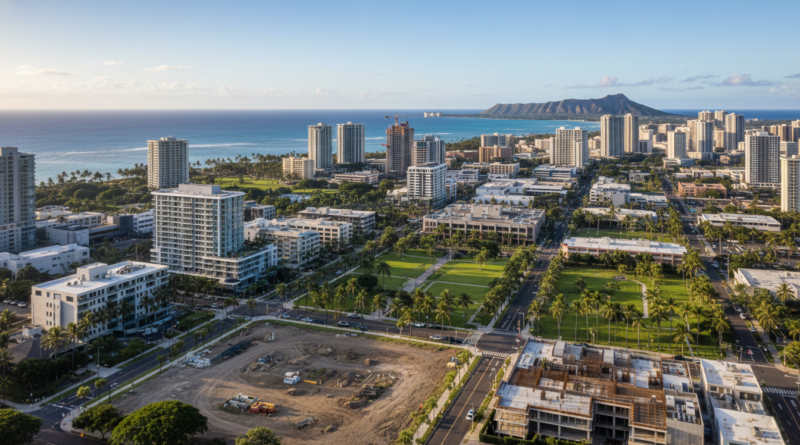
1,032-Unit Waiakoa Development in Kakaako Set to Break Ground in 2026, Bringing 620 Affordable Homes
A massive residential development poised to reshape Kakaako’s skyline received final approvals this week, with groundbreaking scheduled for 2026 on what will become one of Honolulu’s largest affordable housing projects in decades.
The Waiakoa development, a joint venture between Koa Partners and Castle & Cooke Hawaii, will deliver 1,032 residential units across multiple high-rise towers on a 4.2-acre site bounded by Auahi Street, Kamani Street, and South Street. The project’s centerpiece: approximately 620 units designated as affordable housing, representing 60% of the total inventory.
The development sits strategically in the heart of Kakaako’s urban core, within walking distance of Ward Village, Whole Foods, and the burgeoning restaurant scene along Auahi Street. The location places future residents minutes from downtown Honolulu’s business district and major transit connections.
“This project represents exactly the kind of mixed-income development Kakaako needs,” said Maria Santos, housing policy analyst with the Honolulu nonprofit Housing Solutions Hawaii. “When you can deliver this many affordable units in such a central location, you’re addressing both the housing crisis and the jobs-housing balance that’s been missing from so many Kakaako developments.”
Affordable Housing Details
The affordable units will serve households earning between 80% and 120% of Area Median Income, translating to roughly $76,000 to $115,000 annually for a family of four. This income range targets essential workers like teachers, nurses, and first responders who have been increasingly priced out of urban Honolulu.
Unit configurations will range from studios to three-bedroom apartments, with the affordable components integrated throughout the development rather than segregated into separate buildings. This mixed-income approach represents a shift from earlier Kakaako projects that often concentrated affordable units in less desirable portions of developments.
The development will also include approximately 10,000 square feet of ground-floor commercial space, likely accommodating neighborhood-serving retail and dining options that have become hallmarks of successful Kakaako projects.
Infrastructure and Community Impact
Waiakoa’s location requires significant infrastructure coordination with the Hawaii Community Development Authority, which oversees Kakaako development. The project site sits near several other major developments, including the completed Ae’o and Ke Kilohana towers, creating density that will test neighborhood parking, traffic flow, and utility capacity.
The development includes structured parking for residents and visitors, though specific ratios haven’t been disclosed. Given Kakaako’s increasing traffic congestion, particularly during evening rush hours, the project’s transportation impact will likely draw close scrutiny from neighborhood groups.
Construction is expected to span four years, with the first residential units potentially available by 2030. The extended timeline reflects both the project’s scale and the complex coordination required for affordable housing financing, which typically involves multiple funding sources including city housing funds, state programs, and federal tax credits.
Neighborhood Transformation
Waiakoa represents the latest phase in Kakaako’s dramatic transformation from an industrial district to Honolulu’s densest residential neighborhood. The area has added thousands of units over the past decade, fundamentally changing its character from warehouse district to vertical urban village.
The development’s affordable component addresses longstanding criticism that Kakaako’s growth has primarily served luxury buyers and investors rather than local residents. Previous projects like Park Lane and Anaha attracted significant mainland and international investment, contributing to concerns about housing speculation.
However, the concentration of new residents will continue pressuring Kakaako’s limited green space and recreational facilities. The neighborhood’s primary park, Keeaumoku Street Park, already experiences heavy use, and additional density will likely intensify demands for expanded community amenities.
For prospective residents, Waiakoa’s 2030 completion timeline means several more years of Kakaako’s ongoing construction activity. The neighborhood currently hosts active construction on multiple sites, creating noise, dust, and traffic disruptions that test longtime residents’ patience.
The project’s success will largely depend on its ability to integrate affordably housed families into a neighborhood where market-rate units often command $800,000 to $1.5 million. Creating genuine community cohesion across such income disparities remains one of mixed-income development’s greatest challenges.
As Waiakoa moves toward groundbreaking, it represents both opportunity and uncertainty for Kakaako’s evolution. The development could demonstrate that large-scale affordable housing integration is viable in Honolulu’s most expensive neighborhoods — or highlight the practical limits of mixing vastly different income levels in Hawaii’s constrained housing market.
