
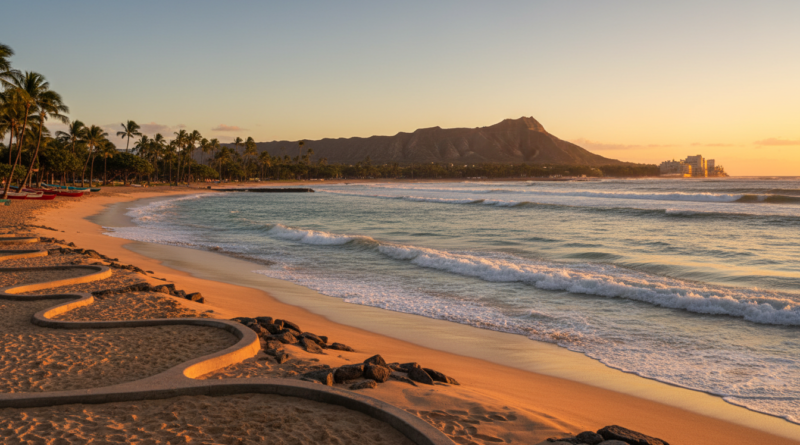
HCDA Weighs Sand Stabilization for Eroding Kawehewehe Beach at May 6 Waikiki Hearing
The Hawaii Community Development Authority will consider authorizing project management for a sand stabilization structure at Kawehewehe Beach during its May 6 meeting, marking the latest effort to address chronic erosion threatening Waikiki’s shoreline.
The proposed engineering intervention targets a particularly vulnerable section of beach between the Royal Hawaiian and Moana Surfrider hotels, where decades of wave action and rising sea levels have steadily carved away sand. The Kawehewehe sector has become a focal point for coastal management as tourism officials worry about the long-term viability of Hawaii’s most famous beach destination.
Unlike previous beach nourishment projects that simply dumped new sand onto eroding shores, the proposed stabilization structure would use engineered features to anchor sediment in place. The approach represents a shift toward more permanent solutions after repeated sand replenishment efforts showed mixed results across Waikiki.
Learning from Past Efforts
Waikiki has undergone multiple beach restoration attempts since the 1970s, with varying degrees of success. The most recent major nourishment project in 2012 pumped 24,000 cubic yards of sand onto the beach at a cost of $2.8 million, but much of that material migrated away within five years.
“We’ve learned that simply adding sand without addressing the underlying dynamics doesn’t provide lasting protection,” said Dr. Kenji Matsumoto, a coastal engineer who has consulted on previous Waikiki projects. “Stabilization structures can help interrupt the processes that carry sediment away, but they need to be carefully designed to avoid unintended consequences.”
The Kawehewehe proposal would likely incorporate submerged breakwaters or groins designed to slow wave energy while maintaining water circulation. Such structures have been used successfully at other Hawaiian beaches, including sections of Lanikai and Sunset Beach, though each location presents unique challenges.
Balancing Tourism and Environment
The timing of the HCDA consideration reflects growing urgency around Waikiki’s coastal management. Hotel operators along the strip have reported narrowing beach frontage affecting guest amenities, while surf schools and outrigger canoe operators worry about losing launching areas.
Environmental advocates have generally supported engineering approaches over repeated sand dumping, arguing that stabilization structures create less ongoing disruption to marine ecosystems. However, any intervention in Waikiki’s nearshore waters requires extensive permitting and environmental review.
The proposed project would need approval from multiple agencies, including the Army Corps of Engineers and the state Department of Health, before construction could begin. Community input sessions would also be required given the high-profile nature of the location.
Economic Stakes
Waikiki generates approximately $2 billion annually in visitor spending, making beach preservation a critical economic issue for the state. The shoreline supports not only major hotels but also dozens of small businesses offering surf lessons, canoe rides, and beach equipment rentals.
Recent studies have estimated that complete loss of Waikiki Beach could reduce visitor arrivals by 15-20%, representing hundreds of millions in lost revenue. Those projections have motivated increased investment in coastal protection measures across the resort district.
The Kawehewehe sector represents roughly 400 feet of shoreline, making it a manageable pilot area for testing new stabilization approaches. Success there could influence decisions about similar interventions along other vulnerable sections of Waikiki Beach.
Technical Challenges
Engineers face unique constraints working in Waikiki’s densely developed coastal zone. Any stabilization structure must accommodate existing seawalls, storm drains, and underground utilities while maintaining public beach access and recreational use.
Wave patterns in the area are complicated by the nearby Ala Wai Harbor entrance and the protective reef system offshore. Computer modeling has shown that poorly placed structures could redirect erosion to adjacent beach sections, creating new problems elsewhere.
The HCDA’s May 6 meeting will focus on authorizing project management rather than approving specific designs. That distinction allows the authority to begin detailed planning and community engagement while leaving technical decisions for later review.
For Waikiki residents and businesses, the stabilization project represents both hope and uncertainty. While permanent solutions are desperately needed, any construction would likely disrupt beach activities for months and could alter the character of the shoreline.
The HCDA meeting begins at 9 a.m. at the authority’s downtown offices, with public testimony scheduled early in the agenda. Final project approval could still be years away, but authorization of planning work would signal the state’s commitment to addressing Waikiki’s erosion crisis through engineering rather than periodic sand replacement.