
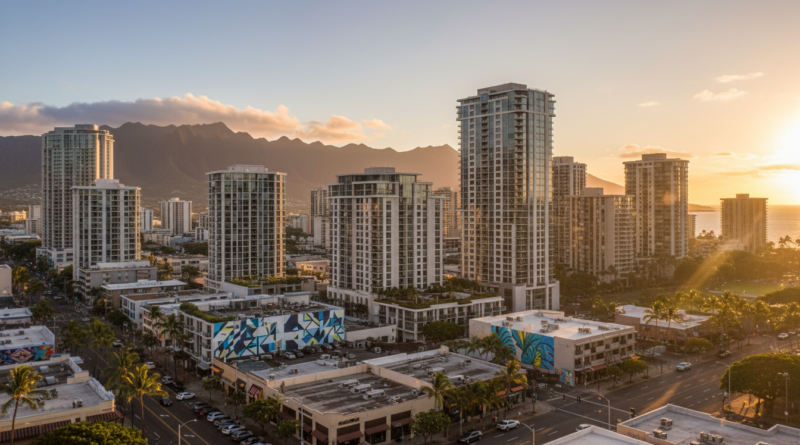
Waiakoa Will Bring 1,032 Homes — 600 of Them Affordable — to SALT Kakaako
A new residential development promising to deliver more than 1,000 homes — with a majority designated as affordable housing — is set to transform another corner of Kakaako’s rapidly evolving landscape.
Waiakoa, the latest addition to the Our Kakaako master-planned community adjacent to the SALT neighborhood, will feature two residential towers containing 1,032 units when construction begins in 2026. The project stands out in Honolulu’s development pipeline for dedicating roughly 60% of its units — approximately 600 homes — to workforce and affordable housing categories.
The development represents a significant test of whether Kakaako’s transformation can actually serve local families, rather than pricing them out entirely. With median home prices in the area now exceeding $800,000 for condominiums, workforce housing projects like Waiakoa have become crucial for teachers, firefighters, nurses and other essential workers who keep Honolulu running.
Mixed-Income Housing in a High-Priced Market
Located within the broader Our Kakaako master plan, Waiakoa will join a growing collection of residential towers that have reshaped the former industrial district over the past decade. The development’s affordable component will target households earning between 80% and 140% of the area median income — roughly $76,000 to $133,000 for a family of four.
The remaining 432 market-rate units will likely command premium prices given the area’s waterfront proximity and urban amenities. SALT Kakaako, with its mix of local retailers, restaurants and entertainment venues, has become one of Honolulu’s most desirable neighborhoods for young professionals and empty nesters alike.
“Projects like Waiakoa are essential for maintaining economic diversity in areas that are experiencing rapid gentrification,” said Marcus Tanaka, a housing policy researcher at the University of Hawaii’s Public Policy Center. “The question is whether 600 affordable units can meaningfully offset the displacement pressure created by thousands of market-rate units throughout Kakaako.”
Kakaako’s Broader Transformation
The Our Kakaako master plan envisions eventually housing more than 15,000 residents across multiple phases of development. When complete, the community will span 60 acres between Ala Moana Boulevard and Queen Street, creating one of Honolulu’s densest residential neighborhoods.
This transformation has generated both excitement and concern among longtime Honolulu residents. Supporters point to increased housing supply and transit-oriented development that reduces car dependency. Critics worry about the loss of industrial jobs and affordable rental housing that previously characterized the area.
The Hawaii Community Development Authority, which oversees development in Kakaako, has required affordable housing components in most major projects. However, the actual affordability of these units remains a point of contention, as “affordable” housing targeted at 140% of median income can still cost more than $400,000.
Timeline and Community Impact
With groundbreaking scheduled for 2026, Waiakoa residents could begin moving in by 2029 or 2030, depending on construction timelines and permitting processes. The project will add to a growing inventory of new housing options in urban Honolulu, but also contribute to ongoing concerns about neighborhood character and infrastructure capacity.
Recent developments in Kakaako have strained local schools, parks and traffic patterns. The area’s elementary school, Keelikolani, operates significantly over capacity, while Keeaumoku Street and other access routes experience increasing congestion during peak hours.
The success of Waiakoa’s affordable housing component will depend largely on the selection process and long-term affordability controls. Many workforce housing projects in Hawaii have struggled with buyers who qualify initially but later sell to investors or higher-income purchasers, undermining the original affordability goals.
What This Means for Honolulu
Waiakoa represents both the promise and the challenge of Honolulu’s efforts to address its housing crisis through private development. While 600 affordable units would provide homes for hundreds of local families, the project also reflects the broader economic forces making it difficult for working residents to remain in increasingly expensive neighborhoods.
The development’s impact will extend beyond its immediate residents to influence housing costs and community composition throughout urban Honolulu. As Kakaako continues evolving from industrial district to residential hub, projects like Waiakoa will help determine whether the area becomes a model for inclusive development or another example of displacement disguised as progress.
For prospective residents, the Hawaii Community Development Authority is expected to release application procedures and income requirements for Waiakoa’s affordable units closer to the project’s completion date.