
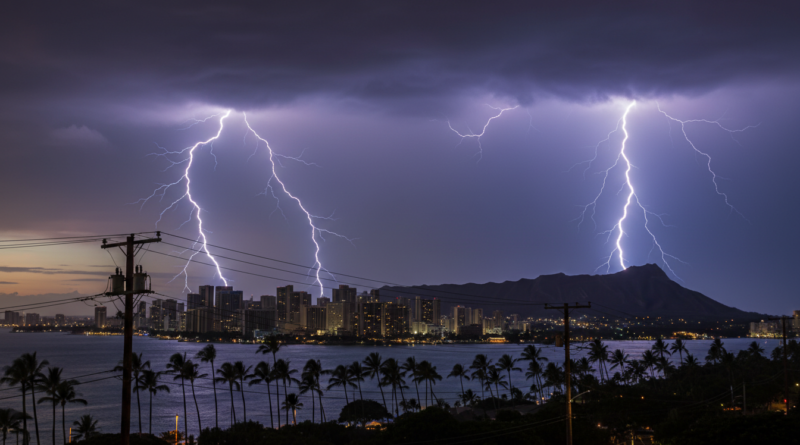
Oahu’s Lightning Storms Knocked Out Power to Thousands — Is the Grid Ready for More?
The thunderstorms that rolled across Oahu last Thursday night left more than just puddles in their wake. When lightning strikes and torrential rains knocked out power to nearly 8,000 Hawaiian Electric customers from Wahiawa to the North Shore, it exposed lingering questions about the resilience of the island’s aging electrical infrastructure.
The storm system, which meteorologists described as unusually intense for May, dumped 2-4 inches of rain per hour across central and northern Oahu. Lightning strikes damaged multiple power lines, while flooding forced Honolulu Police Department officers to shut down both directions of Kamehameha Highway near Wahiawa for nearly three hours.
“We haven’t seen rainfall rates this high in a single evening since Hurricane Lane back in 2018,” said Tom Birchard, a meteorologist with the National Weather Service’s Honolulu office. “When you get that much water falling that fast, combined with electrical activity, it creates a perfect storm for infrastructure problems.”
The outages stretched from Mililani and Wahiawa down through parts of Pearl City, with the North Shore communities of Haleiwa and Sunset Beach losing power for up to six hours. Hawaiian Electric crews worked through the night to restore service, but the incident has renewed concerns about grid vulnerability as extreme weather events become more frequent across the Pacific.
Aging Infrastructure Under Pressure
Hawaiian Electric’s Oahu grid includes transmission lines and equipment dating back decades, much of it installed when the island’s population was half its current size. The utility has been working to modernize the system, but progress has been uneven across different neighborhoods.
The North Shore, in particular, has been a persistent challenge. The area’s overhead power lines stretch across rural terrain that’s difficult to access for maintenance crews, and the coastal environment accelerates corrosion of equipment.
“Every time we get a significant weather event, whether it’s high surf, strong winds, or now these intense thunderstorms, we’re reminded that parts of our grid weren’t built for the climate we’re experiencing today,” said City Councilmember Matt Weyer, who represents the North Shore district.
Hawaiian Electric has invested heavily in grid modernization over the past five years, spending more than $200 million on new transmission equipment and smart grid technology. But the utility acknowledges that hardening the entire system against extreme weather will take years and require continued rate increases to fund the work.
Climate Change Factor
Scientists say intense rainfall events like last week’s storm are becoming more common as climate change alters Pacific weather patterns. The same warming that has contributed to more frequent marine heat waves around the Hawaiian Islands also creates conditions for more volatile atmospheric events.
Data from the National Weather Service shows that the number of days per year with rainfall exceeding two inches per hour on Oahu has increased by roughly 30% since 2000. That trend puts additional stress on drainage systems, roads, and electrical infrastructure that wasn’t designed for such extremes.
Hawaiian Electric has been incorporating climate resilience into its planning process, including elevation of equipment in flood-prone areas and installation of more storm-resistant power poles. The utility is also expanding its network of automated switches that can quickly reroute power around damaged sections of the grid.
Emergency Response Lessons
Last week’s storm also highlighted gaps in emergency communication. Many residents in affected areas reported that they didn’t receive timely updates about expected restoration times, and Hawaiian Electric’s outage map crashed repeatedly due to high traffic.
The utility has promised to improve its customer communication systems, particularly for mobile users who may be relying on cellular data during power outages.
HPD’s decision to close Kamehameha Highway proved prescient as flooding made the roadway impassable near the Wahiawa bridge. But the closure created massive traffic backups that lasted well into Friday morning, stranding some North Shore residents who work in town.
For Oahu residents, last week’s storm serves as a reminder that island living means island vulnerability. As extreme weather becomes more frequent, the question isn’t whether the next major storm will test the grid again — it’s whether Hawaiian Electric and local emergency managers will be better prepared when it does.
Hawaiian Electric plans to present an updated grid resilience plan to state regulators next month, including proposed investments in underground power lines for the most vulnerable areas. The utility estimates that fully hardening Oahu’s electrical system against extreme weather would cost upward of $1 billion over the next decade.