
Council Members Grill Emergency Manager Over Slow North Shore Flood Response
Honolulu City Council members delivered sharp criticism to Emergency Management Administrator Janet Babb during Wednesday’s committee hearing, questioning why evacuation orders for North Shore communities came hours after flooding had already begun two weeks ago.
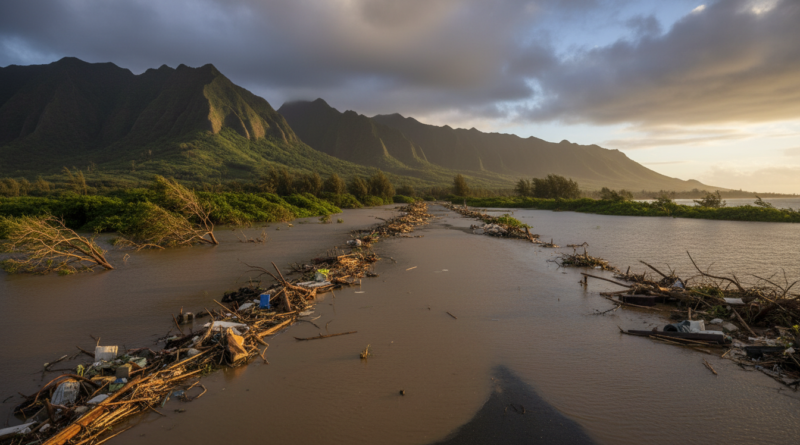
The April 15 storm dumped more than eight inches of rain in less than four hours across areas from Haleiwa to Sunset Beach, yet official evacuation notices weren’t issued until 2 p.m. — well after residents were already stranded by rising waters that morning.
“We had families trapped on rooftops in Waialua while the city was still debating whether to sound the alarm,” said Councilwoman Andrea Tupola, whose district includes much of the affected North Shore. “That’s unacceptable.”
The hearing revealed multiple breakdowns in the city’s emergency response system. Weather monitoring stations in Haleiwa and Sunset Beach went offline during the storm’s peak, leaving emergency officials relying on delayed reports from residents and first responders rather than real-time data.
Babb acknowledged the delayed response but defended her department’s actions, citing rapidly changing conditions and communication challenges with North Shore communities.
“The storm intensified far beyond what our models predicted,” Babb told council members. “We were working with incomplete information and had to prioritize public safety over speed of notification.”
Residents Still Struggling Two Weeks Later
The flooding damaged more than 200 homes across North Shore neighborhoods, with Waialua and sections of Haleiwa hit hardest. Many residents remain displaced, staying with relatives or in temporary housing while waiting for insurance claims to process.
The Kamehameha Highway remained partially closed near Laniakea Beach until Tuesday, forcing lengthy detours for North Shore residents commuting to Honolulu for work. Local businesses, already struggling with reduced tourism, have seen another significant drop in foot traffic.
Maria Santos, who runs a shave ice stand in Haleiwa, said the delayed evacuation order left her family scrambling as water rose around their rental home near the Anahulu River.
“By the time they told us to leave, we couldn’t leave,” Santos said. “My kids were scared, and we had to wait on the roof for the fire department to get us out with a boat.”
Council Chair Tommy Waters pressed Babb on why the city’s alert system failed to reach many North Shore residents. Text alerts and emergency broadcasts didn’t function properly due to cell tower outages, leaving some communities isolated without warnings.
Infrastructure Gaps Exposed
The storm exposed critical gaps in North Shore infrastructure that have plagued the area for years. Aging drainage systems in Waialua, some dating to the 1950s, quickly became overwhelmed. The Anahulu Stream’s concrete channel, modified decades ago for development, couldn’t handle the massive water volume.
Councilman Radiant Cordero called for immediate infrastructure investments, noting that climate change will likely bring more intense storms to Oahu’s vulnerable North Shore communities.
“We can’t keep putting band-aids on 70-year-old drainage systems and expect them to handle modern storm patterns,” Cordero said during the hearing.
The Department of Environmental Services has identified $180 million in needed drainage improvements across the North Shore, but funding remains uncertain. Current plans focus on upgrading storm drains in Haleiwa and expanding the Waialua pump station, though construction wouldn’t begin until 2027 at the earliest.
Emergency management officials also revealed that backup communication systems failed during the storm. Ham radio operators eventually helped coordinate rescues, but the city lacks formal agreements with amateur radio groups for emergency situations.
Changes Coming to Emergency Response
Babb announced several immediate changes to emergency protocols following the council’s criticism. The city will lower thresholds for issuing evacuation warnings and establish redundant communication systems for North Shore communities.
New weather monitoring stations will be installed in Waialua and near Sunset Beach by June, providing better real-time data during future storms. The emergency management office is also working with Hawaiian Electric to prioritize power restoration for critical communication infrastructure.
The council is expected to vote next month on emergency funding for temporary flood mitigation measures, including portable pumps and improved emergency communication equipment for North Shore fire stations.
For North Shore residents still rebuilding their lives, Wednesday’s hearing offered some accountability but few immediate solutions. The next major test will come with the start of hurricane season in June, when the city’s promised improvements will face their first real trial.
