
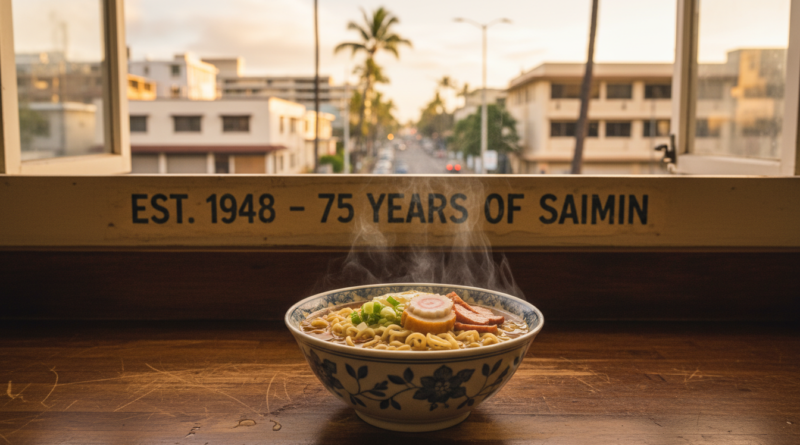
Honolulu’s Oldest Saimin Stand Passes 75-Year Milestone With Original Recipe
Shige’s Saimin House tucked away on North King Street has been serving the same hand-pulled noodles and secret broth recipe for three-quarters of a century, making it officially Honolulu’s longest-running saimin stand still operated by the founding family.
The humble eatery, wedged between a laundromat and auto repair shop in the Kalihi-Palama neighborhood, celebrated its 75th anniversary last month with little fanfare—exactly how founder Shigeru “Papa Shige” Nakamura would have wanted it. His granddaughter Lisa Nakamura-Kim now runs the 12-seat counter alongside her cousin James, maintaining the same no-frills approach that has kept locals coming back since 1949.
“We get calls from food bloggers wanting to know our ‘story,’ but honestly, there’s no big secret,” Nakamura-Kim said while ladling steaming broth into ceramic bowls during the lunch rush. “We just make good saimin the way Grandpa taught us, and people keep showing up.”
The original Shigeru Nakamura opened the stand after returning from World War II service, using savings and a small loan to secure the 400-square-foot space. He developed his signature broth recipe—a closely guarded blend that family members say involves pork bones, dried shrimp, and at least six other ingredients—through trial and error in the early months.
Unlike many Honolulu saimin shops that have modernized their operations or expanded their menus, Shige’s remains virtually unchanged. The same red vinyl counter stools from the 1960s line the narrow space, and the handwritten menu board still lists just eight items, with the basic saimin bowl priced at $6.50.
Community Institution in Kalihi-Palama
The stand occupies a special place in Kalihi-Palama’s working-class community, where multiple generations of families have made it their regular stop. Construction workers grab breakfast bowls before 7 a.m., office employees line up during lunch, and high school students from nearby Farrington often pool their money for after-school orders.
“My dad brought me here when I was small kid, and now I bring my own children,” said longtime customer Robert Tanaka, a Kalihi resident and city bus driver. “The taste never changes, and that’s why we keep coming back.”
The consistency extends beyond just flavor. Nakamura-Kim and her cousin still hand-pull fresh noodles daily using the same technique Papa Shige perfected decades ago. They arrive at 4:30 a.m. to start the broth, which simmers for hours before the 6 a.m. opening.
The family has weathered numerous challenges over the decades, including rising rent costs, supply chain disruptions during the pandemic, and pressure from developers eyeing the prime King Street location. They’ve turned down multiple offers to sell, including one last year that would have netted them enough to retire comfortably.
Preserving Local Food Heritage
Food historians note that Shige’s represents an increasingly rare breed of authentic local establishments that predate Hawaii’s tourism boom and chain restaurant influx. The stand’s survival speaks to both family dedication and community support in an era when many mom-and-pop eateries struggle to compete.
“Places like Shige’s are living pieces of Hawaii’s culinary history,” said Dr. Rachel Laudan, a food historian who has written extensively about local cuisine. “They preserve not just recipes, but entire cultural practices around food and community gathering.”
The saimin itself reflects Hawaii’s unique cultural fusion, combining Chinese noodle-making techniques, Japanese broth traditions, and local ingredients. Shige’s version includes kamaboko, char siu pork, green onions, and nori in generous portions that regularly overflow the ceramic bowls.
Nakamura-Kim acknowledges the challenges of maintaining a traditional operation in modern Honolulu. Rising costs for ingredients have forced small price increases over the years, and finding reliable suppliers for specialty items like kamaboko requires maintaining relationships with longtime vendors across the island.
The family has no immediate plans for major changes, though they recently added a small parking area behind the building to accommodate customers who previously had to hunt for street parking. They’re also training Lisa’s teenage son in noodle-pulling techniques, ensuring the tradition continues into a fourth generation.
For Honolulu residents seeking authentic local flavors in an increasingly commercialized food landscape, Shige’s Saimin House remains a dependable constant—a place where 75 years of tradition comes served in a simple ceramic bowl for under $7.