
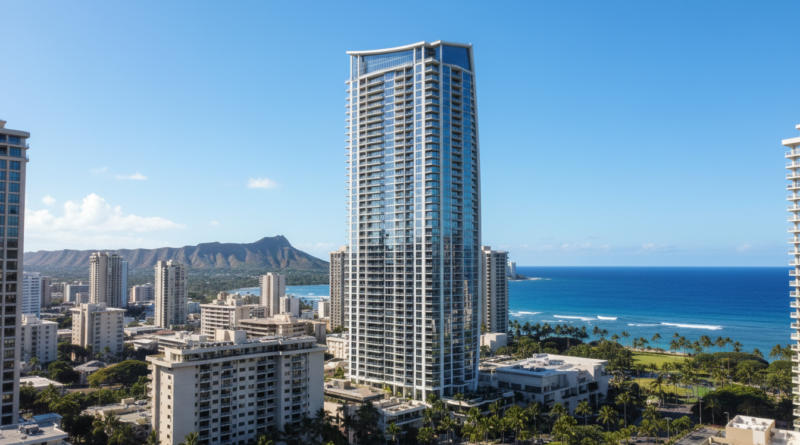
Kahuina Kakaako: 861-Unit Mixed-Use Tower With 60% Workforce Housing to Break Ground This Year
Construction crews will break ground this year on Kahuina, a 861-unit mixed-use tower that promises to deliver on Kakaako’s long-awaited commitment to workforce and affordable housing in one of Honolulu’s most rapidly developing neighborhoods.
The 40-story tower, developed by Stanford Carr Development on Block C of the Our Kakaako master-planned community, will dedicate 517 units — roughly 60% of its total — to workforce and affordable housing. The remaining 344 units will be market-rate condominiums.
Located at 685 Auahi Street between Kamakee and Cooke streets, Kahuina represents a significant milestone for the Hawaii Community Development Authority’s vision of creating a mixed-income urban community in the former industrial district turned residential hub.
“This project demonstrates that we can build beautiful, well-designed housing that serves working families alongside market-rate buyers,” said Tom Shigemoto, executive director of the Hawaii Community Development Authority. “Kahuina shows that workforce housing doesn’t have to be an afterthought — it can be integral to creating vibrant communities.”
Addressing Honolulu’s Housing Crunch
The tower’s workforce housing component targets families earning 80% to 120% of Honolulu’s Area Median Income, translating to roughly $75,000 to $112,000 annually for a family of four. Affordable units will serve households earning up to 80% AMI.
These income brackets capture many of Honolulu’s essential workers — teachers, nurses, firefighters, and service industry employees — who have been increasingly priced out of urban neighborhoods like Kakaako, where median home prices exceed $800,000.
Beyond residential units, Kahuina will include 42,000 square feet of ground-floor commercial and retail space, continuing Kakaako’s evolution into a walkable urban district. The development will also feature a 3,500-square-foot community room and recreational amenities including a fitness center and rooftop terrace.
Our Kakaako’s Broader Vision
Kahuina sits within Our Kakaako, a master-planned community spanning multiple blocks between Ala Moana Boulevard and Queen Street. When fully built out, the development will include over 4,700 residential units across several towers, with plans calling for 30% to be reserved for workforce and affordable housing.
The master plan represents one of Hawaii’s most ambitious attempts to create dense, transit-oriented development that serves multiple income levels. Its proximity to downtown Honolulu, the planned Honolulu rail line, and Ala Moana Center positions residents within walking distance of jobs, shopping, and transportation.
Stanford Carr Development, led by CEO Stanford Carr, has built a reputation developing workforce housing projects across Hawaii. The company’s previous Kakaako projects include Ke Kilohana, a 424-unit tower that similarly mixed market-rate and workforce housing.
Construction timelines indicate Kahuina’s workforce housing units could welcome residents by 2026, though exact completion dates depend on permitting and construction progress.
Infrastructure and Community Concerns
Kakaako’s rapid development has raised questions about infrastructure capacity, particularly traffic congestion on already-strained arteries like Ala Moana Boulevard and Kapiolani Boulevard. Community advocates have pushed for improved pedestrian infrastructure and green space to serve the growing population.
The Hawaii Community Development Authority has required developers to contribute to public infrastructure improvements, including sidewalk enhancements, park space, and traffic mitigation measures.
Ward Village, the neighboring master-planned community developed by The Howard Hughes Corporation, has faced similar growing pains as thousands of new residents have moved into recently completed towers.
However, supporters argue that projects like Kahuina represent exactly the type of development Honolulu needs to address its housing crisis — dense, transit-oriented construction that maximizes urban land use while preserving rural and suburban neighborhoods from development pressure.
Looking Ahead
Kahuina’s groundbreaking marks a critical test of whether Kakaako can successfully integrate workforce housing into a district that has attracted significant luxury development. Early sales and leasing interest will provide important signals about demand for mixed-income urban living in Honolulu.
For working families who have watched Kakaako transform from industrial wasteland to luxury high-rise district, Kahuina represents a rare opportunity to live in one of Honolulu’s most connected neighborhoods without paying luxury prices.
The project’s success could influence similar developments across urban Honolulu, where land costs and regulatory hurdles have made workforce housing increasingly difficult to deliver at scale.
