
UH Researchers Win National Award for Waikiki Flood Adaptation Design Study
University of Hawaii researchers have earned national recognition for their innovative approach to helping Waikiki adapt to future flooding, receiving the American Institute of Architects’ Climate Action Award for their groundbreaking visualization study.
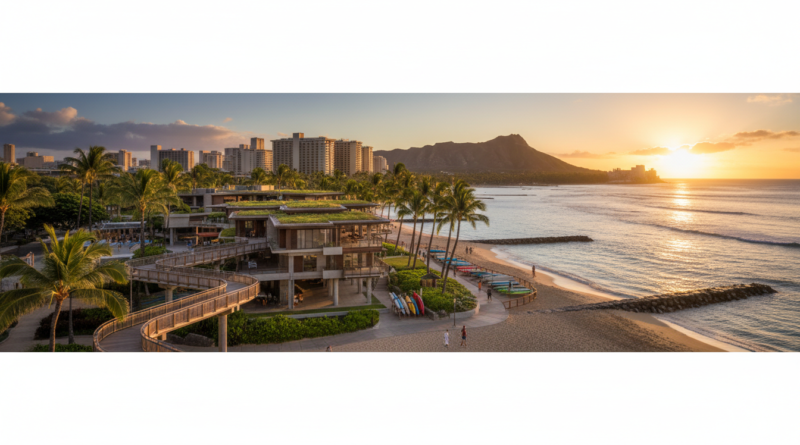
The research team, led by UH School of Architecture professor Dr. Sarah Chen and graduate student Marcus Kawelo, created detailed architectural renderings that show how Waikiki’s hotels, condominiums, and commercial buildings could be retrofitted to withstand increasing flood risks from sea level rise and storm surge.
“We’re not just showing pretty pictures,” said Dr. Chen, who has studied coastal adaptation for over a decade. “These renderings provide concrete, actionable solutions that property owners and city planners can implement today to protect one of Hawaii’s most economically vital neighborhoods.”
The award-winning study focuses on the most vulnerable areas of Waikiki, particularly the stretch along Kuhio Avenue and the neighborhoods mauka of Ala Wai Canal. The team’s renderings propose elevated building entrances, flood-resistant ground floor designs, and integrated green infrastructure that can absorb excess water during heavy rain events.
The research takes on heightened relevance following recent severe weather that flooded parts of Waikiki and highlighted the area’s vulnerability. Last month’s storms caused significant water damage to several hotels along Kalakaua Avenue and forced temporary evacuations of ground-floor retail spaces.
Practical Solutions for Iconic Destination
The UH team’s approach stands out for its focus on maintaining Waikiki’s character while improving resilience. Rather than proposing massive seawalls or wholesale redevelopment, their designs show how existing buildings can incorporate flood-adaptive features.
One rendering shows the iconic Royal Hawaiian Hotel with modified landscaping that doubles as bioswales to channel floodwater. Another depicts Waikiki Beach Walk with elevated walkways and permeable surfaces that reduce runoff while preserving the area’s pedestrian-friendly atmosphere.
“The beauty of this research is that it doesn’t require Waikiki to stop being Waikiki,” explained graduate student Kawelo, a Kaimuki native whose family has worked in the tourism industry for generations. “These adaptations can happen incrementally as buildings undergo renovations or updates.”
The American Institute of Architects selected the UH study from over 200 submissions nationwide. The Climate Action Award recognizes projects that demonstrate innovative responses to climate change impacts on the built environment.
Economic Stakes Drive Urgency
The timing couldn’t be more critical for Honolulu’s economy. Waikiki generates approximately $2 billion annually in visitor spending and supports thousands of local jobs. Climate scientists project that sea levels around Oahu could rise 1-4 feet by 2100, while more intense storms bring increasing flood risks.
City Council member Tommy Waters, who represents District 4 including Waikiki, praised the research as essential for the neighborhood’s future. “This kind of forward-thinking planning is exactly what we need to protect our residents, businesses, and visitors while preserving what makes Waikiki special.”
The study also addresses equity concerns, noting that many Waikiki residents live in older apartment buildings that lack resources for major renovations. The researchers propose community-scale solutions like improved drainage systems and shared flood barriers that could protect entire blocks.
Dr. Chen’s team collaborated with local architects, engineers, and community groups to ensure their proposals reflect both technical feasibility and local needs. They held workshops with Waikiki Neighborhood Board members and conducted interviews with longtime residents about flooding concerns.
Next Steps and Implementation
The award comes with a $25,000 grant that the research team plans to use for expanding their study to other vulnerable coastal areas around Oahu, including parts of Sand Island, Mapunapuna, and Hawaii Kai.
More immediately, the City and County of Honolulu is incorporating elements from the UH study into its updated Climate Change Commission recommendations, expected to be released next month. The renderings are also being shared with major Waikiki property owners as they plan future renovations.
For Honolulu residents, the research offers hope that the city’s most famous neighborhood can adapt to climate challenges without losing its essential character. As extreme weather events become more frequent, this kind of proactive planning could serve as a model for coastal communities across the Pacific.
The full study and renderings are available on the UH School of Architecture website, providing a glimpse into how thoughtful design can help Waikiki weather whatever storms lie ahead.