
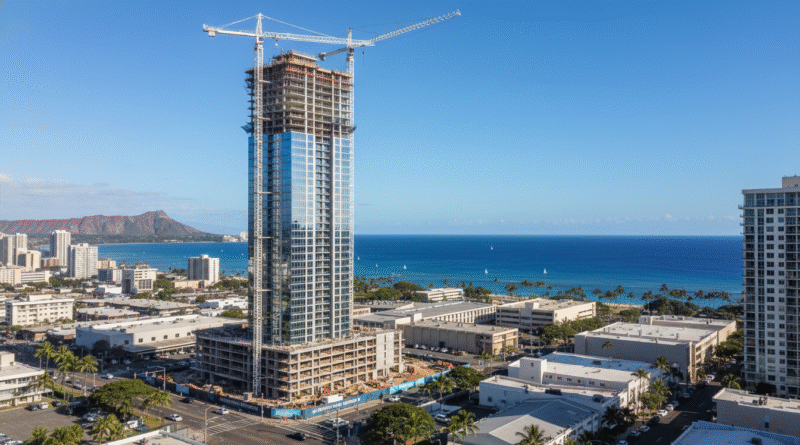
Kakaako’s Kahuina Tower Plans to Break Ground This Year With 60% Workforce Housing — One of the Neighborhood’s Biggest Affordable Commitments
Stanford Carr Development’s ambitious Kahuina Tower project in Kakaako is preparing to break ground this year, bringing what could be the neighborhood’s most significant affordable housing commitment to date. The mixed-use development on Block C will deliver 861 residential units, with an unprecedented 60% designated as workforce and affordable housing.
The project represents a major shift in Kakaako’s development pattern, where luxury condominiums have dominated the landscape since the Hawaii Community Development Authority began transforming the former industrial district into a high-density residential hub. At a time when Honolulu’s median home price hovers around $1.1 million, Kahuina’s affordability commitment addresses a critical need for local workers priced out of the market.
“This project demonstrates that developers can be profitable while serving the community’s housing needs,” said Maria Santos, a housing policy analyst with the Honolulu-based advocacy group Affordable Housing Coalition. “Kahuina could set a new standard for what’s possible in urban Honolulu.”
Mixed-Income Community Design
The development will feature two towers rising from a shared podium that includes 42,000 square feet of commercial space. Stanford Carr Development has designed the project to integrate workforce housing units throughout the building rather than segregating them, creating a truly mixed-income community.
Workforce housing units will be available to households earning between 80% and 140% of Area Median Income, translating to approximately $76,000 to $133,000 annually for a family of four. Affordable units will serve households earning up to 80% of AMI, around $76,000 for a four-person household.
The commercial component will anchor the project’s ground level along Pohukaina Street, with plans for retail spaces, restaurants, and potentially a small grocery store to serve both residents and the broader Kakaako community.
Strategic Location and Transit Access
Block C sits strategically between the existing Ward Village development and the Honolulu Authority for Rapid Transportation’s upcoming Keeaumoku station. This positioning gives residents access to both the neighborhood’s growing retail and dining scene and future rail connections to downtown Honolulu and the airport.
The site’s proximity to Keeaumoku Park and the waterfront also provides residents with recreational amenities often lacking in urban housing developments. The project’s design incorporates pedestrian-friendly streetscapes and bicycle storage to encourage alternative transportation options.
Construction is expected to begin in late 2025 or early 2026, with completion targeted for 2028. The development timeline aligns with HART’s projected rail service launch, potentially making Kahuina one of the first transit-oriented developments to take full advantage of Oahu’s rail system.
Addressing the Housing Crisis
Kahuina emerges as Honolulu grapples with a severe housing shortage that has pushed homeownership out of reach for many local families. The project’s affordability component directly responds to criticism that Kakaako’s transformation has primarily benefited wealthy mainland buyers rather than local residents.
Previous developments in the area, including luxury towers like Anaha and Ae’o, have drawn buyers from across the Pacific Rim but offered limited affordable options. Kahuina’s 60% affordability commitment represents a dramatic departure from this pattern.
The Hawaii Community Development Authority has increasingly emphasized affordable housing requirements for new Kakaako projects, but few developers have embraced such ambitious targets. Stanford Carr Development’s approach suggests that mixed-income projects can remain financially viable while serving community needs.
Economic Impact and Future Development
Beyond housing, Kahuina’s commercial component could generate hundreds of construction and permanent jobs while adding to Kakaako’s growing reputation as a live-work-play destination. The project’s scale makes it one of the largest single developments in the neighborhood’s ongoing transformation.
The development’s success could influence future projects throughout Honolulu, particularly as the city seeks to address housing shortages in other urban corridors. City planners and housing advocates will closely watch whether Kahuina’s mixed-income model proves sustainable for other developers.
For Honolulu residents, Kahuina represents more than just another development project. It offers a potential pathway to homeownership in an increasingly expensive city, while demonstrating that thoughtful urban development can serve both market demands and community needs. As groundbreaking approaches, the project stands as a test case for whether Kakaako’s continued evolution can truly benefit local families rather than displacing them.