The Books Nobody Reviews (And Why That’s a Problem for Readers)
Every week, thousands of books are published that serious readers will never hear about, not because the books aren’t worth reading, but because they took the wrong road to print.
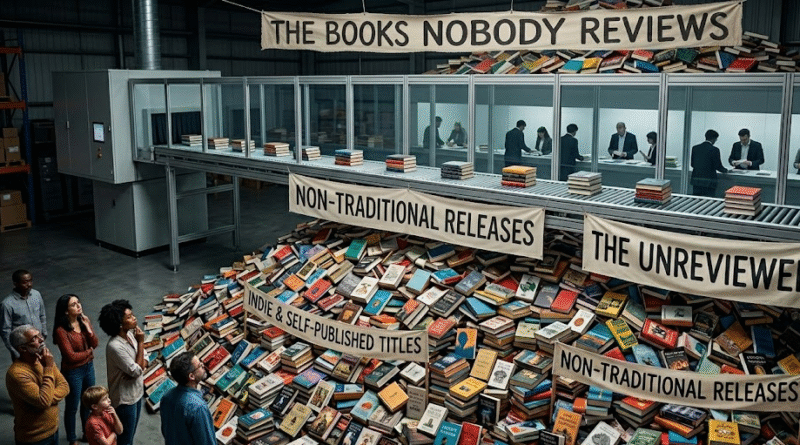
The unwritten rule at most major review outlets is simple: if a book wasn’t published by a traditional house, it doesn’t get reviewed. No column inches in the literary supplements. No coverage in Publishers Weekly. No consideration for year-end lists. The book might reach fifty thousand readers, change the way a business owner runs their company, or offer a perspective unavailable anywhere else. None of that matters. The path to publication is the filter, not the work itself.
That policy is increasingly difficult to defend.
How We Got Here
The logic behind it was never really about quality. It was about capacity and convenience. Traditional publishers, the reasoning went, had already done the work of separating the signal from the noise. If a book survived the acquisition process, the editorial process, and the production process at a major house, it had passed through enough filters to be worth a reviewer’s time. In an era when self-publishing meant vanity presses and spiral-bound memoirs sold out of car trunks, that shortcut made a certain kind of sense.
The market looks nothing like that now.
Roughly a third of the top-selling books on Amazon at any given moment are independently published. The business books, entrepreneurship guides, and practical nonfiction that millions of professionals are reading every week are overwhelmingly self or hybrid-published. Authors who could get traditional deals are choosing not to, because the economics and the control calculus have shifted. The old equation, traditional publishing equals quality, independent publishing equals vanity, has not been true for years.
The Reader Gets Left Behind
What this means in practice is that a substantial portion of the books people are actually buying and reading exist outside the critical conversation entirely. Readers looking for guidance have nowhere to turn except Amazon star ratings and Goodreads averages, both of which measure popularity and sentiment rather than quality, and both of which are structurally vulnerable to manipulation.
This is the gap that led Mike Partners to launch WritersReview as an independent literary publication that reviews books regardless of how they were published.
“I’ve helped more than thirty authors publish their books,” Partners says. “These are serious people with serious ideas, writing for serious audiences. When the book comes out, the critical apparatus acts like it doesn’t exist. Readers are flying blind in a market where a third of the product is invisible to reviewers. That’s not a quality standard. That’s a habit.”
The Business Book Problem
The gap is most visible in the categories that reviewers have always treated as secondary: business, self-help, entrepreneurship, and personal finance. These are also the categories where independent publishing has the deepest roots and the strongest track record, precisely because the audiences are specific, the marketing channels are direct, and the traditional publishing model adds less value.
Partners himself has published books in this space, including The Book on How to Write a Book and AI or Die, both of which found substantial readerships outside the traditional review circuit. The experience of watching books reach real readers and create real impact while receiving no critical attention shaped his thinking about what a review publication should do.
“The question we ask at WritersReview is whether the book is worth reading,” he says. “Not who published it, not what the advance was, not whether it fits the current acquisition trends at the major houses. Just: is this worth a reader’s time? That’s the only question that should matter.”
A Different Kind of Gate
None of this is an argument that all self-published books deserve reviews. Most books, traditionally or independently published, are not worth reviewing, and editorial judgment is the whole point. The argument is that the publishing pathway is the wrong filter to use when making that judgment.
A review publication that refuses to consider independently published books is not maintaining a quality standard. It is outsourcing its editorial judgment to the acquisitions departments of a handful of large companies, which have their own commercial incentives and their own blind spots.
WritersReview was built on a different premise: that independent editorial judgment means making the call yourself, on the evidence of the book in front of you, without reference to who paid for the print run. In a market that has already moved well beyond the old gatekeeping model, that seems less like a radical position than simply an honest one.