
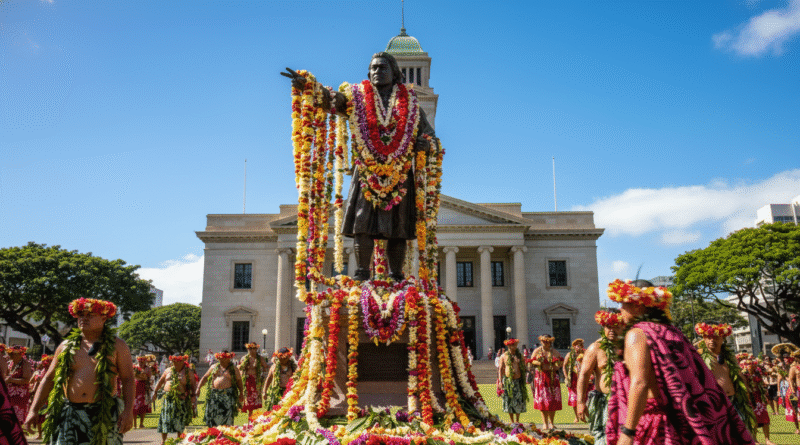
King Kamehameha Day 2026: Lei Draping, Floral Parade, and Ho’olaule’a Take Over Downtown and Kapiolani Park
Downtown Honolulu transforms into a vibrant celebration of Hawaiian culture today as King Kamehameha Day brings thousands together for one of Hawaii’s most cherished state holidays. The festivities begin at dawn with the traditional lei draping ceremony at the King Kamehameha statue fronting Aliiolani Hale, followed by the spectacular floral parade winding through the heart of the city to Kapiolani Park.
The iconic bronze statue of King Kamehameha I, draped in dozens of fragrant lei made from maile, pikake, and plumeria, serves as the ceremonial centerpiece for a day that honors Hawaii’s great unifier. Royal societies, cultural organizations, and community groups gather at 8 a.m. to participate in the solemn draping ceremony, a tradition that dates back to 1901.
“This day connects us to our past while celebrating the living culture that makes Hawaii unique,” said Kealani Nakamura, president of the Hawaiian Cultural Society of Oahu. “When you see those lei cascading down the statue, you’re witnessing more than decoration — you’re seeing the mana of our people expressed through flowers.”
The King Kamehameha Floral Parade kicks off at 9 a.m. from Iolani Palace, featuring elaborate floats adorned with thousands of tropical blooms. The procession travels down King Street, turns onto Kalakaua Avenue, and culminates at Kapiolani Park, where the day’s ho’olaule’a celebration unfolds.
A Moving Garden Through Honolulu
This year’s parade showcases more than 50 entries, including traditional pa’u riders representing each Hawaiian island, marching bands from local high schools, and community floats celebrating everything from hula halau to environmental conservation groups. The Royal Order of Kamehameha leads the procession, followed by descendants of Hawaiian royalty and cultural practitioners.
Spectators line the parade route from downtown to Waikiki, with prime viewing spots along King Street near the Hawaii State Capitol and along Kalakaua Avenue near the Honolulu Zoo. Many families arrive hours early with folding chairs and coolers, turning the event into an impromptu street party.
The parade’s signature element remains the pa’u riders — women dressed in traditional Hawaiian riding attire representing each island with distinctive colors and flowers. Oahu riders wear yellow and ilima, while Maui representatives don pink and lokelani, creating a moving rainbow of island pride.
Ho’olaule’a Celebrates Living Culture
Kapiolani Park transforms into a cultural village once the parade concludes, with the ho’olaule’a offering hands-on experiences in traditional Hawaiian arts and crafts. Visitors can learn lauhala weaving, try their hand at poi pounding, or watch master carvers demonstrate traditional woodworking techniques.
Multiple hula and music stages feature performances throughout the afternoon, showcasing everything from keiki (children’s) hula groups to renowned local musicians. Food vendors serve traditional Hawaiian plate lunches alongside contemporary local favorites, while craft booths offer authentic Hawaiian artwork and jewelry.
The celebration emphasizes education alongside entertainment, with cultural practitioners sharing stories about Kamehameha’s legacy and Hawaii’s path to statehood. Interactive exhibits explore pre-contact Hawaiian society, the monarchy period, and the cultural renaissance that began in the 1970s.
Beyond the Festivities
King Kamehameha Day holds particular significance as Hawaii’s only state holiday that predates statehood, established by the Kingdom of Hawaii in 1871. The holiday honors Kamehameha I, who unified the Hawaiian Islands through both warfare and diplomacy in the early 1800s, establishing the foundation for modern Hawaii.
The celebration occurs during Native Hawaiian History Month, part of a broader effort to increase awareness of Hawaiian culture and history. Many local businesses and schools use the holiday as an opportunity to discuss Hawaiian sovereignty, land rights, and cultural preservation.
For visitors, today’s events offer an authentic glimpse into Hawaii beyond tourist attractions. The festivities demonstrate the living nature of Hawaiian culture, showing how traditional practices continue to evolve and thrive in contemporary island life.
As the ho’olaule’a winds down this evening, organizers are already looking toward next year’s celebration. Plans include expanding educational components and increasing participation from neighbor island cultural groups, ensuring King Kamehameha Day remains a vital expression of Hawaiian pride and cultural continuity for future generations.