
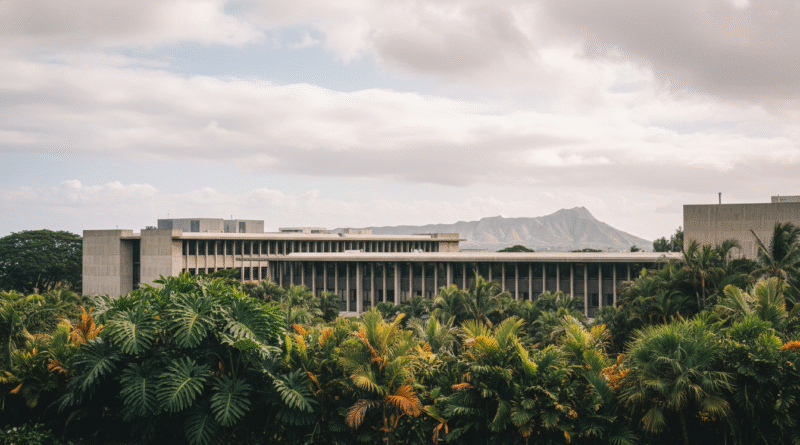
Hawaii State Hospital at 30% Over Capacity: Staff Fear for Safety as Union Weighs Grievance
The Hawaii State Hospital in Kaneohe is operating at 30% over its designed capacity, housing 387 patients in a facility built for just 300, creating dangerous conditions that have staff fearing for their safety and considering formal grievance action.
The overcrowding crisis at the state’s only public psychiatric facility has reached a breaking point, with workers reporting a surge in patient-on-staff assaults and increasingly volatile conditions. The Hawaii Government Employees Association is now weighing whether to file a formal grievance over unsafe working conditions.
“We’re seeing more incidents every week,” said Maria Santos, a psychiatric technician who has worked at the hospital for eight years. “When you pack that many people with serious mental health issues into spaces that weren’t designed for it, tensions run high and violence becomes almost inevitable.”
The Kaneohe facility, which sits on 150 acres in windward Oahu, was designed in the 1960s with careful consideration for patient flow and safety protocols. But decades of inadequate funding for community mental health programs has forced the hospital to become a catch-all for individuals who might otherwise receive treatment in less restrictive settings.
A Perfect Storm of Factors
Several factors have converged to create the current crisis. Hawaii’s chronic shortage of mental health professionals means fewer patients are being successfully transitioned to community-based care. Meanwhile, homelessness across Oahu has increased the number of individuals cycling through the criminal justice system who end up at the state hospital for competency evaluations.
The hospital’s outdated infrastructure compounds the problem. Patient rooms designed for single occupancy now regularly house two people, while common areas built for smaller populations become pressure cookers when filled beyond capacity.
Emergency department diversions from hospitals like Queen’s Medical Center and Kapiolani Medical Center have also increased the patient load, as individuals experiencing mental health crises are routed to the state facility when other options are unavailable.
Staff shortages make the situation even more precarious. The hospital is operating with roughly 75% of its optimal staffing levels, meaning fewer workers are available to de-escalate situations before they turn violent.
Safety Incidents on the Rise
Internal incident reports show a 40% increase in patient-on-staff assaults over the past 18 months. Workers describe being punched, kicked, and having objects thrown at them during routine care activities. Some have required emergency room treatment for their injuries.
The overcrowding also affects patient care quality. Psychiatrists report having less time for individual assessments, while group therapy sessions become unwieldy when packed with too many participants. Treatment plans that might normally lead to faster discharge are delayed, creating a vicious cycle that keeps beds occupied longer.
Union representatives say they’ve raised concerns with state administrators repeatedly, but meaningful changes haven’t materialized. The potential grievance would force the state to formally address working conditions and could lead to binding arbitration if negotiations fail.
Ripple Effects Across Oahu
The hospital’s capacity crisis extends far beyond its Kaneohe campus. When the state facility can’t accept new patients, individuals experiencing mental health emergencies often end up in jail cells or emergency rooms ill-equipped to provide appropriate care.
Honolulu Police Department officers report spending more time dealing with mental health-related calls because fewer treatment options are available. Emergency rooms at facilities like Pali Momi and Straub Medical Center are seeing longer stays for psychiatric patients awaiting transfer.
The situation also affects families across Oahu who are trying to get loved ones the help they need. Wait lists for admission have grown longer, and some families resort to costly private facilities on the mainland when local options aren’t available.
Looking for Solutions
State health officials acknowledge the overcrowding but say immediate solutions are limited. Plans for a new 144-bed facility have been discussed for years but remain unfunded. Meanwhile, efforts to expand community-based mental health services face their own challenges, including difficulty recruiting qualified staff to Hawaii’s expensive housing market.
Some advocacy groups are pushing for crisis intervention programs that could divert individuals from the hospital entirely, similar to successful models in Portland and San Antonio. These programs pair mental health professionals with police officers to respond to crisis calls.
For now, workers at the Hawaii State Hospital continue managing an impossible situation. The union’s potential grievance could force the state to confront a problem that affects not just hospital staff and patients, but the broader safety and wellbeing of communities across Oahu. Without significant intervention, experts warn the crisis will only deepen as Hawaii’s mental health needs continue to outpace available resources.
