
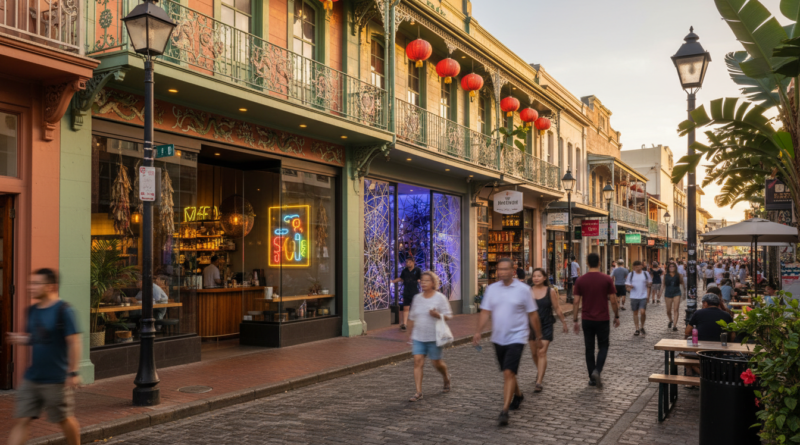
Chinatown’s Spring Revival: Six New Restaurants, a Cocktail Lounge, and a Co-Working Space Test Whether the Neighborhood’s Comeback Is Real
Eight new businesses are betting big on Chinatown’s potential this spring, with a wave of restaurant openings and the arrival of a national co-working brand marking what could be a pivotal moment for the historic district. The question facing Honolulu’s business community: Is this the inflection point Chinatown has been waiting for, or just another false start in a neighborhood that’s been struggling with vacancy and street-level challenges for over a decade?
The most visible sign of change sits in the restored Encore Saloon building on Hotel Street, where six new food concepts are preparing to open their doors. The century-old building, once home to a notorious dive bar, now houses everything from a Vietnamese pho shop to a modern bakery, representing a $2.3 million renovation that developers hope will anchor the neighborhood’s dining scene.
“We’re seeing entrepreneurs willing to take risks on Chinatown again,” said Lisa Chen, executive director of the Chinatown Business and Community Association. “These aren’t just pop-ups or temporary ventures — these are serious businesses making long-term commitments to the neighborhood.”
The new tenants in the Encore building include Saigon Street, a Vietnamese restaurant focusing on authentic pho and banh mi; Luna Bakehouse, specializing in artisanal pastries with local ingredients; and Midnight Ramen, offering late-night bowls for the area’s growing nightlife crowd. The building will also house a craft beer tap room, a traditional dim sum restaurant, and a Hawaiian-fusion concept.
Just blocks away, Pewa by Pono Potions has taken over the former Du Vin wine bar space on Bethel Street. The cocktail lounge represents a significant expansion for the locally-based spirits brand, known for its botanical-infused liqueurs made with native Hawaiian plants. The 3,000-square-foot space features a full bar program alongside retail sales of Pono Potions’ signature products.
Co-Working Giant Bets on Downtown Revival
Perhaps the most significant vote of confidence comes from WeWork competitor Spaces, which announced plans to open a 15,000-square-foot co-working facility on Hotel Street by summer. The Amsterdam-based company chose Chinatown over several Kakaako locations, citing the neighborhood’s “authentic character” and lower overhead costs.
The co-working space will occupy two floors of the historic Alexander Building, with capacity for 200 members. Spaces executives say they’re targeting freelancers, remote workers, and small startups who want downtown access without Kakaako price tags.
For longtime Chinatown advocates, the timing feels different than previous development waves. The neighborhood weathered significant challenges during the pandemic, with several long-standing businesses closing and foot traffic remaining below pre-2020 levels. But recent months have shown signs of sustained recovery, with rising pedestrian counts and increased interest from mainland investors.
However, the same issues that have plagued Chinatown for years remain. Homeless encampments still dot several blocks, parking remains scarce, and some property owners continue to struggle with vacancy rates. The success of these new businesses may depend on their ability to attract customers from across Honolulu, not just neighborhood residents.
Local Ingredients, Global Concepts
What sets this wave of openings apart is the focus on local sourcing and community connection. Luna Bakehouse plans to feature ingredients from Oahu farms, while Pewa emphasizes its Hawaiian botanical heritage. Even the Vietnamese and dim sum concepts have committed to incorporating local proteins and produce when possible.
“We’re not trying to replicate what works in other cities,” said Marcus Wong, one of the Encore building’s developers. “These businesses understand they need to serve the local community first, then build from there.”
The economic impact could extend beyond individual restaurants. Commercial real estate brokers report increased interest in Chinatown properties, with asking rents rising modestly for the first time since 2019. Several other buildings are reportedly in negotiations with potential restaurant and retail tenants.
For Honolulu residents, these openings represent more than just new dining options. They signal whether Chinatown can finally overcome its reputation for false starts and establish itself as a sustainable entertainment and business district. The neighborhood’s proximity to downtown offices, harbor activities, and public transit makes it theoretically ideal for such a role.
The real test will come in the next 12 months, as these new businesses navigate their crucial first year. Success could trigger additional investment and development, while failures might reinforce longstanding perceptions about Chinatown’s viability as a commercial district. Either way, spring 2026 is shaping up as a defining moment for one of Honolulu’s most storied neighborhoods.