
UH Researchers Win National Award for Envisioning a Flood-Ready Waikiki
A University of Hawaii research team has earned national recognition for their visionary work reimagining how Waikiki could adapt to rising seas and increasingly severe flooding. The interdisciplinary group won the Outstanding Research Award at the ARCC-EAAE International Architecture Conference for their comprehensive study visualizing a flood-resilient future for Hawaii’s most famous neighborhood.
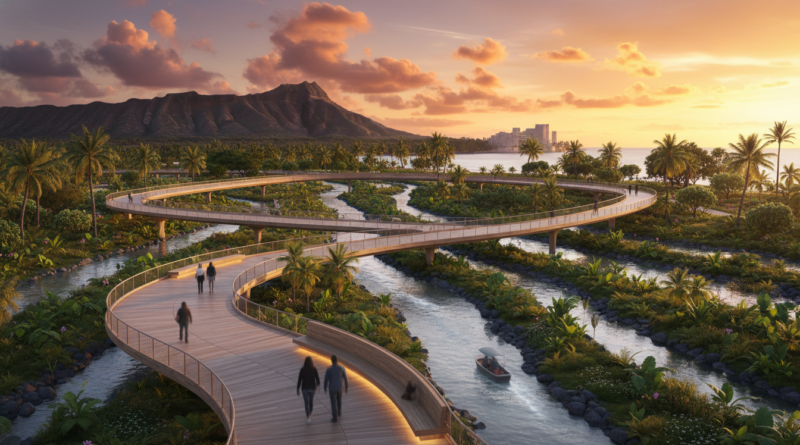
The award-winning project, led by researchers from UH’s School of Architecture and College of Engineering, presents detailed renderings and proposals for transforming Waikiki’s built environment to work with water rather than against it. Their vision includes elevated pedestrian walkways connecting hotels and shopping centers, permeable street surfaces that allow floodwater to drain naturally, and redesigned public spaces that can temporarily hold stormwater during heavy rains.
“We’re not talking about building seawalls or trying to keep water out,” said Dr. Marina Kaholokula, the project’s lead researcher and associate professor of architecture at UH Manoa. “Instead, we’re designing spaces that can function beautifully whether they’re dry or flooded.”
Floating Boardwalks and Living Shorelines
The team’s renderings show a dramatically different Waikiki, where floating boardwalks replace rigid sidewalks near the beach and buildings are designed with flood-resistant ground floors. Traditional concrete surfaces give way to permeable materials that allow water to filter through rather than pooling on streets.
One striking proposal involves transforming sections of Kalakaua Avenue into a “blue-green corridor” — a landscaped waterway that normally serves as an attractive pedestrian promenade but can channel floodwater safely toward the ocean during storm events. The design incorporates native Hawaiian plants that thrive in both wet and dry conditions.
The research also envisions modified hotel and retail spaces with adaptable ground floors that can be temporarily flooded without damage. These spaces would feature materials and electrical systems designed to handle periodic inundation, allowing businesses to reopen quickly after flood events.
Beyond Emergency Response
What sets this work apart from typical flood mitigation studies is its focus on creating spaces that enhance daily life in Waikiki, not just protect against disasters. The proposed elevated walkways would offer new vantage points for viewing the ocean and mountains, while redesigned parks could provide both recreation space and stormwater management.
The team spent two years studying flood patterns in Waikiki, analyzing everything from king tide frequencies to the neighborhood’s aging storm drain system. They found that current infrastructure, much of it built when sea levels were lower, increasingly fails during even moderate rain events combined with high tides.
“Waikiki already floods regularly — visitors and residents see it during king tides and summer storms,” Kaholokula noted. “Our approach accepts that reality and designs for it.”
Implementation Challenges
While the research offers compelling visions, translating these ideas into reality faces significant hurdles. The proposed changes would require coordination among dozens of property owners, from major hotel chains to small businesses along Kalakaua Avenue.
Funding represents another major challenge. The researchers estimate that comprehensive flood adaptation for Waikiki could cost hundreds of millions of dollars, though they argue this investment would be far less expensive than repeatedly repairing flood damage or losing tourism revenue to closed businesses.
The team is now working with city planners and the Hawaii Tourism Authority to identify pilot projects that could demonstrate flood-adaptive design principles on a smaller scale. Possible starting points include redesigning sections of the Ala Wai Canal pathway and creating demonstration gardens that showcase flood-tolerant landscaping techniques.
A Model for Island Communities
The international recognition reflects growing interest in the Hawaii team’s approach beyond just Waikiki. Island and coastal communities worldwide face similar challenges from rising seas and changing precipitation patterns.
The ARCC-EAAE conference, which brings together architecture and environmental researchers from around the globe, selected the UH project from more than 200 submissions. Judges praised the work for its integration of cultural sensitivity, environmental science, and practical design solutions.
For Honolulu residents, the research offers both hope and a reality check about climate adaptation. While comprehensive transformation of Waikiki remains years away, the project demonstrates that thoughtful design can help communities thrive even as environmental conditions change.
The next phase of research will focus on developing economic models for funding flood adaptation and creating detailed implementation timelines. The team expects to release preliminary recommendations for pilot projects by early next year, potentially setting the stage for the first flood-adaptive infrastructure improvements in Waikiki by 2028.