
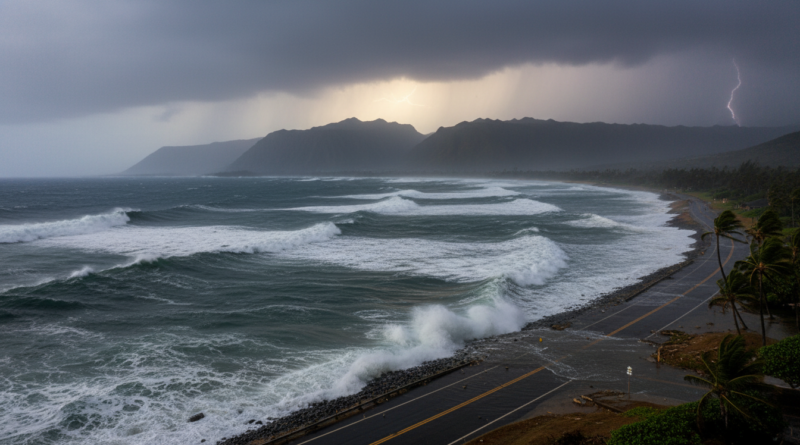
Council Blasts City Emergency Managers Over Slow Evacuation Orders During North Shore Kona Low Flooding
Honolulu City Council members delivered sharp criticism to the city’s emergency management team Wednesday, accusing officials of dangerously slow response times during last week’s devastating Kona low storm that flooded several North Shore communities.
The contentious hearing focused on what council members described as a nearly three-hour delay between the first flash flood warnings and mandatory evacuation orders for areas including Haleiwa, Waialua, and parts of Wahiawa that experienced record-breaking rainfall.
Emergency Management Director Sarah Nakamura faced pointed questions about communication breakdowns that left residents scrambling for information as floodwaters rose rapidly throughout the region. The April 3 storm dumped more than 14 inches of rain in six hours across parts of the North Shore, causing the Anahulu River to crest at historic levels.
“We had families trapped in their homes for hours while our emergency management team was still ‘assessing the situation,'” said Councilwoman Lisa Chang, whose District 2 includes much of the affected area. “This is exactly the kind of life-threatening delay we cannot afford in Hawaii’s unpredictable weather patterns.”
Timeline Under Scrutiny
According to city records, the National Weather Service issued the first flash flood warning at 2:15 p.m. on April 3, but mandatory evacuation orders for the hardest-hit areas weren’t issued until 5:45 p.m. During that window, several North Shore neighborhoods saw water levels rise to dangerous heights, particularly along Kamehameha Highway near Haleiwa Beach Park.
Nakamura defended the response timeline, arguing that officials needed time to coordinate with state agencies and verify ground conditions before ordering evacuations. She noted that voluntary evacuation advisories were issued earlier in the afternoon.
“We don’t take evacuation orders lightly,” Nakamura told the council. “These decisions affect thousands of residents, and we need accurate information to make the right call.”
But council members weren’t satisfied with that explanation, pointing to social media posts from North Shore residents who documented rapidly rising waters hours before official evacuation notices reached their phones.
Communication Breakdown
Beyond timing concerns, several council members criticized the city’s emergency alert system for sending confusing messages that failed to specify which neighborhoods faced immediate danger. Some residents in Pupukea reported receiving generic flood warnings that didn’t indicate whether they should evacuate or shelter in place.
The criticism comes as the North Shore continues recovering from the storm’s aftermath. Kamehameha Highway remains partially closed near Waimea, and several families are still displaced from flood-damaged homes in Waialua.
Council Chair Tommy Waters called for a comprehensive review of the city’s emergency protocols, specifically questioning whether the current warning system adequately serves Oahu’s diverse geography and microclimates.
“The North Shore isn’t downtown Honolulu,” Waters said. “We need emergency procedures that recognize the unique challenges of our rural communities, where evacuation routes are limited and cell service can be spotty.”
Calls for Reform
Local advocacy groups have seized on the council hearing to push for broader emergency management reforms. The North Shore Community Coalition submitted a formal petition calling for dedicated weather monitoring stations in vulnerable areas and improved coordination with neighborhood board chairs who often have better real-time information about local conditions.
“Our kupuna and families shouldn’t have to rely on Facebook posts to know when it’s time to evacuate,” said coalition president David Keoni, whose Haleiwa home sustained significant flood damage. “The city needs systems that work at island speed, not bureaucratic speed.”
The criticism also extends to the city’s public communication strategy. Several residents noted that emergency alerts were only sent in English, despite the North Shore’s significant Filipino and Pacific Islander populations.
Next Steps
Mayor Rick Blangiardi’s administration has promised a full after-action review of the storm response, with results expected within 60 days. The study will examine everything from evacuation procedures to the effectiveness of the city’s emergency alert system.
For North Shore residents still dealing with flood cleanup and displaced families, the council’s scrutiny offers some hope for improved disaster preparedness. But the real test will come when the next severe weather system threatens Oahu’s vulnerable coastal communities.
The council is scheduled to receive a preliminary report on emergency management reforms at its May 15 meeting. Meanwhile, the National Weather Service continues monitoring weather patterns that could bring additional heavy rainfall to Hawaii through the end of April.