Skyline Rail Columns Rising in Iwilei as Segment 3 Construction Reshapes Downtown Honolulu
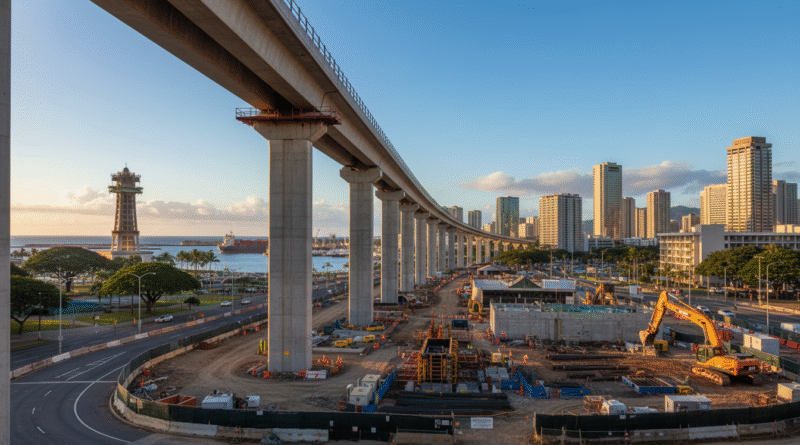
Massive concrete columns are steadily rising along Nimitz Highway and Kaʻaahi Street as the Honolulu Authority for Rapid Transportation pushes forward with Segment 3 of the rail project, bringing the skyline closer to downtown Honolulu with each passing week.
The above-ground guideway construction marks a visible milestone for the long-awaited rail line, with crews working to install the elevated structure that will eventually carry trains from Iwilei through downtown to Ala Moana Center. The concrete pillars, some reaching heights of 40 feet, are transforming the industrial landscape of Iwilei into the foundation for Oʻahu’s first mass transit system.
“We’re seeing real progress on the ground now,” said James Jimenez, a Kalihi resident who commutes daily through the construction zone. “It’s been a long road, but you can finally visualize what this thing is going to look like when it’s done.”
HART continues targeting a 2031 completion date for Segment 3, which will add four stations from Iwilei to Ala Moana. The segment includes stops at Iwilei, downtown Honolulu’s Civic Center, Kakaʻako, and the Ala Moana Center — connecting the existing West Oʻahu line to the island’s primary shopping and employment hub.
Construction crews are simultaneously working on multiple fronts across the segment. Beyond the visible column installation in Iwilei, teams are advancing tunnel boring operations beneath downtown Honolulu and preparing station sites at key locations including the area near Honolulu Hale and the planned Kakaʻako station.
New Authority for Route Extensions
While Segment 3 construction continues, HART received expanded authority last month when the Honolulu City Council passed Bill 60, allowing the agency to study potential rail extensions beyond the current planned route.
The legislation specifically permits HART to explore extending the rail line west to Kapolei and east through the University of Hawaii at Mānoa. Both extensions have generated significant community interest, particularly the Kapolei route which would serve the rapidly growing second city and provide connections to resort areas.
The Mānoa extension could potentially serve university students, faculty, and residents in the valley, though significant engineering challenges would need to be addressed given the area’s topography and existing infrastructure.
HART officials emphasize that Bill 60 only authorizes studies, not actual construction. Any extensions would require separate funding approval and environmental review processes that could take years to complete.
Summer Road Impacts
Commuters should prepare for increased traffic disruptions this summer as construction accelerates along the downtown corridor. HART has scheduled several weekend closures of Nimitz Highway lanes to accommodate crane operations and column installations.
The most significant impacts will occur along the Nimitz Highway stretch between Iwilei Road and Ala Moana Boulevard, where crews are installing both columns and connecting beam segments. Drivers can expect periodic lane closures, particularly during overnight and weekend hours when heavy equipment moves through the work zones.
Construction activity will also affect local streets in Iwilei and Kakaʻako as utility relocations continue. Kaʻaahi Street has experienced intermittent closures, and similar disruptions are planned for portions of Queen Street and other downtown arteries.
HART recommends commuters consider alternate routes during peak construction periods and stay updated through the agency’s website and social media channels, which provide real-time construction notifications.
Economic Development Implications
The visible progress on Segment 3 is already influencing development patterns across the corridor. Property owners and developers in Kakaʻako continue advancing high-density residential and commercial projects designed to capitalize on future rail connectivity.
The Iwilei area, long dominated by industrial uses, is seeing increased interest from mixed-use developers who view the rail connection as a catalyst for neighborhood transformation. Several major projects are in planning phases that would bring thousands of residential units and retail spaces to the area surrounding the future Iwilei station.
Downtown property owners are similarly positioning for increased foot traffic and development opportunities once the rail line provides direct connections between the urban core and West Oʻahu communities.
For Honolulu residents, the advancing construction represents both short-term inconvenience and long-term transportation relief. The 2031 completion target for Segment 3 would finally provide the island’s first comprehensive alternative to automobile travel between major employment and residential centers.
Success of the current segment will likely influence public support for the potential extensions to Kapolei and Mānoa, making the next few years of construction progress crucial for the rail project’s ultimate scope and impact on Oʻahu’s transportation future.
