Council Considers Transit-Oriented Development Measure to Reshape Neighborhoods Near Skyline Stations
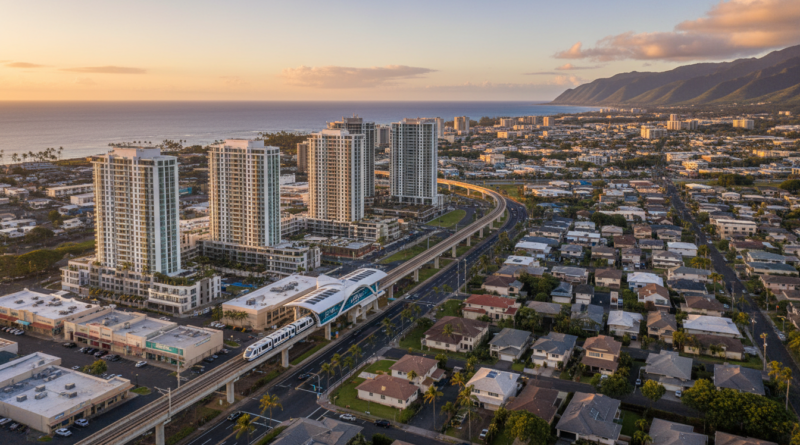
The Honolulu City Council is weighing a comprehensive measure that could dramatically transform neighborhoods surrounding Skyline rail stations, potentially ushering in a new era of high-density development from West Oahu to the urban core.
The proposed transit-oriented development (TOD) ordinance would establish special zoning districts within a half-mile radius of each Skyline station, allowing for increased building heights and density while requiring developers to incorporate affordable housing components and pedestrian-friendly design elements.
Under the current proposal, areas near stations in Kapolei, Pearl City, and Kalihi-Palama could see buildings rise to 12 stories, while zones closer to downtown Honolulu and the upcoming Aloha Stadium station might accommodate structures reaching 20 stories or more. The measure represents the city’s most ambitious attempt yet to capitalize on the $10 billion rail investment.
Reshaping West Oahu’s Future
The changes would be particularly dramatic in West Oahu, where much of the development has historically consisted of single-family homes and low-rise commercial buildings. Communities like Waipahu, Pearl City, and Kapolei could see their skylines fundamentally altered as developers take advantage of the new zoning allowances.
“We’re looking at creating complete communities where people can live, work, and play without having to drive everywhere,” said Councilmember Andrea Tupola, who represents much of the affected West Oahu corridor. “The rail line gives us this once-in-a-generation opportunity to build the kind of walkable neighborhoods that reduce traffic and provide more housing options.”
The measure includes requirements that new developments within TOD zones dedicate at least 20% of residential units to affordable housing, addressing concerns that increased density could accelerate gentrification and displacement of longtime residents.
Downtown and Urban Core Implications
While West Oahu would see the most dramatic changes in character, the measure also affects established urban neighborhoods like Kalihi-Palama and areas near the planned Aloha Stadium station. These zones already feature higher-density development but could accommodate even taller structures under the new rules.
The Aloha Stadium area, in particular, represents a significant opportunity for redevelopment as the aging facility undergoes reconstruction. The TOD designation could facilitate mixed-use developments that combine residential, retail, and office space, potentially creating a new urban center in the Salt Lake-Moanalua corridor.
Current zoning in many of these areas limits buildings to six or eight stories, but the TOD measure would allow structures up to 20 stories in some locations, provided they meet specific design standards and community benefit requirements.
Design Standards and Community Concerns
The proposed ordinance includes detailed design guidelines aimed at ensuring new development enhances rather than overwhelms existing neighborhoods. Requirements include ground-floor retail space, bicycle parking, and public gathering areas.
Buildings would need to incorporate “tropical architecture” elements and provide transitions between high-density development and adjacent single-family neighborhoods through stepped building heights and landscaping buffers.
However, community groups in several affected areas have expressed concerns about infrastructure capacity, parking availability, and potential impacts on neighborhood character. Some residents worry that rapid development could strain already overtaxed water and sewer systems, particularly in West Oahu.
Economic Development Catalyst
Supporters argue the TOD zones could generate significant economic activity and provide housing options for the estimated 100,000 people who will live and work within walking distance of rail stations once the system is fully operational.
The measure also includes provisions for expedited permitting within TOD zones, potentially reducing development timelines from years to months for projects that meet specific criteria.
Commercial developers have already begun purchasing properties near several stations in anticipation of the zoning changes, with land values increasing substantially in areas like Kapolei and Pearl City over the past two years.
Next Steps and Timeline
The City Council is expected to hold public hearings on the TOD measure throughout May, with committee votes likely in June. If approved, the new zoning designations could take effect by late 2026, coinciding with the planned opening of additional Skyline stations.
The timing aligns with the city’s broader efforts to address Oahu’s housing shortage while maximizing the rail system’s potential to reduce traffic congestion and create more sustainable development patterns.
For Honolulu residents, the measure represents a pivotal moment in the city’s evolution, potentially determining whether the rail investment catalyzes the kind of compact, walkable communities that planners have long envisioned, or simply enables more sprawling development with higher buildings.
