
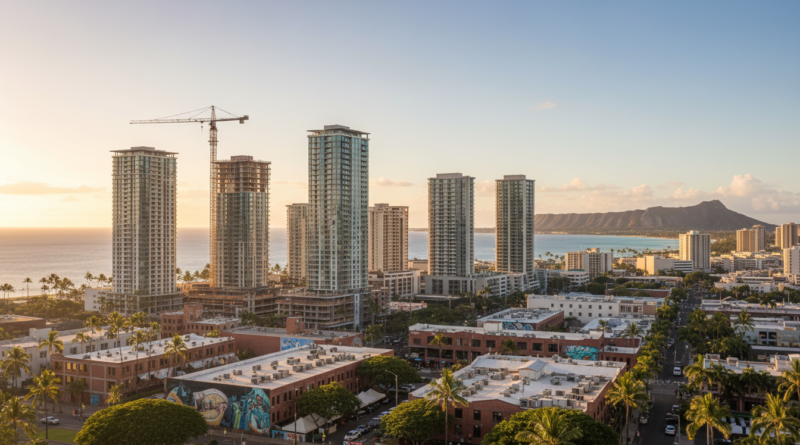
Kakaako’s Kahuina Project Set to Break Ground: 861 Homes, 60% Affordable Housing
Stanford Carr Development’s ambitious Kahuina project in Kakaako is poised to become a defining test case for affordable housing in Honolulu’s most rapidly transforming neighborhood. The 861-unit development, part of Kamehameha Schools’ master-planned community, promises to deliver 60% workforce and affordable housing alongside market-rate units when groundbreaking begins in 2026.
Located on what’s known as Block C in the Our Kakaako master plan, Kahuina represents one of the largest mixed-income developments to emerge from the neighborhood’s ongoing transformation. The project will span multiple towers and include 42,000 square feet of commercial space, creating a vertical community that developers hope will serve as a model for inclusive development in urban Honolulu.
“This project represents exactly the kind of mixed-income community we envisioned when we began planning Our Kakaako,” said Kamehameha Schools’ community development team in materials outlining the project scope. “Kahuina will provide housing options for teachers, firefighters, nurses, and other essential workers who keep our community running.”
Mixed-Income Challenge
The project’s 60% affordable and workforce housing commitment puts it at the forefront of a critical debate about Kakaako’s future character. As luxury condominiums have dominated much of the neighborhood’s recent development, longtime residents and housing advocates have expressed concerns about displacement and gentrification.
Kahuina’s affordable units will target households earning between 80% and 120% of Area Median Income, with workforce housing designed for essential workers like teachers, police officers, and healthcare professionals. Market-rate units will comprise the remaining 40% of the development.
The project sits within walking distance of the Keeaumoku-Kapiʻolani transit station, part of the Honolulu rail system expected to connect Kakaako to downtown Honolulu and eventually to Ala Moana Center. This transit connectivity is seen as crucial for making the affordable units genuinely accessible to working families.
Commercial Component
Beyond residential units, Kahuina’s commercial space is planned to include ground-floor retail, restaurants, and potentially office space that could serve the growing number of residents in the immediate area. The commercial component reflects lessons learned from earlier Kakaako developments, where the lack of neighborhood-serving businesses left residents traveling to other parts of the city for basic needs.
The project’s design will need to navigate Kakaako’s evolving building height and density regulations, which have been adjusted several times as the neighborhood has developed. Current zoning allows for significant vertical development, but community input has consistently emphasized the importance of creating pedestrian-friendly streetscapes and public spaces.
Infrastructure Readiness
One key advantage for Kahuina is its location within an area where much of the necessary infrastructure work has already been completed or is underway. The neighborhood has seen significant investment in new roads, utilities, and public spaces as part of the broader Our Kakaako development.
However, the project will still need to coordinate with ongoing construction of the rail system and manage the logistical challenges of building in an increasingly dense urban environment. Construction traffic and temporary disruptions are expected to be significant considerations for existing residents and businesses in the area.
Market Timing
The 2026 groundbreaking timeline positions Kahuina to enter the market as Honolulu’s housing shortage remains acute. Recent data shows the city needs thousands of additional housing units to meet demand, with workforce and affordable housing representing the most critical gaps.
Stanford Carr Development has experience with mixed-income projects in urban Honolulu, though Kahuina represents their largest undertaking in Kakaako to date. The developer will need to navigate construction cost pressures that have challenged other affordable housing projects statewide.
For Honolulu residents, Kahuina represents both promise and proof of concept. If successful, it could demonstrate that large-scale mixed-income development is viable in the city’s most expensive neighborhoods. If it struggles to maintain affordability or creates community conflicts, it could influence how future Kakaako projects approach the balance between market-rate and affordable housing.
The project’s progress will be closely watched by housing advocates, city planners, and other developers as Honolulu continues grappling with its housing crisis while trying to preserve community character in rapidly changing neighborhoods.