
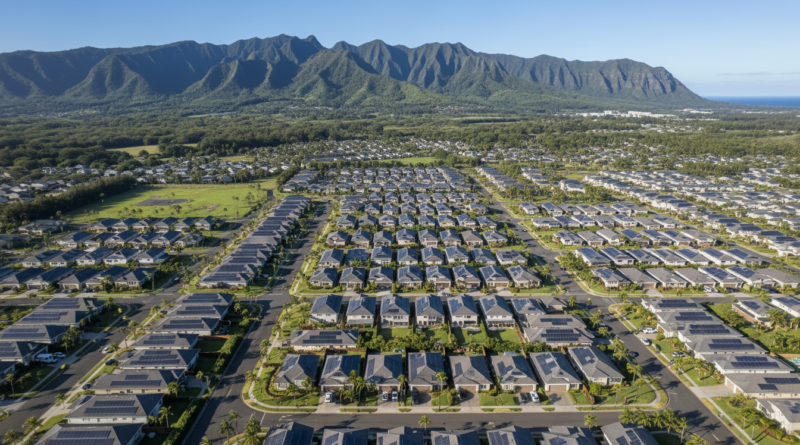
Solar-Powered Net-Zero Community Planned for Former Dole Plantation Land
A massive solar-powered residential development is set to transform 600 acres of former Dole plantation land in Central Oahu, promising to become one of Hawaii’s first net-zero energy communities when completed in 2028.
Kapalama Holdings announced plans Tuesday for the $2.8 billion “Pineapple Commons” project, which will feature 4,200 homes ranging from affordable housing units to luxury estates, all powered entirely by renewable energy. The development will be located on agricultural land near Wahiawa, between the existing Mililani and Wheeler Army Airfield.
The ambitious project represents a significant shift for land that once produced thousands of tons of pineapples annually under Dole Food Company’s operations, which ceased in the area in 2008. Since then, the property has remained largely undeveloped, serving as a reminder of Hawaii’s agricultural past while presenting opportunities for sustainable future growth.
Renewable Energy at the Core
The development’s centerpiece will be a 150-megawatt solar farm integrated throughout the community, coupled with battery storage systems capable of powering all residences even during extended periods without sunshine. Each home will also feature rooftop solar panels and energy-efficient appliances designed to minimize overall consumption.
“This isn’t just about building houses – we’re creating a model for how Hawaii can achieve true energy independence at the community level,” said Maria Santos, Kapalama Holdings’ director of sustainable development. “Every kilowatt-hour consumed will be generated on-site through clean, renewable sources.”
The project aligns with Hawaii’s mandate to achieve 100% renewable electricity by 2045, positioning the state as a leader in clean energy transition. Currently, Hawaii relies on imported fossil fuels for approximately 70% of its energy needs, making electricity costs among the highest in the nation.
Addressing the Housing Crisis
Thirty percent of the planned units will be designated as affordable housing, with prices starting around $450,000 for one-bedroom condominiums. The remaining homes will range from $650,000 townhomes to $2.2 million single-family estates, all featuring smart home technology and sustainable building materials.
The development comes as Oahu faces a severe housing shortage, with median home prices exceeding $900,000 and many local families priced out of homeownership. Honolulu County estimates it needs approximately 50,000 additional housing units over the next decade to meet demand.
The project will be developed in four phases over seven years, with the first 800 units expected to break ground in late 2025. Infrastructure work, including roads, utilities, and the solar installation, will begin next spring pending final environmental approvals.
Community Features and Economic Impact
Beyond residential units, Pineapple Commons will include a town center with retail spaces, restaurants, and offices, plus two schools, medical facilities, and recreational areas. Developers plan to preserve 120 acres as open space, including trails connecting to existing hiking paths in the nearby Koolau Mountains.
The project is expected to create approximately 8,000 construction jobs and 2,500 permanent positions once completed. Local contractors and suppliers will be prioritized, with requirements that 30% of construction workers be Hawaii residents.
However, the development faces potential challenges from environmental groups concerned about agricultural land conversion and traffic impacts on already-congested highways. The H-2 freeway, which provides the primary access route to Honolulu, already experiences significant congestion during peak hours.
Regulatory Hurdles Ahead
The project requires approval from the Honolulu City Council and state Land Use Commission, processes that typically take 18-24 months. Developers must also complete environmental impact studies addressing concerns about groundwater usage, native species habitat, and cultural sites.
Archaeological surveys have identified several areas of potential cultural significance, including stone walls and terraces that may date to pre-contact Hawaiian settlements. The development team is working with Native Hawaiian cultural practitioners to ensure appropriate preservation and access.
Transportation improvements are also being negotiated, including potential contributions to H-2 widening projects and enhanced public transit connections to existing TheBus routes.
Setting a Precedent
If successful, Pineapple Commons could serve as a blueprint for future large-scale sustainable developments across Hawaii and other island communities worldwide. The project’s emphasis on energy independence, affordable housing, and environmental stewardship reflects growing recognition that traditional development models are unsustainable in Hawaii’s unique environment.
For Honolulu residents, the development represents both opportunity and uncertainty – potential relief for the housing crisis and advancement toward renewable energy goals, balanced against concerns about growth management and preserving the island’s character. The next two years of planning and approval processes will largely determine whether this vision becomes reality.