
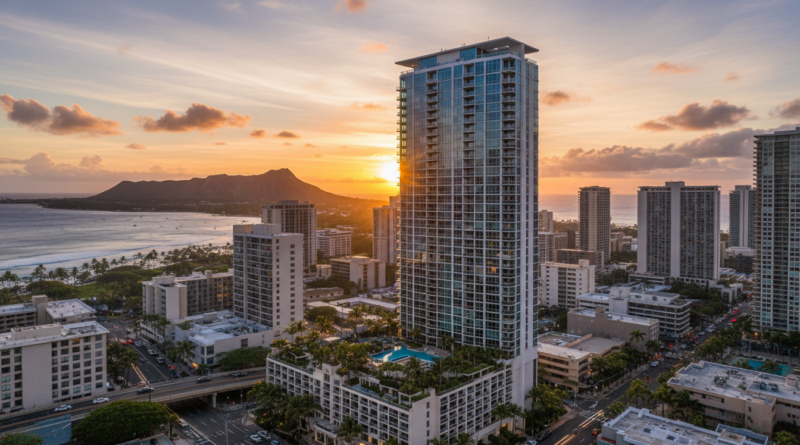
New Micro-Unit Apartments Target Young Professionals in Downtown Honolulu
A new residential development targeting young professionals is set to transform a corner of downtown Honolulu with micro-unit apartments designed specifically for the island’s tight housing market. The 12-story building at 1247 South Beretania Street will feature 180 studio and one-bedroom units averaging 350 square feet, with monthly rents starting at $1,800.
Developer Pacific Urban Residential broke ground last month on what they’re calling “The Hive,” a project that aims to address Honolulu’s chronic housing shortage by maximizing efficiency in a small footprint. The building sits just two blocks from the Blaisdell Center and within walking distance of Ward Village’s shopping and dining scene.
“We’re seeing tremendous demand from young professionals who want to live in town but can’t afford the typical one-bedroom apartment that runs $2,500 to $3,000,” said Maria Santos, Pacific Urban’s development director. “These units give people a chance to live independently in the urban core without breaking the bank.”
The micro-units will range from 280 to 450 square feet, with most featuring murphy beds, built-in storage solutions, and compact kitchens with full-size appliances. Each unit includes high-speed internet and access to shared amenities like a rooftop garden, fitness center, and co-working spaces on the ground floor.
Addressing Honolulu’s Housing Crunch
The project comes as Honolulu grapples with some of the nation’s highest housing costs relative to income. The median rent for a one-bedroom apartment in urban Honolulu hit $2,400 last quarter, according to data from Apartment List, while the median household income for residents under 35 remains around $65,000.
City planning officials have increasingly embraced micro-unit developments as one tool to address the affordability crisis. The Honolulu City Council updated zoning codes in 2022 to allow smaller minimum unit sizes in transit-oriented development areas, paving the way for projects like The Hive.
“We need creative solutions that match how people actually live and work today,” said Councilmember Carol Fukunaga, who represents the downtown district. “Young professionals often prioritize location and amenities over square footage, especially when they’re spending most of their time outside the unit anyway.”
The building’s target demographic includes recent college graduates, young healthcare workers at nearby Queen’s Medical Center, and professionals working in downtown’s government and business district. Pre-leasing begins in March 2024, with the first residents expected to move in by summer.
Mixed Community Response
Not everyone welcomes the micro-unit trend. Some housing advocates worry these developments could normalize substandard living conditions while developers profit from high per-square-foot rents. The Hive’s units will rent for roughly $5.14 per square foot, compared to $3.20 per square foot for traditional one-bedroom apartments nearby.
Long-time Kakaako resident James Nakamura expressed concerns about the building’s impact on the neighborhood’s character. “I understand we need more housing, but cramming people into these tiny boxes doesn’t feel like a sustainable solution,” he said. “What happens to families, or people who want to put down roots here?”
Pacific Urban counters that the development includes bike storage, car-sharing partnerships, and proximity to public transit to reduce residents’ overall living costs. The building sits one block from a planned rail station and offers discounted bus passes through a partnership with TheBus.
The developer plans to reserve 20% of units for residents earning 80% of area median income, meeting the city’s affordable housing requirements. Those units will rent for $1,440 monthly, still a significant portion of qualifying residents’ income.
Urban Living Evolution
The Hive represents a broader shift in how Honolulu approaches urban density. Similar micro-unit projects are planned for Kalihi and Pearl City, while established neighborhoods like Chinatown and Kaimuki are seeing increased interest from developers seeking to build smaller, more affordable units.
The success of The Hive could influence future residential development across Oahu, particularly as the rail system comes online and creates new transit-oriented opportunities. For young professionals priced out of traditional rentals, these micro-units offer a potential pathway to independent living in one of America’s most expensive housing markets.
Whether this model provides a genuine solution to Honolulu’s housing crisis or simply creates a new tier of expensive small-space living will become clearer as residents begin moving in next year. The experiment reflects the island’s ongoing struggle to balance housing costs, quality of life, and sustainable growth in a constrained geographic space.
