
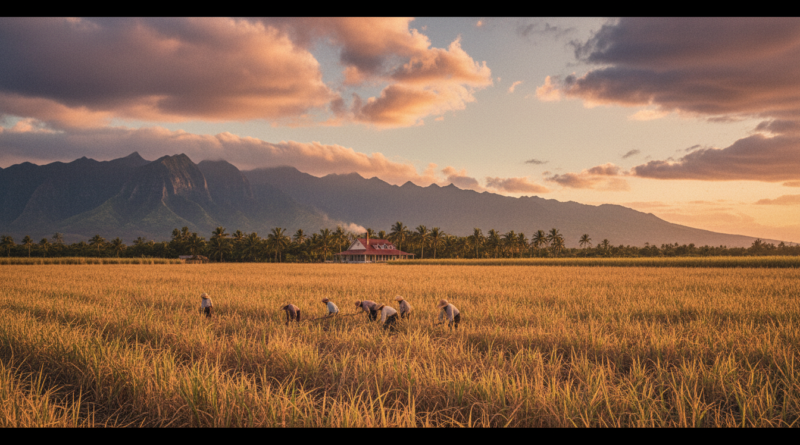
Local Theater Company Stages World Premiere of Play About Plantation-Era Hawaii
Kumu Kahua Theatre is bringing an untold chapter of Hawaii’s plantation era to life with the world premiere of “Fields of Gold,” a powerful new drama that explores the complex relationships between Native Hawaiian, Portuguese, and Filipino laborers in early 20th century Oahu.
The production, which opens Friday at the theater’s intimate46-seat venue in downtown Honolulu, marks playwright Keoni Alvarez’s first full-length work to receive professional staging. Set in 1920 on a sugar plantation in what is now Waipahu, the play examines how different immigrant communities navigated survival, identity, and solidarity under the demanding conditions of plantation life.
“This isn’t just another plantation story,” said Alvarez, whose great-grandfather worked the cane fields of central Oahu. “It’s about the humanity that persisted despite a system designed to divide people by ethnicity and keep them competing for scraps.”
The story follows three families from different cultural backgrounds who find their lives intertwined when a labor strike threatens to shut down the plantation. Through intimate scenes set in company housing and the fields themselves, audiences witness both the tensions and unexpected alliances that formed between communities often pitted against each other by plantation managers.
A Story Rooted in Family History
Alvarez spent three years researching the play, drawing from oral histories collected by the University of Hawaii’s Center for Oral History as well as his own family’s stories. His great-grandfather, Manuel Alvarez, arrived from the Azores in 1918 and worked on multiple plantations before eventually opening a small store in Kalihi.
“The more I learned about that era, the more I realized how little most people understand about the day-to-day reality,” Alvarez explained. “We know the broad strokes — different groups came to work sugar — but the personal relationships, the small acts of resistance, the ways people created joy and community despite everything? That’s what I wanted to capture.”
Director Sarah Kim-Chen, known for her work with Honolulu Theatre for Youth, said the script resonated immediately with the theater’s mission to tell local stories. Kumu Kahua has been showcasing Hawaii-focused productions for nearly five decades, making it the natural home for “Fields of Gold.”
“Keoni has written something that feels both historically grounded and completely relevant to conversations happening in our community today,” Kim-Chen said. “Questions about belonging, about who gets to call Hawaii home, about how we bridge cultural differences — these themes echo from 1920 to 2024.”
Bringing Authenticity to the Stage
The production features a cast of eight local actors, including veteran performer Kalani Queypo as Portuguese luna João Silva and newcomer Maria Santos as Filipino field worker Elena Bautista. The set design incorporates actual artifacts from plantation-era Hawaii, on loan from the Japanese Cultural Center of Hawaii and the Portuguese Genealogical and Historical Society.
Costume designer Rachel Nakamura worked with cultural consultants from each represented community to ensure authentic period dress while avoiding stereotypical representations. The soundscape includes traditional songs and work chants from Filipino, Portuguese, and Native Hawaiian traditions, woven together by composer David Farmer.
“Every detail matters when you’re telling a story this close to home,” Kim-Chen noted. “We have audience members whose grandparents lived through this era. The responsibility to get it right is huge.”
Beyond Entertainment
Kumu Kahua is partnering with the Japanese Cultural Center of Hawaii and the Center for Filipino Studies at UH Manoa to offer post-show discussions and educational workshops throughout the run. These sessions will explore how plantation-era dynamics continue to influence contemporary Hawaii society.
The theater is also working with local high schools to bring student groups to matinee performances, part of an ongoing effort to connect younger generations with their complex cultural inheritance.
“Fields of Gold” runs through March 15, with performances Thursday through Sunday at Kumu Kahua Theatre on Merchant Street. Tickets are $20 for general admission, $16 for students and seniors.
For a community still grappling with issues of affordability, cultural preservation, and belonging, Alvarez’s play offers both historical perspective and contemporary insight. In an era when Hawaii’s stories are too often told by outsiders, “Fields of Gold” represents the power of local voices reclaiming their own narratives — one authentic story at a time.