
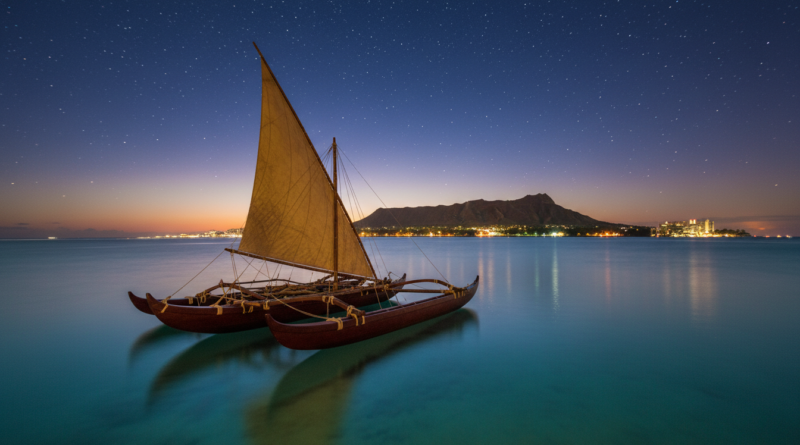
Bishop Museum Opens Groundbreaking Exhibition on Ancient Hawaiian Navigation
The Bishop Museum has unveiled its most ambitious exhibition in years, diving deep into the sophisticated wayfinding techniques that allowed ancient Polynesian navigators to traverse thousands of miles of open ocean to reach Hawaii.
“Navigating by Stars: The Science and Spirit of Polynesian Wayfinding” opened Saturday in the museum’s Hawaiian Hall, transforming the iconic Kalihi-Palama institution into an immersive journey through one of humanity’s most remarkable maritime achievements.
The exhibition features a full-scale replica of a traditional double-hulled sailing canoe, or wa’a kaulua, positioned at the center of the main gallery. Visitors can step aboard to experience the cramped conditions navigators endured during voyages that could last weeks or months.
Interactive displays demonstrate how ancient Polynesian sailors read ocean swells, wind patterns, and celestial movements to navigate without instruments. A centerpiece installation projects a real-time star map onto the gallery ceiling, showing how constellations guided voyagers across the Pacific.
“These weren’t lucky accidents or random drifting,” said Dr. Nalani Wilson, the museum’s curator of Polynesian culture who spent three years developing the exhibition. “This was sophisticated science passed down through generations of master navigators who could read the ocean like we read a book.”
Ancient Knowledge Meets Modern Technology
The exhibition combines traditional artifacts with cutting-edge technology to bring ancient practices to life. Visitors can use touch screens to plot their own course across the Pacific, learning how navigators used everything from bird flight patterns to the taste of seawater to determine their location.
One particularly striking display features wave patterns recreated in a water tank, showing how skilled navigators could detect the presence of distant islands by reading subtle changes in ocean swells reflected off landmasses hundreds of miles away.
The museum partnered with the Polynesian Voyaging Society, whose traditional sailing canoe Hokulea has completed multiple transpacific voyages using only ancient navigation techniques. Several artifacts from Hokulea’s journeys are featured, including the star compass used during the canoe’s famous 1976 voyage to Tahiti.
Traditional navigation tools on display include woven stick charts from the Marshall Islands that map ocean swell patterns, and replica navigational stones from various Pacific islands. The exhibition also showcases contemporary works by Native Hawaiian artists who draw inspiration from wayfinding traditions.
Cultural Significance in Modern Hawaii
Beyond its historical importance, the exhibition addresses how traditional navigation knowledge continues to influence modern Hawaiian culture and identity. A multimedia presentation features interviews with contemporary navigators, including members of the Hokulea crew who have sailed to destinations across the Pacific using only traditional methods.
The timing feels particularly relevant as Hawaii grapples with questions of cultural preservation and indigenous knowledge systems. The exhibition emphasizes how Polynesian navigation represents one of humanity’s most sophisticated pre-instrumental maritime technologies.
“Our ancestors were the greatest navigators the world has ever known,” Wilson noted. “They developed techniques that modern science is only beginning to fully understand and appreciate.”
The museum has scheduled a series of companion programs throughout the exhibition’s run, including navigation workshops led by Polynesian Voyaging Society members and stargazing sessions at nearby Keeaumoku Street that demonstrate traditional celestial navigation techniques.
Planning Your Visit
Located on the slopes of Kalihi Valley, the Bishop Museum has extended hours through the end of February to accommodate expected crowds. The exhibition occupies the entire first floor of Hawaiian Hall, with additional displays spilling into the adjoining Polynesian Hall.
Museum officials anticipate the exhibition will draw visitors from across the Pacific, particularly from other Polynesian communities interested in their shared maritime heritage. Educational groups from local schools have already begun booking field trips.
“Navigating by Stars” runs through December 2024, making it the museum’s longest-running special exhibition in recent memory. For Honolulu residents, it offers a profound opportunity to connect with the remarkable journey that brought the first Hawaiians to these islands over a millennium ago.
The exhibition reminds us that long before GPS and modern navigation tools, Polynesian voyagers possessed knowledge systems sophisticated enough to guide them across the world’s largest ocean to find tiny island chains. Their legacy lives on in Hawaii’s continued connection to the sea and stars.