State Clears $89M for Honolulu Skyline Rail as Downtown Column Construction Ramps Up
The Honolulu Authority for Rapid Transportation will receive $89.4 million in state reimbursements, providing a significant financial boost as the rail project’s most visible phase takes shape in Downtown Honolulu and Iwilei.
The Hawaii Department of Transportation announced the approval Friday after completing its review of HART’s reimbursement requests. The funding comes from the state’s general excise tax surcharge dedicated to the rail project, marking one of the largest single disbursements to date.
“This reimbursement represents our commitment to seeing this project through to completion,” said Deputy Transportation Director Edwin Sniffen in a statement. “With construction ramping up in the urban core, these funds will help maintain momentum on critical infrastructure work.”
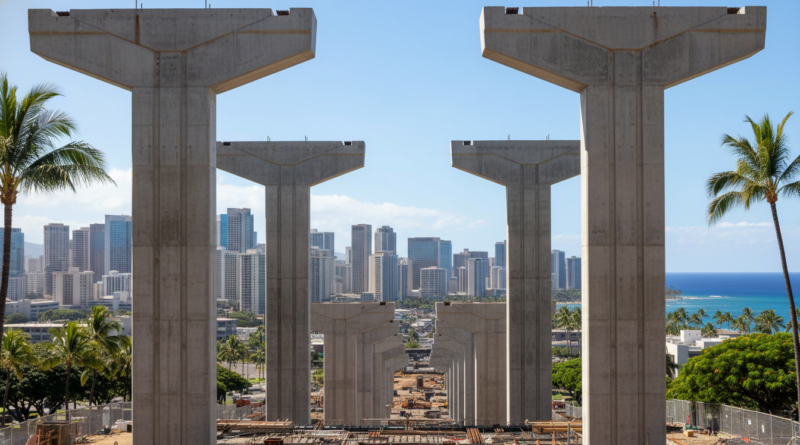
The timing coincides with increasingly visible construction activity along the rail’s Segment 3 route, which stretches from Aloha Stadium through Downtown Honolulu to Ala Moana Center. Towering concrete columns are rising along Dillingham Boulevard and Nimitz Highway, fundamentally altering the skyline in neighborhoods like Kalihi-Palama and Iwilei.
Downtown Construction Intensifies
HART crews have been working around the clock to install guideway columns in some of Oahu’s busiest corridors. The most dramatic changes are visible along the Nimitz Highway corridor, where massive concrete structures now stand where commuters once had unobstructed views of Honolulu Harbor.
The construction has created significant traffic disruptions, particularly during evening rush hours when lane closures compound existing congestion. Business owners in Iwilei have reported customer access challenges, though many remain supportive of the long-term transportation benefits.
Local resident Maria Santos, who commutes daily from her Kalihi home to downtown, says the construction chaos will be worth it. “Every morning I sit in traffic for 45 minutes just to go a few miles,” she said. “If this train can cut that down, I’m willing to deal with the mess now.”
The $89.4 million reimbursement covers expenses HART incurred over several months, including materials, contractor payments, and utility relocation costs. State officials had been reviewing the requests since early this year, examining invoices and project documentation to ensure compliance with federal transit guidelines.
Federal Oversight Remains
The funding approval comes as HART continues operating under federal oversight due to previous cost overruns and schedule delays. The Federal Transit Administration maintains close scrutiny of the project’s finances and progress, requiring detailed monthly reports and regular site inspections.
HART’s current budget stands at approximately $9.9 billion, with completion of the full 20-mile system targeted for 2031. The project has faced numerous setbacks since groundbreaking in 2011, including archaeological discoveries, utility conflicts, and the ongoing challenges of building elevated infrastructure through dense urban areas.
The rail system’s first segment, from East Kapolei to Aloha Stadium, began passenger service in June 2023. Daily ridership has steadily increased, with recent figures showing approximately 4,000 boardings per weekday. HART officials project ridership will multiply significantly once the system reaches Honolulu’s employment centers.
Transit advocates see the state reimbursement as validation of the project’s importance to Oahu’s transportation future. With the island’s population expected to grow and traffic congestion worsening, the rail system represents the largest public transit investment in Hawaii’s history.
Looking Ahead
The approved funding will help HART maintain its current construction pace through the remainder of 2024. Major milestones ahead include completion of the Kalihi and Airport stations, installation of electrical systems along completed segments, and continuation of guideway construction toward Downtown Honolulu.
HART expects to open service to the Airport station by late 2025, providing a direct connection between West Oahu communities and Daniel K. Inouye International Airport. The extension would mark a significant expansion of the system’s utility for both residents and visitors.
For Honolulu residents, the state’s financial commitment signals continued momentum despite the project’s troubled history. As concrete columns rise across the urban landscape, the rail system is becoming an increasingly tangible reality rather than a distant promise.
The next major funding decision will likely come later this year when HART submits additional reimbursement requests to cover ongoing Segment 3 construction costs. With federal oversight continuing and local scrutiny intense, every dollar spent will face careful examination as the project moves toward its ambitious completion timeline.