Sumibana ‘Ink Flowers’ Exhibition Blends Calligraphy and Ikebana at Downtown Art Center
In the heart of Chinatown’s vibrant streets, where vendors hawk fresh fish and tourists hunt for trinkets, an unexpected oasis of tranquility has emerged. The Downtown Art Center’s Courtyard Gallery is currently hosting “Sumibana,” a unique exhibition that marries the ancient Japanese arts of calligraphy and ikebana flower arrangement in ways that invite contemplation amid the urban bustle.
The collaborative show, which runs through the end of March, features works by local artists who have found common ground between the flowing strokes of sumi-e ink painting and the structured elegance of traditional Japanese floral design. Both art forms emphasize balance, negative space, and the beauty found in simplicity — principles that translate surprisingly well to contemporary Hawaiian artistic expression.
“There’s something about the way both calligraphy and ikebana require you to slow down and really consider each movement,” said Keiko Tanaka, one of the participating artists and a longtime practitioner of both disciplines. “In our fast-paced island life, these traditional practices offer a different way of seeing and being present.”
The exhibition’s title, “Sumibana,” literally translates to “ink flowers,” reflecting how the two art forms complement each other. Visitors will find installations where bold black brushstrokes seem to grow organically from minimalist floral arrangements, and delicate cherry blossom branches that appear to dance alongside flowing calligraphic poems.
East Meets West in Chinatown
The location itself adds another layer of meaning to the show. Chinatown has long been a crossroads of Asian cultures in Honolulu, and the Downtown Art Center sits just blocks from the historic temples and cultural institutions that have served the community for generations. The gallery’s courtyard setting, with its open-air design and natural lighting, provides an ideal backdrop for art forms that celebrate the intersection of nature and human creativity.
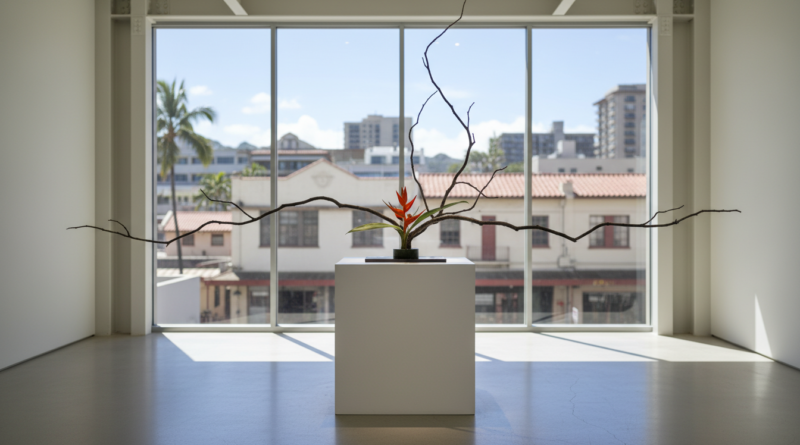
Several pieces in the exhibition directly reference Hawaii’s landscape and multicultural identity. One striking installation pairs calligraphy inspired by Hawaiian place names with arrangements featuring native plants like maile and bird of paradise. Another series explores the concept of “ma” — the Japanese appreciation for negative space — through sparse arrangements that highlight the gallery’s architectural elements.
The collaborative nature of “Sumibana” reflects a growing trend in Honolulu’s art scene, where artists from different cultural backgrounds are finding new ways to honor traditional practices while creating something uniquely local. The participating artists include both Japanese cultural practitioners and Hawaii-born artists who have studied these forms as part of their broader artistic education.
Mindful Art in a Busy World
For many visitors, the exhibition offers more than visual pleasure — it provides a meditative experience. The gallery has organized its programming to include weekend demonstrations where visitors can watch artists work in real-time, creating both calligraphy and floral arrangements. These sessions often draw small, focused crowds who seem genuinely interested in understanding the philosophical underpinnings of both practices.
The timing of “Sumibana” feels particularly relevant as Honolulu residents continue to seek balance in an increasingly connected world. The exhibition’s emphasis on mindfulness and intentional creation offers a counterpoint to the constant stimulation of modern life, even as it sits in the middle of one of downtown’s busiest neighborhoods.
Local art collector and frequent gallery visitor Maria Santos noted how the show creates an unexpected sense of peace. “You walk in from the chaos of Hotel Street, and suddenly you’re in this space where every element has been placed with such care and consideration. It makes you want to slow down and really look.”
The Downtown Art Center has also partnered with local cultural organizations to offer workshops throughout the exhibition’s run. These sessions, led by master practitioners, provide hands-on introductions to both calligraphy and ikebana for beginners while offering advanced techniques for more experienced students.
Cultural Bridge Building
Beyond its artistic merit, “Sumibana” represents something larger about Honolulu’s cultural landscape. In a city where East and West have been mixing for more than a century, exhibitions like this one demonstrate how traditional art forms can evolve and find new expression while maintaining their essential character.
The show runs through March 30, with gallery hours Tuesday through Saturday from 11 a.m. to 6 p.m. Admission is free, though donations are encouraged to support the center’s programming. The Downtown Art Center is located at 1041 Nuuanu Avenue, easily accessible by city bus or a short walk from downtown parking areas.
For Honolulu residents looking for a different kind of cultural experience — one that prioritizes contemplation over consumption — “Sumibana” offers a rare opportunity to engage with art forms that have been refined over centuries yet feel remarkably fresh in their current presentation. In our island community that values both tradition and innovation, this exhibition strikes exactly the right balance.
