
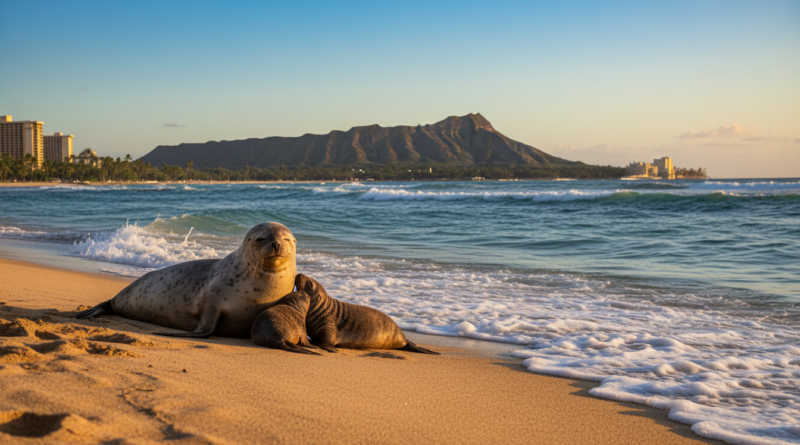
Hawaiian Monk Seal Kaiwi Gives Birth at Kaimana Beach for Fourth Time Since 2021
A familiar sight returned to Kaimana Beach Sunday evening as Kaiwi, a 15-year-old Hawaiian monk seal, gave birth to her latest pup just as the sun set over Diamond Head. The critically endangered mother chose the same stretch of sand in Waikiki where she’s delivered three previous pups since 2021, turning the popular local swimming spot into an impromptu maternity ward.
State wildlife officials quickly established a protective perimeter around the mother and newborn, cordoning off a section of the beach with yellow tape and signs. The Hawaii Department of Land and Natural Resources activated its marine mammal response protocols, deploying volunteers to monitor the seals around the clock and educate beachgoers about keeping a safe distance.
“Kaiwi has made Kaimana Beach her preferred pupping location, and we need the community’s help to ensure both mom and baby have the space they need during this critical bonding period,” said Jason Redulla, a marine biologist with DLNR’s Division of Aquatic Resources. “The first few weeks are crucial for pup survival, and human disturbance can cause serious stress or abandonment.”
The birth highlights an ongoing challenge for Honolulu as the city balances public beach access with protecting Hawaii’s most endangered marine mammal. With fewer than 1,400 Hawaiian monk seals remaining in the wild, every successful birth represents a significant conservation victory — but also creates logistical headaches for beach management.
Local Beach Becomes Seal Sanctuary
Kaimana Beach, tucked between the Natatorium and Diamond Head, has become an unlikely hotspot for monk seal activity in recent years. The protected cove offers calm waters and minimal wave action, creating ideal conditions for pupping and nursing.
Local residents have grown accustomed to periodic beach closures when seals arrive, but the repeated visits by Kaiwi have made the small beach a case study in urban wildlife coexistence. Unlike more remote locations where seals traditionally pupped, Kaimana sits in the heart of Waikiki’s tourist corridor.
“It’s amazing to have these incredible animals choosing our neighborhood beach, but it definitely changes how we use the space,” said longtime Kapahulu resident Maria Santos, who walks her dog past Kaimana each morning. “We’ve all learned to check before we head down with our beach chairs.”
The protective barriers typically remain in place for six to eight weeks while the mother nurses her pup. During this period, the seals require constant monitoring by trained volunteers who work in shifts to prevent human interference while documenting the pup’s development.
Conservation Success Story
Kaiwi’s reproductive success represents a bright spot in Hawaiian monk seal conservation efforts. Born in 2009, she has now produced four pups at Kaimana Beach, with at least three of her previous offspring surviving to weaning age — a strong track record for the species.
Hawaiian monk seals face numerous threats including entanglement in marine debris, shark predation, and human disturbance. Climate change also affects their food sources and beach habitat, making successful urban pupping sites like Kaimana increasingly valuable.
The species’ recovery has been slow but steady, with the population growing at roughly 2% annually over the past decade. However, scientists estimate the seals need to reach at least 2,000 individuals to achieve long-term stability.
State officials emphasize that public cooperation remains essential for continued progress. Federal law requires people to maintain at least 50 feet distance from monk seals, with violations carrying penalties up to $50,000 and potential jail time.
The Kaimana Beach situation also demonstrates how urban development and wildlife conservation can intersect in unexpected ways. As Honolulu continues growing denser, encounters between residents and endangered species are likely to increase, requiring adaptive management strategies.
What Happens Next
Wildlife officials will continue monitoring Kaiwi and her pup throughout the nursing period, tracking the youngster’s weight gain and overall health. The mother typically remains with her offspring for about six weeks before weaning occurs.
For Honolulu residents, Kaiwi’s return raises familiar questions about beach access and wildlife protection priorities. City officials are working with state agencies to develop clearer guidelines for managing temporary closures at popular beaches when protected species arrive.
The successful birth also reinforces Kaimana Beach’s emerging role as a critical habitat for Hawaiian monk seals in urban Honolulu. As the species continues its slow recovery, locations like this small Waikiki cove may prove increasingly important for ensuring these ancient mariners have a future in Hawaii’s waters.
