
Waikiki Beach Gets a $700K Sandbag Groin — And a New Master Plan to Save Its Eroding Shoreline
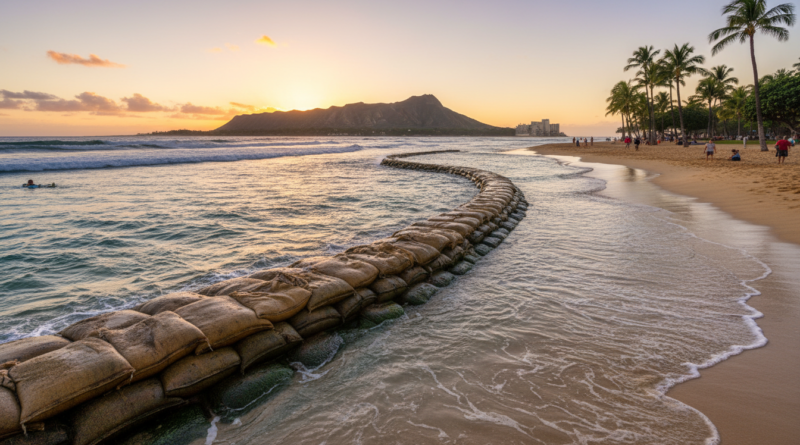
A new $700,000 sandbag structure now stretches 95 feet into the Pacific Ocean off Waikiki Beach, marking the latest chapter in Honolulu’s escalating fight against coastal erosion that threatens one of Hawaii’s most iconic tourist destinations.
The recently completed “groin” — a perpendicular barrier designed to trap sand — represents just the beginning of a comprehensive effort to preserve Waikiki’s shoreline. City and state agencies are simultaneously developing the first-ever Waikiki Beach Master Plan, while preparing for an even larger groin installation near the Royal Hawaiian Hotel scheduled to begin next spring.
The new sandbag structure, installed by the Waikiki Beach Special Improvement District Association (WBSIDA), required trucking in fresh sand to rebuild eroded sections of the beach. The project targets a particularly vulnerable stretch where decades of wave action have steadily carved away the coastline.
“This is about protecting not just a beach, but the economic heart of Hawaii’s tourism industry,” said Rick Egged, president of WBSIDA. “Every foot of sand we lose represents millions in economic impact for local businesses and jobs.”
The Economics of Erosion
Waikiki Beach draws more than 4 million visitors annually, generating billions in tourism revenue that ripples throughout Honolulu’s economy. The 1.5-mile stretch from the Hilton Hawaiian Village to Diamond Head supports thousands of jobs in hotels, restaurants, surf shops, and beach services.
But the beach has been steadily shrinking for decades. Climate change-driven sea level rise, combined with Hawaii’s natural coastal processes, has accelerated erosion along critical sections. Some areas have lost more than 50 feet of beach width since the 1980s.
The problem is particularly acute near the Royal Hawaiian Hotel, where oceanfront properties face the prospect of waves reaching their foundations during high surf events. That’s where the next major intervention will take place.
Master Plan in the Works
The upcoming Royal Hawaiian groin project, slated to begin in spring 2024, will dwarf the recently completed installation. Expected to cost several million dollars, it will involve larger-scale engineering and coordination between multiple government agencies.
These individual projects are feeding into a broader Waikiki Beach Master Plan being developed jointly by the city Department of Parks and Recreation, the state Department of Land and Natural Resources, and WBSIDA. The comprehensive plan aims to create a coordinated, long-term strategy for managing the entire Waikiki coastline.
Previous piecemeal approaches have sometimes created unintended consequences, with sand management in one area affecting erosion patterns elsewhere along the beach. The master plan seeks to address these interconnected coastal dynamics.
Expensive but Essential
The costs are substantial and ongoing. Beyond the initial construction expenses, sandbag groins require regular maintenance and periodic sand replenishment. The bags themselves must be replaced every few years as they degrade in the harsh marine environment.
Some critics question whether such interventions merely delay the inevitable retreat of Hawaii’s coastlines in the face of rising seas. Environmental groups have raised concerns about the ecological impacts of hard structures on coral reefs and marine life.
However, given Waikiki’s outsized importance to Hawaii’s economy, doing nothing isn’t considered a viable option. The beach area generates an estimated $2 billion annually in visitor spending, supporting roughly 40,000 jobs across Oahu.
Resort operators along the beach have increasingly invested in their own erosion control measures. The Outrigger Waikiki Beach Resort recently completed its own beach restoration project, while other properties have installed temporary barriers during high surf seasons.
Looking Ahead
The success of the new sandbag groin will be closely monitored over the coming months, particularly during winter’s larger surf. Engineers will track sand accumulation patterns and measure the structure’s effectiveness at slowing erosion in the targeted area.
Data from this installation will inform both the Royal Hawaiian project and the broader master plan. The goal is developing a toolkit of proven interventions that can be applied strategically along different sections of the beach.
For Honolulu residents and businesses, these projects represent a significant public investment in preserving the city’s tourism foundation. While the costs are steep, the alternative — watching Waikiki Beach gradually disappear — would be far more expensive for Hawaii’s economy and identity.
The completion of the comprehensive master plan, expected within the next year, will provide the roadmap for managing one of the Pacific’s most famous beaches for future generations. Until then, sandbags and fresh sand remain the front lines in Honolulu’s battle against the rising sea.