
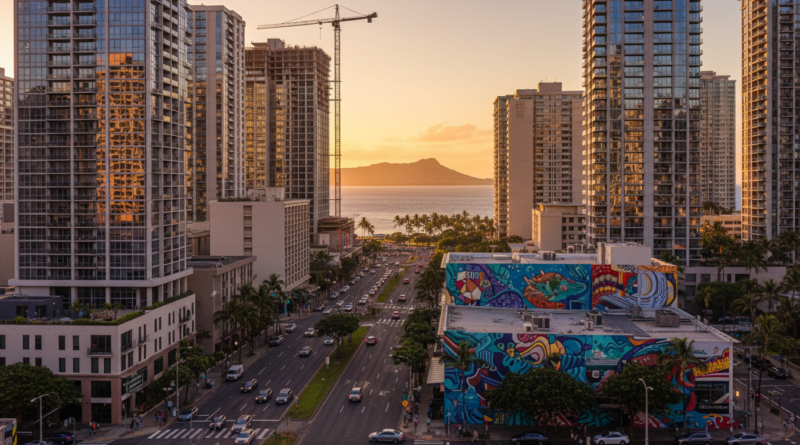
Waiakoa, a 1,032-Unit Affordable Housing Tower, Set to Break Ground in Kakaako’s SALT District
A massive 1,032-unit residential tower is set to break ground in Kakaako’s SALT district this year, bringing a significant boost to Honolulu’s affordable housing inventory while reshaping the neighborhood’s skyline.
Waiakoa, the latest project in the Our Kaka’ako master-planned community, will dedicate 60% of its units to affordable housing — roughly 620 homes — addressing critical housing needs in one of Hawaii’s most expensive real estate markets. The 40-story tower will also include 68,000 square feet of retail space and a full-service grocery store on the ground level.
The development marks another major milestone in the Hawaii Community Development Authority’s vision to transform Kakaako into a dense, mixed-use urban core. Located in the heart of the SALT neighborhood, Waiakoa will rise adjacent to existing Our Kaka’ako towers and the popular SALT at Our Kaka’ako retail complex.
Addressing Honolulu’s Housing Crisis
With Honolulu facing a severe housing shortage and median home prices exceeding $1 million, projects like Waiakoa represent crucial steps toward increasing residential density in the urban core. The affordable component will serve families earning between 80% and 140% of the area median income, translating to households making roughly $85,000 to $150,000 annually.
“This project demonstrates how thoughtful development can address multiple community needs simultaneously,” said David Arakawa, executive director of the Land Use Research Foundation of Hawaii. “We’re seeing workforce housing integrated with retail amenities in a walkable neighborhood — exactly what Honolulu needs more of.”
The tower’s design emphasizes sustainability and livability, featuring energy-efficient systems and resort-style amenities including a fitness center, pool deck, and community spaces. Units will range from studios to three-bedroom layouts, catering to diverse household sizes and income levels.
Retail Component Fills Neighborhood Gap
The inclusion of a full-service grocery store addresses a long-standing need in Kakaako, where residents currently travel to surrounding neighborhoods for basic shopping. The retail component will also feature restaurants, services, and community-oriented businesses, creating a more complete live-work-play environment.
This mixed-use approach aligns with urban planning principles that reduce car dependency and create more sustainable communities. Residents will have easy access to the planned Honolulu Rail Transit system, with the Keeaumoku station located nearby.
The SALT district has emerged as one of Kakaako’s most dynamic areas, anchored by the SALT at Our Kaka’ako shopping center with its mix of local boutiques, restaurants, and community gathering spaces. Waiakoa will add residential density to support these existing businesses while bringing new retail options.
Construction Timeline and Impact
Construction is expected to begin in late 2024, with completion anticipated by 2027. The project will create hundreds of construction jobs during the building phase and permanent positions in retail and property management once operational.
The development team includes experienced Hawaii-based firms familiar with local building conditions and community needs. Special attention is being paid to traffic management during construction, given the project’s location in an increasingly busy part of Kakaako.
Waiakoa represents part of a broader transformation in Kakaako, where multiple high-rise residential towers have risen in recent years. The neighborhood has evolved from an industrial area into Honolulu’s most ambitious urban redevelopment project, though not without controversy over gentrification and community displacement concerns.
Looking Ahead
The project comes at a critical time for Honolulu’s housing market, as state and local officials push for increased residential development to address chronic shortages. Governor Josh Green’s administration has set ambitious goals for new housing units statewide, with dense urban projects like Waiakoa playing a key role in meeting those targets.
For Kakaako residents and the broader Honolulu community, Waiakoa represents both opportunity and change. The influx of over 1,000 new households will bring energy and economic activity to the district while testing infrastructure and community resources.
As construction begins, the project will serve as a test case for balancing affordable housing requirements with market-rate development in Hawaii’s challenging economic environment. Success could provide a model for similar projects across Oahu’s urban core, while any shortcomings will likely inform future policy decisions around density and affordability requirements.
