
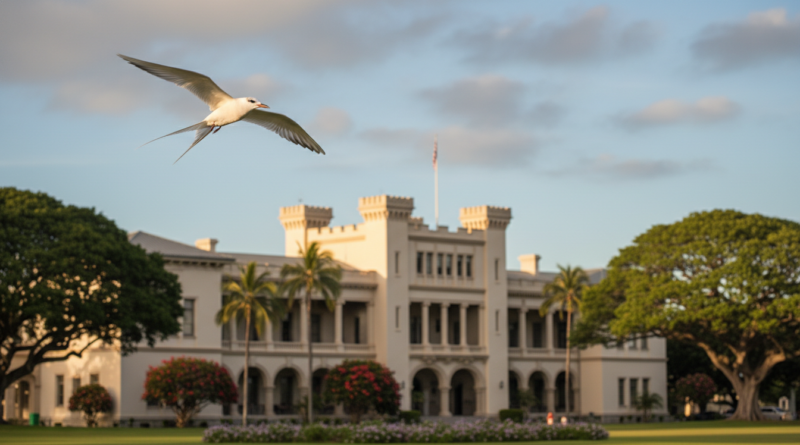
Honolulu’s Official Bird Gets Its Day: 11th Annual Manu o Kū Festival Lands at Iolani Palace
The white tern, Honolulu’s official city bird, will take center stage at the 11th Annual Manu o Kū Festival on May 2 at Iolani Palace. The free community event celebrates one of nature’s most remarkable urban success stories — a seabird that has adapted to nest in downtown Honolulu’s trees rather than on remote cliffs.
Set on the palace’s historic coronation lawn, the festival runs from 8 a.m. to 2 p.m. and promises something for every age. Early risers can join guided bird walks through downtown’s urban canopy, where spotting scopes will help visitors locate the ethereal white birds that seem to float through Honolulu’s concrete jungle.
“The manu o kū represents something truly special about our city,” said Lisa Hadway, education director for the Hawaii Audubon Society, which organizes the festival. “Most seabirds nest on remote islands or cliffs, but these remarkable birds have chosen to raise their families right here among us in downtown Honolulu.”
The white tern earned its official status as Honolulu’s city bird in 2007, but its relationship with the island runs much deeper. Known in Hawaiian as manu o kū, meaning “bird that cries out,” these graceful seabirds have become synonymous with urban Honolulu’s unique ecosystem.
Urban Nesters Break the Rules
What makes Honolulu’s white terns extraordinary isn’t just their beauty — it’s their unprecedented nesting behavior. Unlike their cousins elsewhere in the Pacific, Honolulu’s population has adapted to nest directly on tree branches in the heart of the city, from downtown office buildings to residential neighborhoods like Kalihi and Keeaumoku.
This urban adaptation represents one of the only documented cases worldwide of seabirds successfully breeding in a major metropolitan area. The birds lay their single egg directly on bare tree branches, with no nest materials whatsoever — a precarious arrangement that somehow works in Honolulu’s gentle trade wind climate.
Festival programming reflects both the scientific marvel and cultural significance of these birds. The keiki costume contest encourages young participants to dress as their favorite Hawaiian birds, while educational stations will explore the connection between native Hawaiian birds and traditional wayfinding practices.
Conservation Success in the City
The festival also highlights a conservation success story that’s still unfolding. Honolulu’s white tern population has grown steadily over the past two decades, even as many seabird species face declining numbers due to climate change and habitat loss.
Local researchers estimate the current population at around 2,000 breeding pairs across Oahu, with the highest concentrations in urban Honolulu neighborhoods. The birds’ success stems partly from their adaptability and partly from community awareness — residents have learned to trim trees carefully during nesting season and report injured birds to wildlife rehabilitators.
Interactive displays will showcase ongoing research into the birds’ feeding patterns, nesting success rates, and response to urban development. Visitors can learn how citizen science projects help track the population and contribute to conservation efforts.
Palace Grounds Provide Perfect Setting
Iolani Palace offers an ideal backdrop for celebrating Honolulu’s official bird. The historic grounds, surrounded by mature trees that often host white terns, provide both symbolic significance and practical bird-watching opportunities.
The palace’s central downtown location also puts visitors in prime white tern habitat. Festival organizers encourage participants to look up while walking to and from the event — downtown’s growing canopy of shower trees, monkeypod trees, and other species provides numerous nesting opportunities for the adaptable seabirds.
Food trucks will offer local favorites throughout the day, while craft vendors showcase bird-themed artwork from local artisans. The Hawaii Audubon Society will also launch new educational materials about urban wildlife conservation, including a children’s book about Honolulu’s white terns illustrated by local artist.
For many Honolulu residents, the festival provides a first opportunity to learn about a bird they may see daily without recognizing. The white tern’s ghostly appearance and silent flight often make it blend into the urban background, despite its significance as a symbol of successful coexistence between wildlife and city life.
The Manu o Kū Festival represents more than just bird appreciation — it’s a celebration of Honolulu’s unique position as a city where ancient Polynesian navigation traditions, modern conservation science, and urban wildlife management intersect in remarkable ways.