Honolulu Museum of Art Acquires Rare Collection of 19th-Century Hawaiian Quilts
The Honolulu Museum of Art has acquired one of the most significant collections of 19th-century Hawaiian quilts to emerge in decades, adding 23 rare pieces that showcase the evolution of this uniquely Hawaiian art form during the kingdom period.
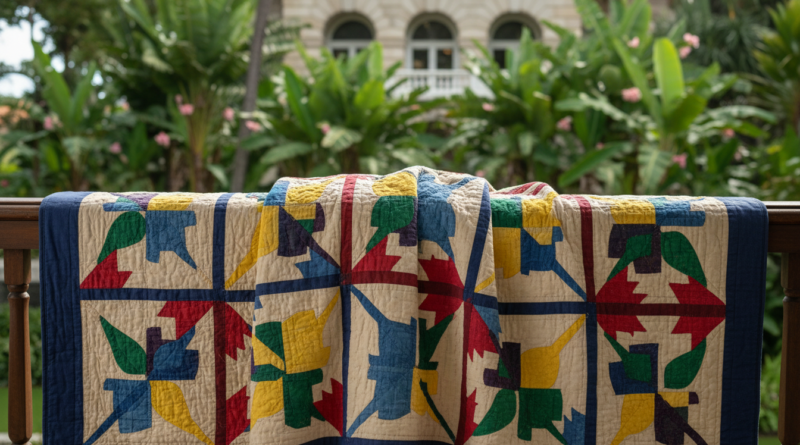
The collection, donated by the estate of longtime Kailua resident Margaret Chen, includes quilts dating from 1840 to 1895. Many feature the distinctive appliqué patterns that became synonymous with Hawaiian quilting, including breadfruit, plumeria, and crown motifs that reflected both natural beauty and royal symbolism.
“These quilts represent an extraordinary chapter in Hawaiian cultural history,” said Dr. Jennifer Saville, the museum’s curator of Pacific art. “They document how Native Hawaiian women adapted Western quilting techniques to create something entirely their own – a visual language that expressed their connection to the land and their monarchy.”
The centerpiece of the collection is an 1863 quilt featuring the royal coat of arms, believed to have been made for Queen Emma. The nine-by-nine-foot piece displays intricate needlework in the traditional red-on-white color scheme that became a hallmark of ceremonial Hawaiian quilts.
Preserving Cultural Legacy
Hawaiian quilting emerged in the 1820s when Protestant missionaries introduced Western-style needlework to Native Hawaiian women. However, the art form quickly evolved beyond its missionary origins, incorporating indigenous design sensibilities and cultural meanings.
Unlike American patchwork quilts made from fabric scraps, Hawaiian quilts typically feature large-scale appliqué designs cut from single pieces of fabric. The patterns often mirror the symmetry found in traditional kapa designs, creating bold, flowing motifs that celebrate island flora and fauna.
Several quilts in the Chen collection showcase this distinctive approach, including an 1875 piece featuring a stylized kukui tree pattern and an 1888 quilt with interconnected pikake blossoms that required an estimated 2,000 hours of hand-stitching to complete.
Museum conservators have spent the past six months carefully examining and stabilizing the textiles. Many required delicate cleaning and repair work to address age-related deterioration while preserving their historical integrity.
Community Connection
The acquisition has generated excitement among Honolulu’s quilting community, which has maintained these traditions across generations. Local quilting circles, many based in neighborhoods from Manoa to Hawaii Kai, continue to practice techniques passed down through families.
“My grandmother taught me to quilt using patterns very similar to what the museum just acquired,” said Leilani Nakamura, who leads quilting workshops at the Japanese Cultural Center of Hawaii. “Seeing these historic pieces preserved for future generations connects us to the women who came before us and kept our culture alive during difficult times.”
The quilts also illuminate the social networks that sustained Hawaiian communities during the kingdom period and beyond. Many were created collaboratively, with groups of women gathering for quilting parties that served both practical and social functions.
Documentation accompanying the collection includes family histories tracing several quilts’ ownership through multiple generations of Native Hawaiian families in areas including Waikiki, Kalihi, and the North Shore.
Research and Display Plans
The museum plans to display selections from the collection in rotating exhibitions beginning this fall, starting with five quilts in a new gallery dedicated to Hawaiian textile arts. The space will be climate-controlled to protect the delicate fabrics while allowing visitors to appreciate their craftsmanship.
Researchers from the University of Hawaii’s American Studies program will work with museum staff to document the quilts’ provenance and techniques. The project aims to create a comprehensive digital archive that will be accessible to scholars and community members worldwide.
The acquisition was made possible through funding from the Hawaii Community Foundation and private donors, reflecting broad community support for preserving indigenous artistic traditions.
For Honolulu residents, the collection represents more than historical artifacts – it embodies the creativity and resilience of Native Hawaiian women who transformed an introduced craft into an authentic expression of island identity. As the museum prepares to share these treasures with the public, they serve as tangible links to ancestors whose artistry continues to inspire contemporary Hawaiian quilters across the Pacific.