
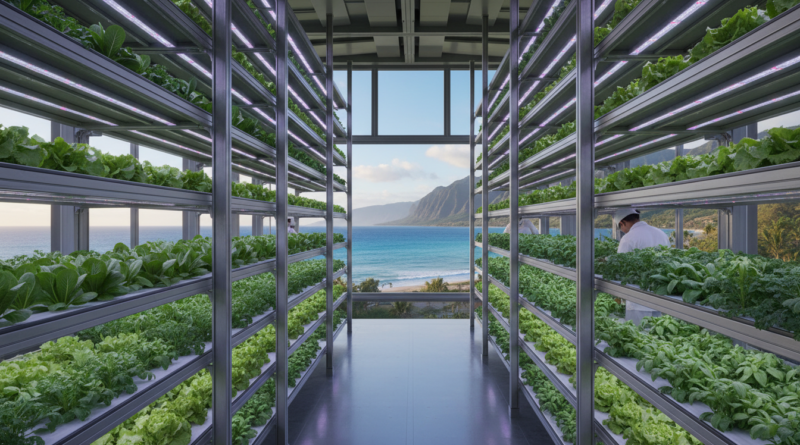
Hawaii’s First Vertical Farm Opens in Kapolei Industrial Park
A towering greenhouse facility in Kapolei Industrial Park is revolutionizing how Hawaii grows its food, marking the state’s entry into commercial vertical farming with the opening of Pacific Vertical Farms this month.
The 40,000-square-foot facility uses stacked growing systems and LED lighting to produce leafy greens, herbs, and microgreens year-round without soil or pesticides. The operation can yield the equivalent of 400 acres of traditional farmland while using 95% less water than conventional agriculture.
“We’re not just growing food differently — we’re addressing Hawaii’s food security crisis head-on,” said Maria Santos, Pacific Vertical Farms’ CEO and co-founder. “Every head of lettuce we grow here stays in Hawaii instead of traveling 3,000 miles from the mainland.”
The facility represents a $12 million investment from a consortium of local investors and California-based agricultural technology company AeroGrow Systems. Construction began in early 2023 on the former site of a defunct electronics manufacturing plant near the intersection of Kapolei Parkway and Kamokila Boulevard.
Addressing Hawaii’s Import Dependence
Hawaii imports roughly 90% of its food, making it one of the most food-insecure states in the nation. Fresh produce often arrives wilted after days in transit, commanding premium prices at local grocery stores. A head of mainland lettuce can cost $4-6 in Honolulu supermarkets.
Pacific Vertical Farms aims to change that equation by delivering harvest-fresh greens to Oahu retailers within hours of picking. The company has already secured contracts with three major grocery chains and plans to supply restaurants in Waikiki and downtown Honolulu.
The facility’s 20-foot-tall growing towers contain thousands of plants in climate-controlled environments. Computer systems monitor nutrient levels, pH balance, and lighting cycles optimized for each crop variety. Automated harvesting equipment can process 10,000 heads of lettuce daily at peak capacity.
Local Workforce and Training
The operation employs 35 people, with plans to expand to 60 workers as production ramps up. Many employees come from traditional agriculture backgrounds on Oahu’s North Shore and Central Valley farms, while others bring technical skills from Hawaii’s aerospace and defense industries.
“We’re combining old-school farming knowledge with cutting-edge technology,” explained Santos, who previously managed operations at Dole’s Wahiawa pineapple processing plant before it closed in 2006. “Our team includes farmers who’ve worked these lands for decades alongside engineers who’ve built satellites.”
The facility partners with Leeward Community College’s agriculture program to provide internships and technical training. Students can earn certificates in controlled environment agriculture, a growing field as vertical farms expand across the mainland.
Sustainability Focus
Beyond reducing food miles, the facility emphasizes environmental sustainability through solar power and water recycling systems. Rooftop solar panels generate 40% of the facility’s electricity needs, while filtered rainwater supplements the municipal water supply.
The company’s hydroponic systems recirculate nutrient solutions, eliminating agricultural runoff that has plagued traditional Hawaiian farming. No pesticides or herbicides are used, as the controlled environment eliminates most plant diseases and pests.
“Traditional farming in Hawaii faces challenges from invasive species, unpredictable weather, and limited arable land,” said Dr. James Kawamoto, a University of Hawaii agricultural economist who consulted on the project. “Vertical farming offers a pathway to local food production that doesn’t compete with housing development or cultural sites.”
Expansion Plans
Pacific Vertical Farms plans to break ground on a second facility in Kalihi later this year, focusing on specialty crops like basil, cilantro, and baby spinach. The company is also exploring partnerships with other Pacific islands facing similar food security challenges.
The Kapolei facility’s success could inspire similar operations across Hawaii, potentially reducing the state’s dependence on food imports while creating high-tech agricultural jobs. With tourism-dependent communities seeking economic diversification, vertical farming represents a growing sector that serves both local needs and environmental goals.
For Oahu residents, the immediate benefit will be fresher, more affordable produce grown just miles from their neighborhood grocery stores — a small but significant step toward food independence in the middle of the Pacific.