
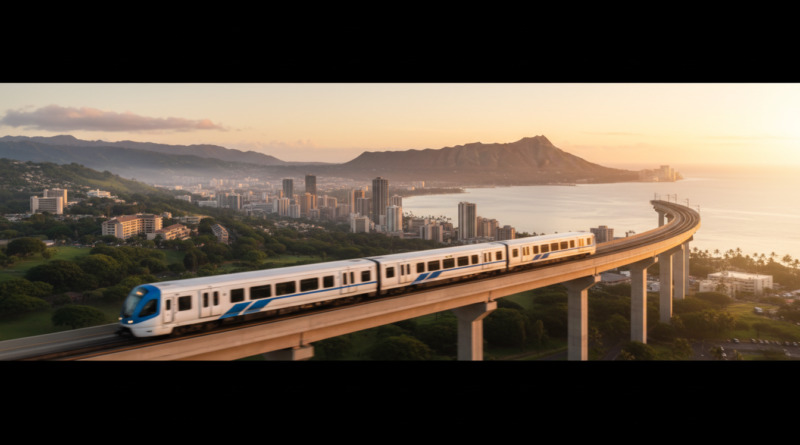
City Council Greenlights HART Study to Extend Skyline Rail to UH Mānoa
The Honolulu City Council has given the green light for the Honolulu Authority for Rapid Transportation to study extending the Skyline rail system beyond its current terminus to serve the University of Hawaii at Mānoa campus.
Council members approved Bill 60 in a 7-2 vote Wednesday, authorizing HART to conduct feasibility studies for the ambitious expansion that could bring rail service to one of Oahu’s largest employment and education centers. The move comes as the $12 billion rail project nears completion of its initial 20-mile route from Kapolei to Kalihi.
The proposed extension would stretch the elevated transit system through densely populated neighborhoods including Kalihi-Palama, Keeaumoku, and potentially into Mānoa Valley itself. Such a route could serve the university’s 17,000 students and 4,500 employees, along with residents throughout urban Honolulu who currently rely on congested surface streets.
Political Push Despite Financial Concerns
Council Chair Tommy Waters championed the measure, arguing that rail’s utility depends on connecting major population and employment centers. The current approved route ends at Ala Moana Center, leaving significant gaps in coverage for East Honolulu communities.
“We’re talking about serving tens of thousands of daily riders who have limited transit options right now,” Waters said during Wednesday’s meeting. “The university alone represents one of the largest trip generators on the island.”
However, the approval comes with significant financial questions. HART has yet to complete its initial phase, which has faced years of delays and cost overruns. The agency recently secured federal funding to finish construction to Ala Moana, but any extension would require new sources of funding and federal environmental approvals.
Council members Calvin Say and Andria Tupola voted against the measure, citing concerns about HART’s track record and the potential for further cost escalation. Say pointed to ongoing issues with the system’s operations and maintenance costs, which have already strained the city’s budget.
Route Challenges and Community Impact
A UH Mānoa extension would face significant engineering and community challenges. The route would likely need to navigate through established neighborhoods with limited space for elevated guideway construction.
Potential alignments could follow major corridors like King Street or Beretania Street before branching toward the university. Each option presents tradeoffs between construction costs, community disruption, and ridership potential.
The study authorization also comes as HART grapples with integrating the Skyline system with existing bus routes operated by TheBus. The agency has acknowledged that successful rail operations depend on seamless connections between different transit modes.
Environmental groups have cautiously supported the extension concept, noting that expanded rail service could reduce car dependency and greenhouse gas emissions. However, they’ve emphasized the importance of avoiding sensitive areas like the Lyon Arboretum and upper Mānoa Valley watersheds.
Federal Coordination Required
Any extension beyond Ala Moana would require extensive coordination with federal transportation officials. The Federal Transit Administration has already invested billions in the current rail project and would need to approve new environmental impact studies for expanded service.
HART officials estimate the feasibility study could take 18-24 months to complete, including community input sessions and preliminary engineering work. The study will examine multiple route options, construction costs, ridership projections, and funding scenarios.
The timing coincides with renewed federal investment in public transit infrastructure. The Biden administration’s infrastructure legislation has made additional funding available for transit expansion projects nationwide.
For Honolulu residents, particularly those in East Honolulu and Mānoa, the potential extension represents a long-term vision for reducing traffic congestion on already strained roadways. H-1 freeway and surface streets through town regularly experience gridlock during peak hours, with limited alternative routes available.
The study’s findings will ultimately inform future City Council and mayoral decisions about whether to pursue the extension. Success will depend on securing sustainable funding sources and demonstrating strong community support for continued rail investment.
HART expects to begin the feasibility study later this year, with initial community meetings planned for various neighborhoods along potential route corridors. The results could shape transit planning decisions for decades to come.
