
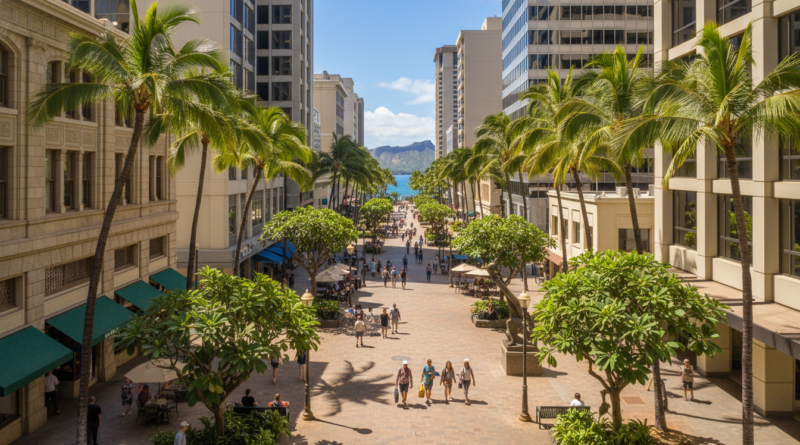
City Council Weighs Expanding Fort Street Mall Pedestrian Zone Downtown
The Honolulu City Council is set to review legislation that would expand the pedestrian-only zone along Fort Street Mall, potentially transforming one of Downtown’s most recognizable corridors into a larger car-free space.
The proposal, introduced by Council Chair Tommy Waters, would extend the current pedestrian mall boundaries from Hotel Street to Merchant Street — adding roughly two blocks to the existing zone that currently runs from King Street to Hotel Street. The expansion would eliminate vehicle access on Fort Street between Hotel and Merchant, creating a continuous pedestrian corridor through the heart of Downtown’s financial district.
“We’re looking at creating a more vibrant, walkable downtown core that puts people first,” Waters said during Wednesday’s council meeting. “The Fort Street Mall has been a success story for pedestrian access, and expanding it could really activate this area.”
The Fort Street Mall, originally established in the 1960s as one of Hawaii’s first pedestrian shopping districts, has evolved significantly over the decades. What once served primarily as a retail corridor now anchors a mixed-use area featuring restaurants, office buildings, and residential towers.
Business Community Split on Proposal
Local business owners along the proposed extension route have expressed mixed reactions to the plan. Some welcome the potential for increased foot traffic, while others worry about delivery access and customer parking.
Maria Santos, who manages a coffee shop on Fort Street near Merchant, said the change could bring more customers during lunch hours. “We see a lot of office workers who prefer to walk rather than drive downtown,” she explained. “More pedestrian space might mean more people stopping by.”
However, concerns remain about logistics for businesses that rely on delivery trucks and customers who drive downtown from other parts of the island. The current Fort Street Mall already presents challenges for vendors and suppliers who must navigate restricted access hours and limited loading zones.
The Downtown Neighborhood Board plans to discuss the proposal at its monthly meeting next Tuesday, with several board members noting they want to hear more details about parking alternatives and traffic rerouting plans.
Infrastructure and Safety Considerations
City planners acknowledge that expanding the pedestrian zone would require significant infrastructure changes. The proposal includes provisions for improved lighting, new street furniture, and enhanced landscaping to create a cohesive pedestrian experience.
Safety has emerged as a key discussion point, particularly regarding emergency vehicle access and late-night security in the extended mall area. The Honolulu Police Department is reviewing the proposal to ensure adequate patrol access and response times.
Transportation officials are also studying how closing additional blocks of Fort Street would affect traffic flow on parallel streets like Alakea and Bishop. Initial assessments suggest most vehicle traffic could be accommodated through existing alternate routes, though some congestion increases are expected during peak hours.
Funding and Timeline Questions
The expansion project would require an estimated $2.8 million for street improvements, signage, and pedestrian amenities, according to preliminary city estimates. Council members are exploring various funding sources, including federal transportation grants and city capital improvement funds.
If approved, the expansion could take 18 to 24 months to complete, with construction potentially beginning in early 2025. The timeline would allow for extensive community input and detailed traffic studies before any street closures occur.
The proposal also includes a provision for a two-year trial period, during which the city would monitor foot traffic, business impacts, and overall community response before making the expansion permanent.
Broader Downtown Development Context
The Fort Street Mall expansion proposal comes as Downtown Honolulu continues to evolve from a primarily business district into a mixed-use urban neighborhood. Recent residential developments, including several new condominium towers, have increased the area’s resident population significantly.
City planners see the pedestrian expansion as part of a broader strategy to create a more livable downtown core that serves both office workers and residents. Similar pedestrian-friendly initiatives in other cities have shown positive economic impacts for local businesses and improved quality of life for urban residents.
The City Council is expected to hold public hearings on the proposal over the next month, with a final vote tentatively scheduled for late May. Residents and business owners interested in weighing in can submit testimony through the city’s online portal or attend the upcoming neighborhood board meeting.
For Downtown Honolulu, the decision represents a significant choice about the area’s future character — whether to prioritize vehicle access and traditional urban transportation patterns, or to embrace a more pedestrian-centered vision that could reshape how residents and visitors experience the city’s core.