HART Goes to Court to Seize Downtown Properties as Rail Segment 3 Pushes Forward
The Honolulu Authority for Rapid Transportation is taking a more aggressive legal approach to acquire key downtown properties needed for the rail project’s third segment, filing new eminent domain proceedings after suffering a significant court setback last December.
HART officials confirmed they are pursuing portions of the Pacific Guardian Center and a former Servco automotive site through the courts, marking a strategic shift in how the agency handles property acquisitions for the troubled rail line. The moves come as pressure mounts to keep the project’s ambitious 2031 passenger service timeline intact.
The eminent domain filings represent HART’s reset after a Circuit Court judge ruled against the authority in December 2025, dealing a blow to the agency’s previous acquisition strategy. That ruling forced HART back to the drawing board on several downtown properties essential for completing the rail line from Middle Street to Ala Moana Center.
“We’re committed to moving forward with the tools available to us under state law,” said HART spokesperson [name], speaking about the renewed legal strategy. “These properties are critical infrastructure needs for completing this vital transportation link for Honolulu residents.”
Downtown Stakes Rise
The Pacific Guardian Center, a prominent office tower on Bishop Street, sits directly in the path of the planned rail alignment through downtown’s urban core. HART needs portions of the property to construct elevated guideway and potentially a station platform, though specific details of what sections the authority seeks remain under legal seal.
The former Servco site presents similar challenges, with the property’s location making it essential for rail infrastructure that will carry trains through some of Honolulu’s most densely developed neighborhoods. Both properties have been the subject of lengthy negotiations between HART and property owners, discussions that have now moved to the courtroom.
Legal experts familiar with Hawaii eminent domain law say HART faces a complex process that could take months or potentially years to resolve, depending on how aggressively property owners fight the takings.
Segment 3’s Critical Timeline
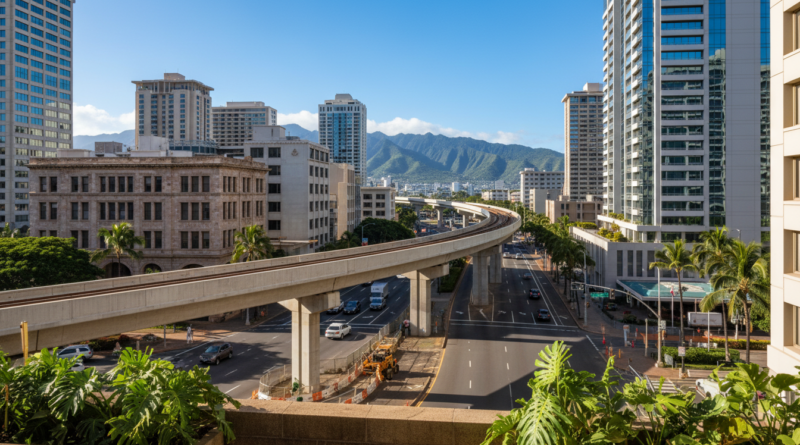
The property battles come as HART races against time to complete Segment 3, the most technically challenging portion of the rail project. This segment must thread elevated tracks through downtown’s tight urban canyon, requiring precise engineering and coordination with existing buildings and infrastructure.
Recent design delays have already raised concerns about whether the 2031 target for passenger service remains realistic. Civil Beat reported in February that ongoing technical challenges could push back the rail’s opening timeline, making swift property acquisition even more crucial.
The downtown segment represents the rail project’s final link to Ala Moana Center, completing a line that began construction over a decade ago in West Oahu. Without these properties, HART cannot build the elevated guideway needed to carry trains from the current terminus near Kalihi-Palama through downtown to the shopping center.
Community advocates have watched the property disputes with growing frustration, noting that delays in Segment 3 affect the entire rail system’s utility. The line cannot begin full passenger operations until trains can travel the complete route from Kapolei to Ala Moana.
Legal and Financial Implications
Eminent domain proceedings typically require HART to prove the takings serve a legitimate public purpose and offer fair compensation to property owners. However, disputes over property values and the scope of needed land can lead to protracted court battles.
The December court setback highlighted potential weaknesses in HART’s legal approach, forcing the agency to reassess how it justifies property acquisitions and calculates compensation. Legal observers suggest the new filings may reflect lessons learned from that earlier defeat.
Property owners affected by eminent domain can challenge both the necessity of the taking and the compensation offered, potentially creating multiple rounds of litigation that could extend well into 2026 or beyond.
For downtown business owners and residents, the ongoing legal battles create uncertainty about the area’s development future. The Pacific Guardian Center and surrounding properties have been in limbo for years as HART’s plans have evolved and faced various challenges.
The success or failure of these eminent domain cases will likely determine whether HART can maintain its 2031 passenger service goal or face another round of delays that could further erode public confidence in the rail project. With billions already invested and political pressure mounting, the downtown property acquisitions represent a make-or-break moment for completing Honolulu’s long-promised transit system.