Mayor Signs Bill 60 Greenlighting Planning for Skyline Rail Extensions to UH Manoa and Beyond
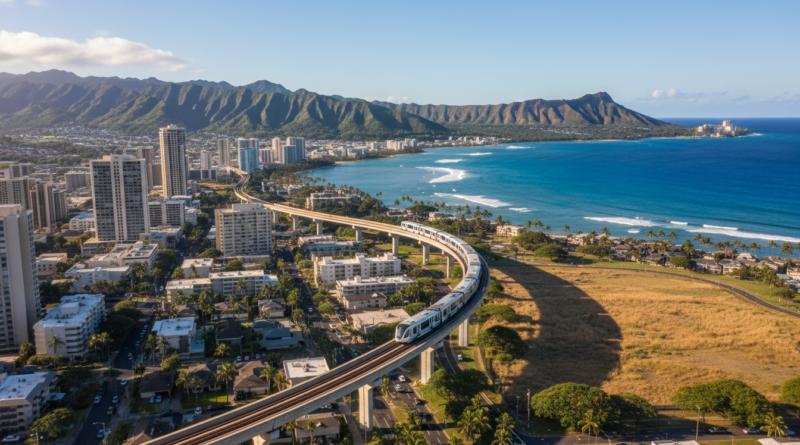
Mayor Rick Blangiardi signed Bill 60 into law last month, officially clearing the way for Honolulu Authority for Rapid Transportation (HART) to begin comprehensive planning studies for potential Skyline rail extensions — even without guaranteed funding in place.
The legislation, passed by the Honolulu City Council in February, authorizes HART to explore three major extension corridors that could dramatically expand the rail system’s reach across Oahu. The most prominent route under consideration would create a spur line from the existing Kalihi-Palama station to the University of Hawaii at Manoa campus, addressing long-standing transportation challenges in one of the island’s most congested corridors.
Two additional westward extensions are also on the table: one extending the current terminus at Halawa Stadium to Pearl Harbor, and another pushing further west to Kapolei and potentially beyond to Ko Olina resort area.
UH Manoa Spur Takes Center Stage
The proposed UH Manoa extension has generated the most public interest and debate. The route would likely follow King Street or Beretania Street through Kalihi, then continue through Keeaumoku and into the heart of Manoa Valley.
For the university’s 17,000 students and thousands of faculty and staff, the connection could provide a direct link to downtown Honolulu and Honolulu International Airport without the need to transfer between bus routes or battle notorious traffic on the H-1 freeway.
“This planning authorization is exactly what we need to move forward responsibly,” said Council member Calvin Say, who represents the Kalihi-Palama area where the Manoa spur would branch off. “We can’t let perfect be the enemy of good when it comes to expanding transit options for our residents.”
The university community has long advocated for better transit connections. Students frequently cite transportation costs and time as barriers to accessing internships and jobs in downtown Honolulu, while faculty have pointed to parking shortages on the landlocked Manoa campus.
Funding Remains the Big Question
While Bill 60 authorizes the planning process, it doesn’t allocate any construction funds. HART estimates that comprehensive studies for all three potential extensions could cost between $15 million and $25 million over the next two years.
The original Skyline project, stretching from East Kapolei to Ala Moana Center, has faced significant cost overruns and delays, with the final price tag now approaching $10 billion. Extension costs remain speculative, but early estimates suggest the UH Manoa spur alone could require $2-3 billion in additional investment.
Federal funding sources could include grants from the Federal Transit Administration, though competition for such funds has intensified nationwide. State and county officials are also exploring public-private partnerships and potential tax increment financing districts around future stations.
Development and Community Impact
Each proposed extension corridor presents unique opportunities and challenges for surrounding neighborhoods. The UH Manoa route would traverse some of Honolulu’s most established residential areas, raising questions about property acquisition, construction impacts, and long-term neighborhood character.
Transit-oriented development around potential new stations could bring increased density to areas like Keeaumoku Street, which already serves as a major commercial corridor for the city’s growing immigrant communities.
The westward extensions toward Pearl Harbor and Kapolei align with the city’s broader growth strategy, supporting development in West Oahu while providing better connections for military personnel and defense contractors working at Pearl Harbor Naval Shipyard.
Timeline and Next Steps
HART officials indicate that initial feasibility studies could begin as early as this summer, with environmental impact assessments and community outreach sessions following through 2027.
The planning process will examine ridership projections, construction feasibility, environmental impacts, and cost-benefit analyses for each corridor. Public hearings are expected to begin in early 2027, giving residents opportunities to weigh in on routing decisions and station locations.
Even with expedited planning, construction on any extension wouldn’t likely begin until the early 2030s, assuming funding materializes. The current Skyline system is expected to reach full operations to Ala Moana Center by late 2031.
For Honolulu residents, Bill 60 represents both promise and pragmatism — acknowledging that the city’s transit needs extend far beyond the current rail alignment while recognizing the financial and political realities of major infrastructure expansion. The coming studies will determine whether these extensions move from planning documents to actual construction sites.