
State Clears $89M for Honolulu Rail Reimbursements as Segment 3 Construction Pushes Forward
The state has approved $89.4 million in reimbursements for Honolulu’s troubled rail project, providing a crucial cash infusion as construction crews continue building the elevated guideway through urban Honolulu. The Department of Accounting and General Services certified the first-quarter payment after auditors identified and removed roughly $43,000 in noncompliant charges from the Honolulu Authority for Rapid Transportation’s funding request.
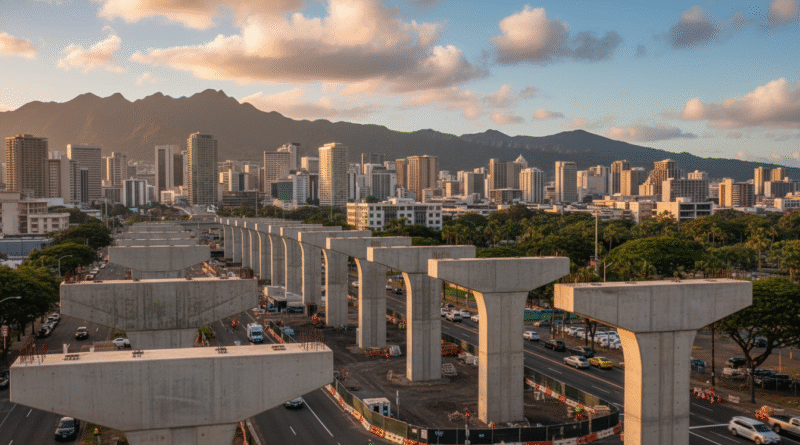
The reimbursement comes as HART prepares to present a $1.07 billion budget for fiscal year 2027 to the Honolulu City Council, with Segment 3 construction showing visible progress along Dillingham Boulevard. Concrete columns are beginning to rise between Kalihi and downtown Honolulu, marking a tangible milestone for the project that has faced years of delays and cost overruns.
Construction Progress Along Dillingham Corridor
Drivers along Dillingham Boulevard have witnessed the gradual transformation of the urban landscape as HART’s contractors install the massive concrete columns that will support the elevated rail line. The 4.2-mile Segment 3 stretches from Kalihi-Palama Station to the future Civic Center Station, passing through some of Honolulu’s most densely developed neighborhoods.
Construction activity has intensified around the Middle Street transit center area, where the rail line will eventually connect with existing bus routes. The elevated guideway will pass over major intersections including Dillingham Boulevard and Keeaumoku Street, requiring complex engineering to minimize disruption to traffic flow.
“We’re seeing steady progress on the structural elements of Segment 3, which represents the most challenging portion of the rail project due to the urban environment,” said Councilmember Brandon Elefante, who chairs the City Council’s Transportation Committee. “The state’s approval of these reimbursements helps maintain the construction momentum we need to keep the project on track.”
Financial Oversight and Budget Scrutiny
The $43,000 in disallowed charges highlights the ongoing financial scrutiny surrounding the rail project, which has ballooned from an initial $5.1 billion budget to more than $12 billion. State auditors continue to review HART’s expenses line by line, ensuring federal and state funds are used appropriately.
The quarterly reimbursement process requires HART to submit detailed documentation for all expenses before the state releases funding. This oversight mechanism was implemented after previous financial management issues plagued the project’s early years.
HART’s upcoming $1.07 billion budget request for fiscal 2027 represents a slight decrease from the current year’s allocation, reflecting the project’s progression through different construction phases. The budget will fund continued work on Segment 3 as well as preliminary activities for the final downtown segment.
Impact on Honolulu Communities
The rail construction continues to affect daily life for residents and businesses along the route, particularly in Kalihi-Palama and the adjacent neighborhoods. Some local businesses have reported decreased foot traffic during the most intensive construction periods, while others anticipate increased development opportunities once the rail system becomes operational.
The elevated guideway will permanently alter the visual landscape of these communities, creating both opportunities and challenges for future development. Urban planners are working with neighborhood boards to address concerns about traffic patterns and pedestrian access around future station locations.
Property owners near planned stations are already seeing increased interest from developers, suggesting the rail system may catalyze transit-oriented development in neighborhoods that have historically seen limited investment.
Timeline and Future Challenges
HART officials maintain that Segment 3 construction remains on schedule for completion by late 2028, though the agency’s track record of meeting projected timelines has been mixed. Weather delays, utility relocations, and coordination with other city infrastructure projects continue to present potential obstacles.
The City Council will review HART’s fiscal 2027 budget proposal over the coming months, with public hearings scheduled to allow community input on spending priorities. Council members are expected to scrutinize the budget closely, particularly given ongoing concerns about the project’s total cost and completion timeline.
For Honolulu residents, the $89.4 million reimbursement represents another step toward completing a transit system that promises to reshape how people move around the island’s urban core. Whether the rail project can deliver on its promises of reduced traffic congestion and increased mobility options will ultimately depend on HART’s ability to maintain construction progress while controlling costs through the final phases of development.
