
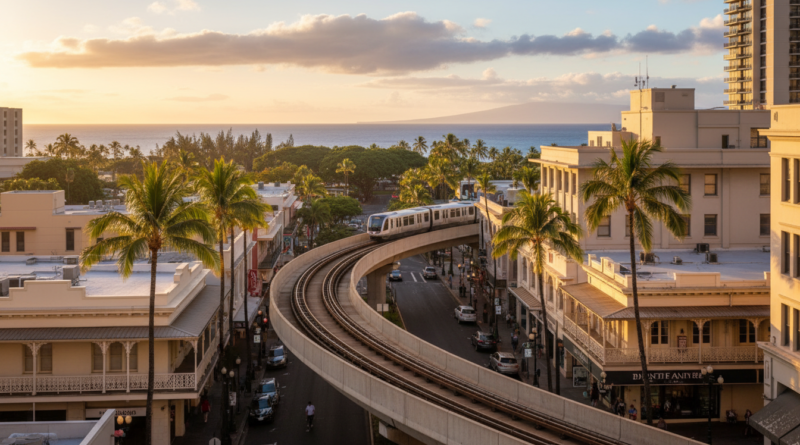
State Releases $89.4M for Honolulu Rail — What the Funding Milestone Means for the City Center Segment
The Honolulu Authority for Rapid Transportation received $89.4 million in state reimbursements this quarter, marking a significant funding milestone as the long-awaited rail project’s final segment takes shape through the urban core. The payment comes as concrete columns rise along the Iwilei-Downtown corridor and station foundation work begins in earnest throughout Chinatown.
The reimbursement represents the largest quarterly payment HART has received in recent months, bringing total state funding for the project closer to the $2.4 billion cap established by the Legislature. The money flows from the state’s general excise tax surcharge dedicated to rail construction, which has generated steady revenue despite earlier concerns about funding shortfalls.
Construction Progress Downtown
Walking through downtown Honolulu today, the scale of Segment 3 construction is impossible to miss. Massive concrete columns now punctuate the skyline along Halekauwila Street, with crews working around the clock to complete the elevated guideway that will connect Kalihi-Palama to Ala Moana Center.
The most visible progress appears in the Iwilei area, where the guideway structure extends from the existing Middle Street Transit Center toward downtown. Construction fencing surrounds future station sites at Kalihi, Kapalama, and Iwilei, with pile driving and foundation work creating the familiar soundtrack of major infrastructure development.
“We’re seeing real momentum now with Segment 3,” said Councilmember Tommy Waters, who represents portions of the rail corridor. “The funding stability has allowed contractors to maintain consistent crews and equipment, which is critical for keeping this massive project on schedule.”
In Chinatown, perhaps the most complex portion of the route, crews are navigating tight urban spaces to build the Downtown and Chinatown stations. The work requires careful coordination with existing utilities, historic preservation requirements, and the need to maintain pedestrian and vehicle access to one of Honolulu’s most culturally significant neighborhoods.
The 2031 Target
HART officials maintain their goal of beginning passenger service to Ala Moana Center by 2031, but construction realities suggest that timeline remains ambitious. The project has weathered numerous delays since groundbreaking, with Segment 3 representing both the most technically challenging and most politically sensitive portion of the route.
The current construction schedule shows guideway work continuing through 2028, followed by systems installation and testing. That leaves little margin for the types of complications that have plagued earlier segments, including utility relocations, soil conditions, and coordination with other city projects.
The funding milestone does provide some stability that earlier phases lacked. Previous segments faced stop-and-start construction cycles tied to political battles over funding sources and cost overruns. The steady flow of GET surcharge revenue has allowed HART to maintain more consistent contractor relationships and avoid the premium costs associated with mobilizing and demobilizing crews.
Community Impact
For downtown businesses and residents, the current construction phase represents both disruption and opportunity. Sidewalk closures and traffic restrictions have become routine along the rail corridor, while property owners eye potential transit-oriented development opportunities once service begins.
The Chinatown station, in particular, has generated discussion about balancing increased accessibility with preserving the neighborhood’s character as an affordable cultural hub. Community groups have pushed for station designs that reflect local architecture and history rather than the standardized approach used in West Oahu.
The state’s continued financial commitment through the quarterly reimbursements signals political support for completing the project, despite ongoing debates about cost-effectiveness and ridership projections. With nearly $9 billion already invested system-wide, the focus has shifted from whether to finish rail to how quickly it can begin serving passengers.
The next major milestone will be completion of the downtown guideway sections by late 2027, which will allow for more comprehensive testing of train operations through the urban core. Until then, Honolulu residents can expect continued construction activity as crews work to deliver the transit system that has defined local politics for more than a decade.
For businesses and commuters navigating the ongoing construction, HART maintains updated closure information and detour routes on its website, while promising that each quarterly funding milestone brings the project closer to transforming how people move around Oahu’s urban core.
