Skyline Segment 3 Rises: First Guideway Column Completed Near City Center
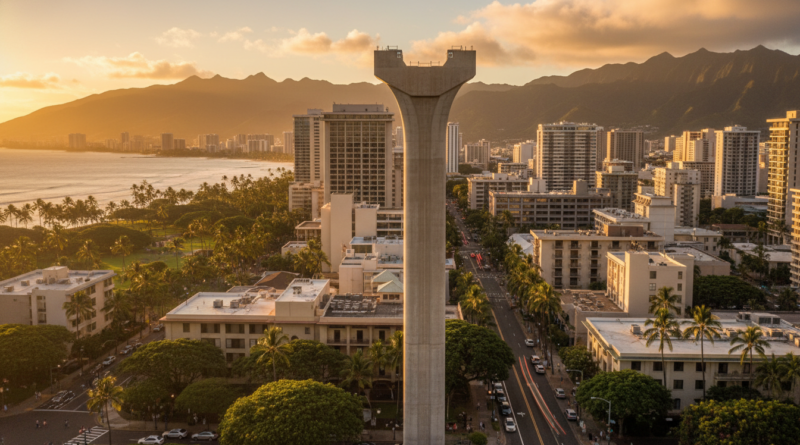
The Honolulu Authority for Rapid Transportation reached a significant milestone on March 31 with the completion of Pier 732, marking the first above-ground guideway column for the rail system’s third segment near downtown Honolulu. The concrete pillar, standing as a tangible sign of progress on the long-delayed Skyline project, represents a crucial step toward connecting the system from Middle Street to Ala Moana Center.
The completion of this initial pier comes at a pivotal moment for the $12.4 billion rail project, which has faced numerous delays and cost overruns since construction began more than a decade ago. Segment 3 represents perhaps the most challenging portion of the entire system, requiring construction through dense urban areas including Kalihi, downtown Honolulu, and the busy commercial corridors leading to Ala Moana.
Mayor Rick Blangiardi recently added another layer of momentum to the project by signing Bill 60 on March 28, which authorizes HART to conduct feasibility studies for potential extensions to both Kapolei and Manoa. This legislation signals the city’s commitment to expanding the rail system beyond its current planned terminus at Ala Moana Center, though any extensions would require additional funding and federal approval.
Construction Timeline Through 2026
HART officials project that Segment 3 construction will continue through 2026, with the most intensive work occurring along Dillingham Boulevard and through downtown’s narrow streets. The segment includes four stations: Kalihi, Kapalama, Iwilei, and Ala Moana Center, each presenting unique engineering challenges in Hawaii’s urban core.
The Iwilei station, in particular, requires complex coordination with existing infrastructure including the harbor area and multiple utility lines. Construction crews must navigate around active businesses and residential areas while maintaining access to critical facilities like the harbor and nearby industrial operations.
“This first pier represents years of planning and community input coming together in concrete form,” said a HART spokesperson familiar with the construction timeline. “We understand the impact on local businesses and residents, and we’re committed to completing this work as efficiently as possible while minimizing disruptions.”
The downtown Honolulu station will require the most delicate construction work, threading the elevated guideway between existing buildings and over busy streets like Hotel Street and Bethel Street. HART has coordinated extensively with downtown businesses and cultural sites to ensure construction respects the area’s historic character while providing modern transit access.
Current System Operations
Meanwhile, the existing portion of Skyline continues to operate between East Kapolei and Halawa, serving thousands of daily riders since opening in June 2023. The system has gradually built ridership as West Oahu residents adapt to having reliable rail transit connecting their communities to urban Honolulu job centers.
HART reports steady increases in ridership, particularly during morning and evening commute hours when traffic congestion on H-1 freeway reaches its peak. The rail system provides a consistent 30-minute journey between East Kapolei and Halawa, compared to drive times that can exceed an hour during rush periods.
The completion of Segment 3 will dramatically expand the system’s utility by connecting West Oahu riders directly to downtown Honolulu and Ala Moana Center. This connection is expected to significantly boost ridership as it provides access to major employment centers and Hawaii’s largest shopping destination.
Looking Beyond 2026
The newly signed Bill 60 opens possibilities for extending Skyline beyond its current planned scope, though such expansions would require substantial additional investment. A Kapolei extension would serve the rapidly growing second urban center, while a Manoa extension could connect the University of Hawaii campus and surrounding residential areas.
Both potential extensions face significant geographic and financial challenges, including mountainous terrain toward Manoa and questions about federal funding availability. However, the feasibility studies authorized by the bill will provide concrete data about costs, ridership projections, and engineering requirements.
For Honolulu residents, the completion of Pier 732 represents tangible progress on a project that has tested public patience for years. While Segment 3 construction will bring continued traffic impacts and construction disruptions through 2026, it also brings the promise of a fully connected rail system serving the island’s most populous corridor.
The success of this urban segment will ultimately determine whether Skyline achieves its goals of reducing traffic congestion and providing reliable public transit for Oahu’s growing population. With construction now visibly underway in the urban core, residents can finally see the rail system taking shape in their neighborhoods.
