
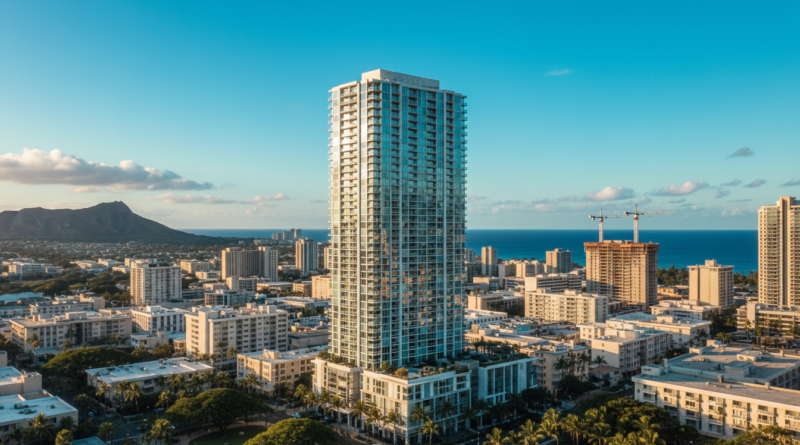
Kahuina: The 861-Unit Affordable-Heavy Tower That Could Reshape Our Kakaako’s Southern Edge
Stanford Carr Development is preparing to break ground on what could become Kakaako’s most ambitious affordable housing experiment. The Kahuina tower, slated for construction starting in 2026, promises 861 residential units with 60% designated as workforce and affordable housing — a density-first approach that developers say is essential to addressing Honolulu’s housing crisis.
Located on Block C of the Our Kakaako master plan near the intersection of Auahi Street and Kamakee Street, the project sits at the southern edge of the rapidly transforming neighborhood. The 40-story tower will rise alongside Ward Village’s luxury developments, creating a stark contrast in both price point and intended residents.
The numbers tell a compelling story. Of the 861 units, approximately 516 will be priced for workforce and affordable housing, with the remainder as market-rate condominiums. The development will also include 42,000 square feet of commercial space at street level, continuing Kakaako’s evolution into a mixed-use urban center.
“This project represents a critical test of whether we can deliver truly affordable housing at scale in Kakaako,” said local housing advocate Maria Santos, who has tracked development in the area for over a decade. “The question isn’t just about the units themselves, but whether the infrastructure and community services can support this kind of density.”
Infrastructure Challenges Loom Large
The Kahuina project faces the same infrastructure pressures that have plagued Kakaako’s rapid development. Traffic congestion along Ala Moana Boulevard and Kapiolani Boulevard already strains during peak hours, and the area’s schools are approaching capacity.
The Hawaii Community Development Authority, which oversees development in Kakaako, has been working to address these concerns through the Our Kakaako master plan. The comprehensive vision calls for improved transit connections, additional parks, and expanded community facilities to support the projected 22,000 new residents expected in the area by 2030.
Kahuina’s commercial component could help address some community needs. The 42,000 square feet of ground-floor retail and office space is designed to serve both tower residents and the broader neighborhood, potentially reducing car trips for daily errands.
Affordability Questions Persist
While Stanford Carr Development touts the 60% affordable and workforce housing allocation, critics question whether these units will remain accessible to local families long-term. Previous Kakaako developments have struggled with affordability requirements, with some initially affordable units eventually converting to market rate.
The project’s workforce housing component targets households earning 80-140% of area median income, while affordable units serve those making 60-80% AMI. For a family of four, this translates to roughly $76,000-$168,000 for workforce housing and $57,000-$76,000 for affordable units.
However, even these “affordable” price points may stretch budgets in a city where the median home price exceeds $800,000. The success of Kahuina’s affordability goals will largely depend on the final pricing structure and financing mechanisms, details that have not been fully disclosed.
Community Impact and Design
The tower’s location places it within walking distance of Keeaumoku Street’s shops and restaurants, as well as the planned Kakaako Waterfront Park expansions. This proximity to amenities could reduce residents’ dependence on cars, though the area’s current transit options remain limited.
Stanford Carr Development has emphasized sustainable design elements and community-focused amenities in preliminary plans. The project aims for LEED certification and includes shared spaces designed to foster neighbor connections — features that could be crucial for creating a sense of community in a high-density environment.
The Broader Kakaako Context
Kahuina represents just one piece of the Our Kakaako puzzle, but it’s a significant one. As luxury towers like Anaha and Waiea have defined much of the neighborhood’s recent growth, this project tests whether developers can deliver on promises of economic diversity.
The timing aligns with broader conversations about Oahu’s housing crisis and the role of transit-oriented development. With the rail line’s planned extension to Ala Moana Center, Kakaako’s density could eventually support more sustainable transportation patterns — if the infrastructure investments keep pace with residential growth.
Ground-breaking in 2026 gives the project time to refine its approach and address community concerns. For Honolulu residents watching housing costs soar, Kahuina’s success or failure could influence how future affordable housing projects are structured across the island.
The real measure of success won’t be the number of units delivered, but whether working families can actually afford to live there — and whether the surrounding community can thrive alongside such concentrated growth.
