
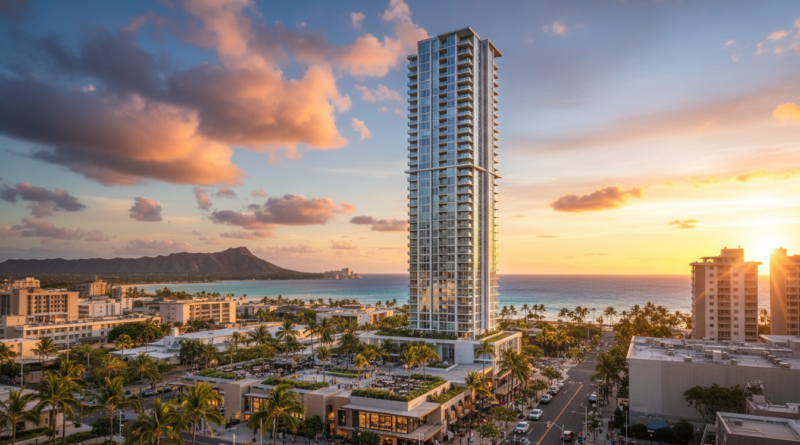
Stanford Carr’s Kahuina Project Would Bring 861 Units to Kakaako — 60% Affordable
Stanford Carr Development is moving forward with plans for Kahuina, an ambitious mixed-use project that would add 861 residential units to Kakaako’s evolving skyline. The development, which received renewed attention at the Hawaii Community Development Authority’s May 6 agenda meeting, promises to deliver a significant boost to the area’s affordable housing stock with 60% of units designated as workforce and affordable housing.
The project, slated to break ground in 2026, would rise on a 3.5-acre site bounded by Ala Moana Boulevard, Keawe Street, and Pohukaina Street. The development spans two towers connected by a podium structure, creating what developers describe as a “vertical neighborhood” in one of Honolulu’s most sought-after urban districts.
Beyond residential units, Kahuina would incorporate 42,000 square feet of commercial space at ground level, continuing Kakaako’s transformation into a mixed-use community where residents can live, work, and shop within walking distance. The commercial component aligns with HCDA’s vision of creating a complete neighborhood rather than simply adding more residential towers to the area.
Affordable Housing Takes Center Stage
The project’s most significant feature may be its affordable housing commitment. With 517 of the 861 units earmarked as workforce and affordable housing, Kahuina represents one of the largest affordable housing developments planned for Kakaako in recent years.
This allocation addresses a critical need in an area where market-rate condominiums often sell for well over $1 million. The affordable units would serve households earning between 80% and 140% of area median income, targeting essential workers like teachers, nurses, and public safety personnel who have been increasingly priced out of urban Honolulu.
“This project demonstrates how private developers can partner with the community to address our housing crisis while still creating a financially viable development,” said Maria Santos, a housing policy analyst with the Hawaii Housing Finance and Development Corporation who has followed Kakaako development trends.
Strategic Location in Kakaako’s Core
The Kahuina site sits in the heart of Kakaako’s makai area, within walking distance of Ala Moana Center, Ward Village, and the emerging Our Kakaako district. This central location provides future residents with access to shopping, dining, and employment opportunities without requiring a car for daily needs.
The proximity to existing infrastructure, including the planned rail line’s Kalihi-Palama and Ala Moana stations, positions Kahuina residents to take advantage of future transit connections throughout Oahu. The development would also benefit from recent improvements to Kakaako’s street grid and waterfront parks.
Stanford Carr Development has been active in the Kakaako market, with previous projects including Ae’o and Anaha towers. The company’s experience with mixed-income housing development in Hawaii’s regulatory environment could prove crucial as Kahuina navigates the approval process.
Timeline and Next Steps
The 2026 groundbreaking timeline reflects the complex approval process required for large-scale development in Kakaako. HCDA oversight involves multiple review stages, from initial design approval through final construction permits.
The project must still clear several regulatory hurdles, including environmental impact assessments and infrastructure capacity studies. Traffic impact analysis will be particularly scrutinized given Kakaako’s ongoing development boom and existing congestion challenges on surrounding streets.
Community input sessions are expected as part of the HCDA review process, giving nearby residents and business owners opportunities to comment on design elements and potential impacts. The May 6 agenda meeting represents an early step in what will likely be an 18-month approval timeline.
For Honolulu residents struggling with housing costs, Kahuina represents both opportunity and a test case for large-scale affordable housing development in urban cores. The project’s success could influence future mixed-income developments throughout the city, particularly as officials seek private sector partnerships to address the housing shortage.
The development would also contribute to Kakaako’s evolution from an industrial district to a complete urban neighborhood. As more residents move into the area, demand grows for services like schools, healthcare facilities, and community spaces that support long-term neighborhood stability.
With construction potentially beginning in just two years, Kahuina could deliver its first residents by the end of the decade, adding substantial housing inventory during a period when Oahu faces acute shortages across all income levels.
