New TOD Bill Would Force Skyline-Area Developers to Deliver More Community Benefits
Honolulu developers seeking lucrative height bonuses and city grants for transit-oriented development projects near Skyline stations would face stricter requirements to deliver community benefits under a new bill being considered by the City Council.
The proposed measure, introduced at Wednesday’s council meeting, aims to strengthen the city’s TOD incentive program by requiring developers to provide more substantial public amenities in exchange for development perks. The bill specifically targets projects within a half-mile radius of Skyline rail stations, including the heavily developed Kakaako district.
Currently, developers can receive building height increases and financial incentives through the city’s TOD program with relatively modest community benefit requirements. The new legislation would establish more rigorous standards for what constitutes adequate public benefit, potentially reshaping how high-rise projects are developed near transit hubs.
“We’re seeing tremendous private investment around our rail stations, which is exactly what we hoped for,” said Councilmember Carol Fukunaga, who chairs the Planning and the Economy Committee. “But we need to ensure these developments truly serve our communities and not just maximize profits for developers.”
Kakaako Development in Focus
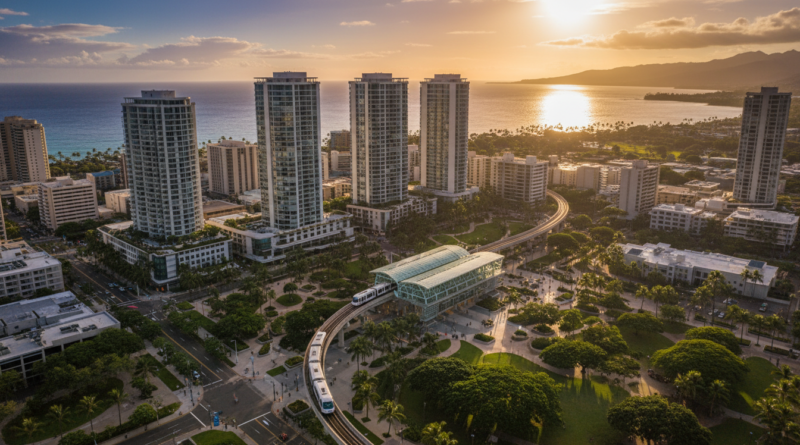
The bill comes as Kakaako continues its rapid transformation, with dozens of residential towers approved or under construction near the upcoming Keeaumoku and Kakaako rail stations. Many of these projects have utilized existing TOD incentives to achieve greater heights and densities than standard zoning would allow.
Under the proposed changes, developers seeking TOD benefits would need to demonstrate how their projects address specific community needs, such as affordable housing, public open space, cultural preservation, or infrastructure improvements. The bill would also establish clearer metrics for measuring the value of community benefits relative to the public incentives being granted.
The Hawaii Community Development Authority, which oversees development in Kakaako, has already begun incorporating similar requirements into recent project approvals. However, the new city legislation would create uniform standards across all TOD zones, extending beyond Kakaako to areas around future rail stations in Kalihi, Iwilei, and downtown Honolulu.
Developer Response and Industry Impact
Local development industry representatives expressed mixed reactions to the proposal. While acknowledging the importance of community benefits, some worry that additional requirements could make projects financially unfeasible, particularly given Hawaii’s already challenging construction costs and regulatory environment.
The Building Industry Association of Hawaii noted that excessive requirements could slow much-needed housing production near transit lines. However, community advocacy groups have long argued that current TOD incentives provide insufficient public value in exchange for significant development rights.
The bill would also establish a community benefit assessment process, requiring public input on proposed TOD projects before incentives are approved. This could extend project timelines but would give neighborhood residents greater voice in shaping development around rail stations.
Transit Investment Protection
City officials emphasize that the legislation aims to protect the public’s $10 billion investment in the Skyline rail system by ensuring surrounding development maximizes community benefits. With rail operations beginning last year between East Kapolei and Halawa, development pressure around existing and planned stations continues to intensify.
The bill includes provisions for affordable housing set-asides, public parking requirements, and community facility contributions. It would also strengthen enforcement mechanisms, allowing the city to recoup incentive value if developers fail to deliver promised community benefits.
Planning Director Dawn Takeuchi Apuna indicated the administration supports reforming the TOD program but emphasized the need to balance community benefits with development feasibility. The city has invested heavily in transit infrastructure planning and wants to ensure complementary development supports broader transportation and housing goals.
The council’s Planning and the Economy Committee will hold public hearings on the bill over the coming weeks, with community groups and industry stakeholders expected to provide extensive testimony. If passed, the new requirements would apply to TOD applications submitted after the ordinance’s effective date.
For Honolulu residents, the outcome could significantly influence how their neighborhoods evolve around rail stations, determining whether transit-oriented development truly serves community needs or primarily benefits private developers. With several major TOD projects still in planning phases, the timing could reshape Kakaako’s continued transformation and set precedents for development around future rail stations extending to Ala Moana Center.
