Chinatown Gets Its First Rail Station Foundation — Here’s What Segment 3 Construction Looks Like Now
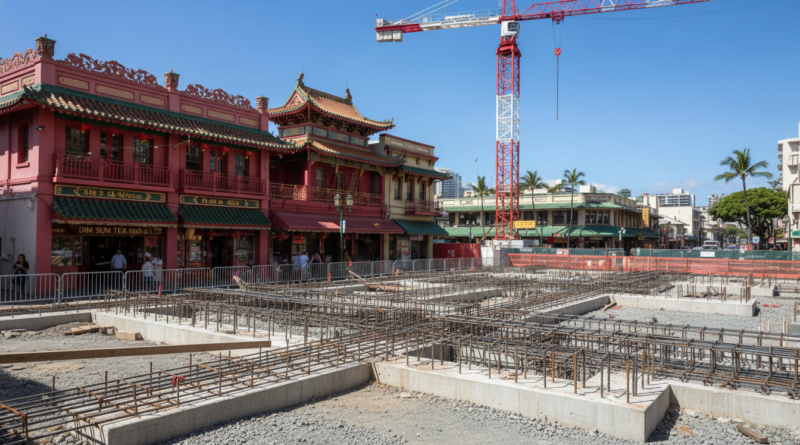
The steady hum of construction equipment now echoes through Chinatown’s historic streets as crews break ground on the area’s first rail station foundation, marking a major milestone in Skyline Segment 3’s journey toward downtown Honolulu. The Chinatown station foundation work, which began in April, represents the westernmost point of current active construction along the elevated rail line.
For business owners along North Hotel Street and the surrounding blocks, the construction brings a familiar mix of disruption and hope. Foot traffic patterns have shifted as sidewalks narrow and parking spots disappear, but many see the temporary inconvenience as an investment in Chinatown’s future connectivity.
“The noise starts early, around 7 a.m., but we’re managing,” said Linda Chen, who runs Golden Palace Seafood Restaurant on North King Street. “My regular customers know to come through the back entrance now. We’re thinking long-term — this station will bring more visitors to Chinatown once it’s done.”
The Chinatown station sits strategically at the heart of one of Honolulu’s most culturally significant neighborhoods. Once completed, it will serve the dense concentration of small businesses, art galleries, and residential towers that define the area bounded by Nuuanu Avenue, Beretania Street, and the harbor.
Construction Impact on Daily Life
Street-level impacts vary block by block. North Hotel Street sees the heaviest equipment traffic as crews establish staging areas for the foundation work. The iconic Maunakea Marketplace has adjusted its delivery schedules to work around morning construction windows.
Parking remains the biggest challenge for both businesses and their customers. The construction zone has claimed roughly 40 street parking spaces, forcing shoppers to park further away in municipal lots or rely more heavily on ride-sharing services.
Weekend farmers market vendors at Kekaulike Market report mixed effects. While some regular customers avoid the area due to construction, others say the visible progress generates conversations about Chinatown’s future as a transit hub.
The Honolulu Authority for Rapid Transportation expects foundation work to continue through late summer, followed by column construction that will begin shaping the station’s elevated platform. The timeline aligns with parallel construction happening at the nearby Civic Center station, where crews are already installing platform elements.
Business Adaptation Strategies
Many Chinatown businesses have adapted their operations around the construction schedule. Restaurants are emphasizing delivery and takeout options, while retail shops have improved their online presence to maintain sales during the disruption period.
The Chinatown Business and Community Association has been coordinating with HART to ensure businesses receive advance notice of major construction activities. They’ve also organized group promotions to encourage residents from other parts of the island to visit despite the ongoing work.
“We’re seeing people discover businesses they never knew existed because they’re walking different routes around the construction,” said association coordinator James Wong. “There’s definitely some silver lining here.”
The station’s design incorporates multiple street-level access points to integrate smoothly with Chinatown’s pedestrian-heavy environment. Plans show entrances connecting to both the Kekaulike Street corridor and areas closer to the harbor, designed to distribute foot traffic rather than create bottlenecks.
Looking Toward 2028
Segment 3 construction extends beyond Chinatown to include stations at Civic Center, Downtown, and Kakaako, with service expected to begin in 2031. The Chinatown station represents a crucial link in connecting West Oahu communities to downtown employment centers without requiring transfers.
For now, Chinatown residents and business owners are settling into a rhythm of construction life that will define the neighborhood for the next several years. The foundation work happening today lays the literal groundwork for what transit officials hope will be a transformation of how people move through urban Honolulu.
The visible progress also brings renewed focus to questions about transit-oriented development in the area. City planners are already studying how the new station might influence housing and commercial development patterns in surrounding blocks, potentially reshaping Chinatown’s character as both a cultural destination and residential neighborhood.
