
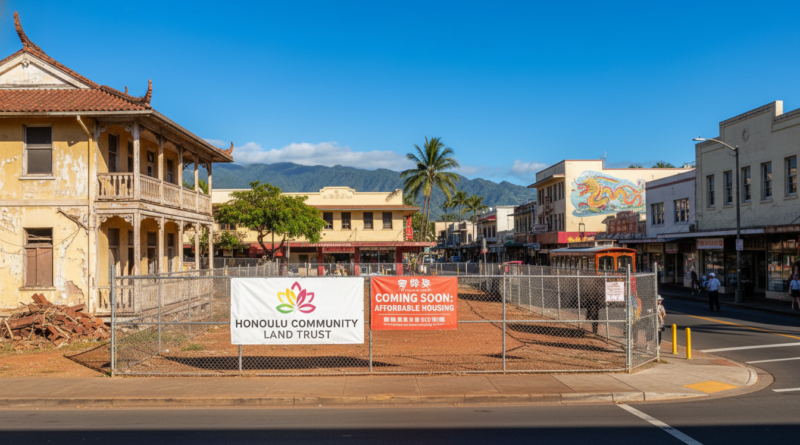
City Acquires 175 N. Pauahi Street to Build Affordable Housing in Chinatown
Honolulu has closed on the purchase of a largely vacant property at 175 N. Pauahi Street in Chinatown, marking a significant step forward in the city’s efforts to address the neighborhood’s affordable housing shortage and combat urban blight.
The acquisition, completed last week, gives the city control of a prime corner lot that has sat mostly empty for years, becoming a visible symbol of Chinatown’s ongoing struggles with homelessness and deteriorating infrastructure. City officials say the property will be developed into affordable rental units, though specific details about the number of units and construction timeline remain under wraps.
“This acquisition represents our commitment to revitalizing Chinatown while preserving its cultural character,” said Councilmember Carol Fukunaga, whose district includes the property. “We’re not just building housing — we’re investing in a community that deserves better.”
The corner property sits at a strategic location within walking distance of downtown Honolulu and public transportation routes, making it an ideal candidate for transit-oriented affordable housing development. The site’s proximity to the planned rail station at Kalihi-Palama further enhances its appeal for working families who rely on public transit.
Addressing Chinatown’s Housing Crisis
The purchase comes as Chinatown grapples with a complex web of challenges, from rising homelessness to aging infrastructure that has left many buildings vacant or underutilized. Property owners in the historic district have long struggled with high renovation costs and complex zoning requirements, leading to a patchwork of empty lots and deteriorating structures.
Recent data from the city’s Department of Community Services shows Chinatown has one of the highest concentrations of unsheltered individuals on Oahu, with many camping in doorways and vacant lots throughout the neighborhood. The lack of affordable housing options has only exacerbated the problem, pushing low-income residents out of the area despite its central location and cultural significance.
The 175 N. Pauahi Street property had been privately owned but sat largely unused for several years, becoming what neighborhood advocates describe as a “dead zone” that contributed to the area’s reputation for crime and drug activity. City officials declined to disclose the purchase price, citing ongoing negotiations with contractors and developers.
Development Timeline and Community Impact
While the city has not announced a specific development timeline, sources familiar with the project suggest construction could begin within the next 18 months, pending environmental reviews and community input sessions. The development is expected to include ground-floor commercial space to maintain the neighborhood’s mixed-use character.
Local business owners have expressed cautious optimism about the project, hoping new residents will bring foot traffic and economic activity to the area. However, some longtime residents worry about potential displacement and changes to Chinatown’s unique cultural atmosphere.
“We need housing, but we also need to make sure this stays Chinatown,” said longtime resident and community advocate James Lum. “The character of this place is what makes it special — we can’t lose that in the name of development.”
The project aligns with Mayor Rick Blangiardi’s broader affordable housing initiative, which aims to create 10,000 new affordable units across Oahu by 2030. Chinatown has been identified as a priority area due to its proximity to job centers and existing infrastructure.
Broader Implications for Urban Renewal
The acquisition represents a shift in the city’s approach to urban renewal, moving away from piecemeal private development toward more direct public investment in troubled neighborhoods. This strategy has shown success in other mainland cities but remains relatively new for Honolulu.
City planners say the project will serve as a model for future affordable housing developments in urban core areas, potentially influencing how similar properties are handled in Kalihi, Iwilei, and other neighborhoods facing similar challenges.
The development will also test the city’s ability to balance affordable housing needs with historical preservation requirements, as Chinatown sits within a nationally registered historic district with strict guidelines for new construction.
For residents and business owners in Chinatown, the 175 N. Pauahi Street project represents both hope and uncertainty. Success could catalyze broader neighborhood improvements and attract additional investment, while failure might deepen existing problems and erode community trust in city-led development efforts.
The city plans to hold the first community meeting about the project next month, where residents can learn more about proposed designs and provide input on the development’s direction. That meeting will be a crucial test of whether the city can build the community support necessary to make this ambitious project a success.
