Kakaako’s Skyline Rail Columns Are Starting to Rise — Here’s What Downtown Will Look Like
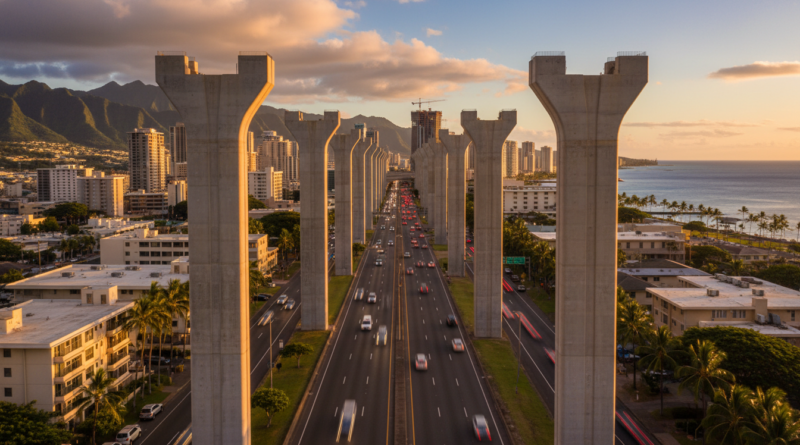
Concrete columns are beginning to pierce Honolulu’s skyline as construction crews work along Nimitz Highway and Kaʻaahi Street, marking the first visible above-ground progress on the rail system’s most anticipated segment through Downtown and Kakaako.
The Honolulu Authority for Rapid Transportation began erecting guideway columns for Segment 3 in late 2025, and the towering concrete structures are now becoming a daily sight for commuters traveling through Iwilei. These columns will eventually support the elevated rail line that promises to transform how residents move between West Oahu, Downtown, and Kakaako by 2031.
“We’re finally seeing the rail take shape in the urban core,” said Lisa Chen, a Kakaako resident who walks past the construction site daily on her way to work. “It’s been talk and plans for so long, but now you can actually visualize what this is going to look like.”
Downtown’s New Skyline Takes Shape
The elevated guideway will snake through some of Honolulu’s most densely developed areas, creating a new architectural feature that will be visible from blocks away. As construction progresses eastward from the current Kalihi-Palama terminus, the rail line will cross over Nimitz Highway at roughly 30 feet above ground level.
The alignment follows Nimitz Highway through Iwilei before curving south toward Downtown Honolulu. Stations planned for Iwilei, Downtown, and Kakaako will serve as major transit hubs, connecting the rail system to TheBus routes and providing pedestrian access to surrounding commercial and residential developments.
From an urban planning perspective, the elevated design allows the rail to avoid conflicts with street-level traffic while providing riders with panoramic views of Honolulu Harbor and the downtown business district. The concrete columns, spaced approximately 100 feet apart, are designed to blend with the urban environment while supporting the weight of the two-track guideway and trains.
Kakaako’s Transit-Oriented Future
The rail’s path through Kakaako will fundamentally alter the neighborhood’s development trajectory. The planned Kakaako station, located near the intersection of Queen Street and Kamakee Street, sits at the heart of one of Honolulu’s fastest-growing residential areas.
Real estate developers have already begun incorporating rail accessibility into their marketing strategies for new condominium projects. The elevated guideway will provide direct connections between Kakaako’s high-rise residential towers and employment centers in Downtown Honolulu, potentially reducing the neighborhood’s notorious traffic congestion.
Construction crews are working in phases to minimize disruption to existing businesses and residents. Current work focuses on foundation installation and column construction, with guideway deck installation scheduled to begin in late 2026.
Economic Impact Beyond Transportation
The visible progress on Segment 3 represents more than just transportation infrastructure — it’s reshaping property values and business decisions throughout the corridor. Commercial real estate near planned stations has seen increased interest from investors betting on future ridership patterns.
Local businesses along Nimitz Highway report mixed impacts from construction. While some face temporary access challenges, others anticipate increased foot traffic once passenger service begins. The rail project has also created hundreds of construction jobs, contributing to the local economy during a period of broader economic uncertainty.
The Honolulu Authority for Rapid Transportation estimates that Segment 3 will serve approximately 50,000 daily riders once fully operational, connecting West Oahu communities to job centers in urban Honolulu more efficiently than existing bus service.
Timeline and Next Steps
Construction on Segment 3 is progressing according to the updated project timeline, which targets passenger service beginning in 2031. The current work represents the most complex phase of rail construction, requiring coordination with multiple utility companies, traffic management, and sensitive archaeological considerations in Downtown Honolulu.
Over the next two years, residents can expect to see the guideway deck installation, station construction, and testing of rail systems. The visual impact will become more pronounced as the elevated structure extends through Downtown toward its eventual terminus near Ala Moana Center.
For Honolulu residents, the emerging columns represent a tangible sign that the long-debated rail project is finally becoming reality. Whether viewed as progress or disruption, the elevated guideway will permanently alter Honolulu’s skyline and transportation patterns, creating new possibilities for how residents live, work, and move through the urban core.