HART Pursues Eminent Domain on Two Downtown Properties to Extend Skyline Rail into Kakaako
The Honolulu Authority for Rapid Transportation voted Wednesday to initiate eminent domain proceedings against portions of two major downtown properties, marking a significant escalation in the agency’s push to complete the rail system’s extension into Kakaako.
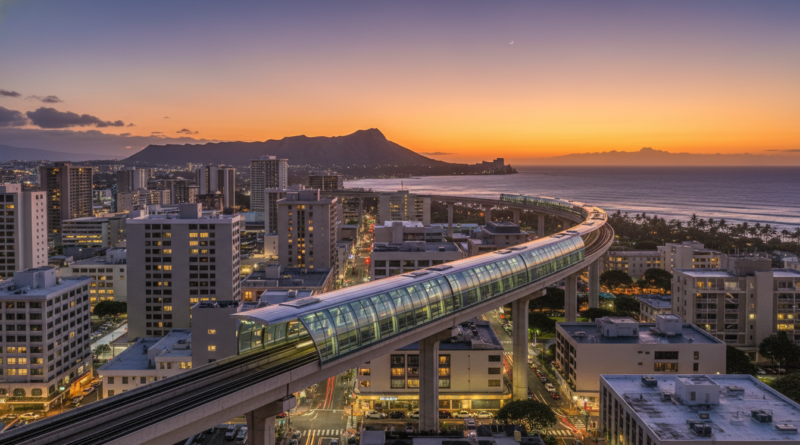
HART’s board authorized condemnation proceedings for parts of Pacific Guardian Center on Bishop Street and Servco Pacific’s headquarters on Keawe Street. The properties are needed to accommodate two new Skyline stations that would extend the elevated rail line deeper into the urban core’s fastest-growing neighborhood.
The decision comes as HART faces mounting pressure to finalize the rail system’s downtown segment, which has ballooned to more than $10 billion in total costs. The agency had been negotiating with both property owners for months before turning to the legal mechanism of last resort.
Property Owners Resist Rail Footprint
Pacific Guardian Center, the 45-story office tower at 1003 Bishop Street, would lose portions of its ground-level retail space and plaza area for the Bishop Street station. The building serves as headquarters for several major Hawaii companies and houses thousands of downtown workers.
Servco Pacific’s waterfront property on Keawe Street presents an even more complex challenge. The automotive and business services company has operated from the site for decades, and the planned Kakaako station would require taking portions of both their parking areas and warehouse facilities.
“We’ve been working in good faith with HART for over a year, but their proposals simply don’t work for our business operations,” said Servco Pacific CEO Mark Fukunaga in a statement released after Wednesday’s vote. “We’re disappointed they’ve chosen this adversarial path when collaborative solutions were still possible.”
Representatives for Pacific Guardian Center did not immediately respond to requests for comment, but sources familiar with the negotiations suggest the building’s owners have concerns about the station’s impact on foot traffic and commercial viability of their retail spaces.
Kakaako’s Transit Future at Stake
The two stations represent crucial links in HART’s vision for connecting Kakaako’s booming residential and commercial development to the island-wide transit network. The neighborhood has added thousands of housing units and millions of square feet of office space over the past decade, creating new demands for transportation infrastructure.
Urban planning experts have long argued that effective transit connections are essential for managing Kakaako’s growth without overwhelming Honolulu’s already congested street network. The rail extension would provide residents and workers with direct access to destinations from Pearl Harbor to Ala Moana Center.
However, the eminent domain proceedings highlight the ongoing tensions between public infrastructure needs and private property rights that have plagued the rail project since its inception. Several other property owners along the route have previously challenged HART’s acquisition efforts in court.
Legal and Financial Implications
The condemnation process typically takes months or years to resolve, potentially delaying the rail extension’s completion timeline. HART must prove in court that the property takings serve a legitimate public purpose and provide just compensation to the affected owners.
Property valuation disputes often complicate eminent domain cases, particularly for prime downtown real estate. Both Pacific Guardian Center and the Servco property occupy valuable locations that have appreciated significantly in recent years as Kakaako has transformed into Honolulu’s second downtown.
The financial impact extends beyond compensation costs. Legal fees, project delays, and potential design modifications to work around property boundaries could add millions to the rail system’s already strained budget.
HART officials emphasized Wednesday that eminent domain represents a standard tool for public transit projects nationwide. The agency pointed to successful acquisitions for other Skyline stations, including properties in Kalihi and the airport area, as evidence of their fair dealing with landowners.
Community Impact and Next Steps
The eminent domain proceedings are likely to intensify scrutiny of HART’s decision-making process from both rail supporters and critics. Some Kakaako residents have expressed frustration with the agency’s communication about station locations and construction impacts.
Meanwhile, businesses in the affected areas worry about prolonged uncertainty as legal proceedings unfold. The Bishop Street corridor serves as a vital commercial artery for downtown Honolulu, while Keawe Street has emerged as a key connection between Kakaako’s residential towers and waterfront amenities.
HART expects to file formal condemnation papers within 30 days, beginning a legal process that could stretch well into 2027. The agency maintains that the Kakaako extension remains essential for completing Honolulu’s transit vision, regardless of the property acquisition challenges.
For Honolulu residents, the outcome will help determine whether the rail system can fulfill its promise of reshaping urban transportation or whether property disputes will continue to complicate the project’s troubled history.